
You can never have enough good starting pitching they say. Good luck naming a team that only used five starting pitchers in a season. Teams need depth. Acquiring the best starting pitchers are pricey too, whether via free agency or trade. Look no further as to what Max Fried (8 yrs/$218M) and Corbin Burnes (6 yrs/$210M) cost in free agency, and Garrett Crochet in trade.
The Washington Nationals could return four of their current starting pitchers with MacKenzie Gore, Jake Irvin, Mitchell Parker, and Trevor Williams who all under team control for next season. Could. Should they? Williams might best be moved to the bullpen, and if that happens there would be two openings.
On top of that, the Nats have Cade Cavalli, Josiah Gray, Shinnosuke Ogasawara, and possibly even Brad Lord as potentials for the Opening Day starting rotation plus DJ Herz will be ready to pitch a couple of months into the 2026 season as he recovers from TJ surgery. Of course Lord has become very valuable in the bullpen, and as of now we don’t know what general manager Mike Rizzo will be thinking.
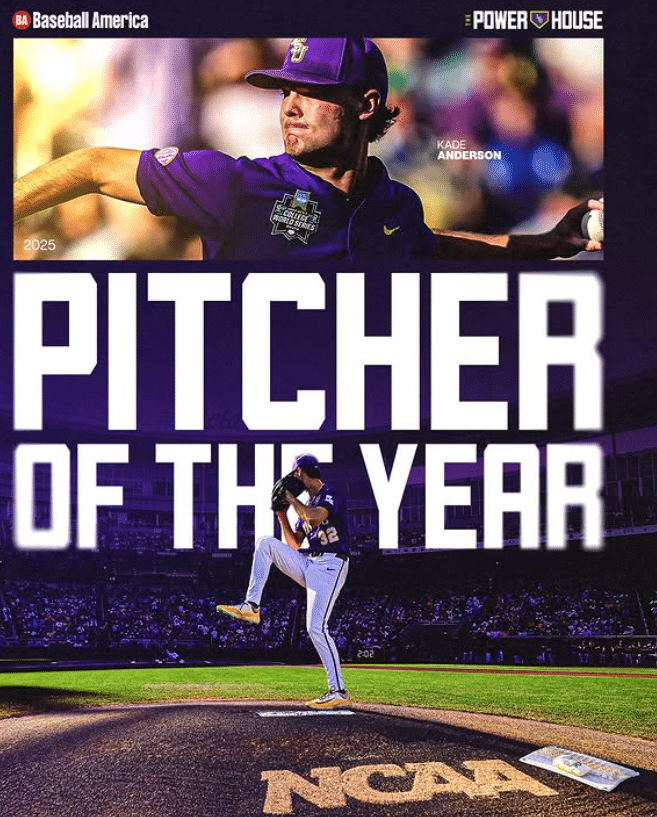
On top of that, the Nationals have top prospect, Travis Sykora, in Double-A — and he could be ready in mid-to-late 2026. On top of that, Baseball America just mocked Kade Anderson as the №1 pick to the Nationals.
“… [Kade Anderson‘s] next pitch should be some place in the Washington Nationals organization. It’s not close. They usually draft really well. He’s the best player in the country. There is nobody closer to the Major Leagues than him right now. But I don’t think you can quantify it. Paul Skenes? …”
— LSU Head Coach Jay Johnson
When we interviewed Johnson in 2023 about his top two players that season with Skenes and Dylan Crews, the LSU head coach was selling them as no-brainers for the top-2 picks in the 2023 draft — and he was right. But Anderson doesn’t feel like a “sure thing” like Skenes and Crews.
There won’t be a roster squeeze due to minor league options as Cavalli, Gray, Ogasawara, and Herz all could start the 2026 season in the minor leagues per Roster Resource. Best five go north is usually the thought, and Anderson’s college coach thinks he’s the closest player in the draft to being MLB ready. That could change the offseason strategy if you believe that Anderson would be like Skenes and be ready that quickly for the big leagues.
There are “ifs” with Anderson as in “If the Nats draft Anderson” and “If he really is quick to the Majors” and “If he will be a dominant front of the rotation pitcher.” There are few guarantees. With the №1 draft pick, the Nationals have a clear path to Anderson if they want him. Anderson is getting comparisons to Fried.
What about the free agent market for starting pitchers, and how would that affect the Nationals filling other roster spots including a fix of the bullpen?
Top-Tier Starting Pitchers:
- Dylan Cease (RHP, Padres): Boasts a strong combination of youth, stuff, and track record, making him a likely high-profile target.
- Zac Gallen (RHP, Diamondbacks): A highly reliable starter with a solid track record.
- Framber Valdez (LHP, Astros): Known for his durability and high groundball rate, making him a valuable asset.
Other Notable Starters:
- Michael King (RHP, Padres): A strong reliever who can also start.
- Ranger Suárez (LHP, Phillies): A reliable lefty starter with a good track record.
- Tyler Mahle (RHP, Twins): A solid veteran who can contribute
The budget for 2026 and planning for 2027
First off, we don’t know the 2026 payroll budget. This is merely the hope for a budget close to $180 million, that would get the Nationals to the MLB middle. Let’s use the current CBT number of $139 million and subtract all of the pending free agents and add back all of the arbitration-eligible raise estimates. That would get us to $119 million to budget as a starting point.
That would give Rizzo $61 million to spend if he doesn’t non-tender Nathaniel Lowe, Luis Garcia Jr., Josiah Gray, and Riley Adams.
Let’s say the Nationals spend on these players at these numbers:
- Second baseman Gleyber Torres $20 million
- Closer $12.5 million
- Catcher Victor Caratini $8 million
- Fireman Reliever $7.5 million
That adds up to exactly $48 million with the thinking that Torres would be the right-handed batter you would add and put him at second base and move Garcia to the DH. That would leave $13 million to spend for a starting pitcher as long as there is no extension of James Wood or any other player.
Let’s be real, you are not getting any of those aforementioned pitchers for $13 million unless you backload a deal. On top of that, it feels aggressive to think that ownership will increase payroll to $180 million.
Could Rizzo instead make a trade like he did before the 2012 season for Gio Gonzalez? Again, so many ifs. In 12-days we will know the name of the Nationals №1 draft pick. If it is Anderson, the whole strategy could change. If not, it does feel like you have to see what you have in your internal candidates for pitchers.
What if your August 20th rotation was:
- MacKenzie Gore LHP
- Jake Irvin RHP
- Kade Anderson LHP
- Mitchell Parker LHP
- Travis Sykora RHP
That looks like an excellent rotation that would carry into the 2027 season.
Leave a Reply