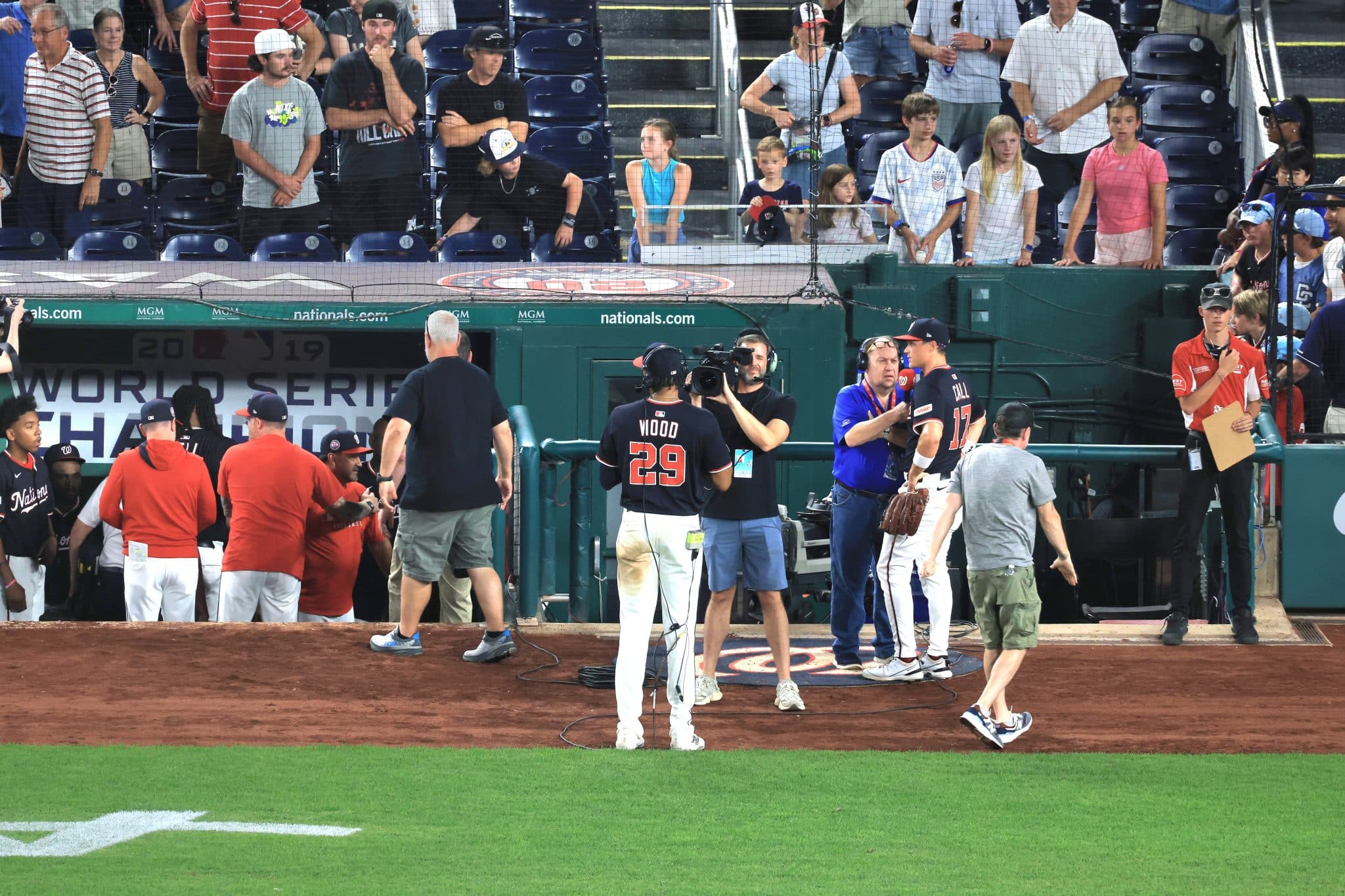

James Wood, the 22-year-old outfielder for the Nationals, has emerged as one of the National League’s brightest stars this season. With an explosive blend of power, speed, and plate discipline, Wood is delivering a breakout season that should have made him an All-Star lock in the fan voting for the starting line-up.
Yet, in a glaring oversight, he was not even among the top-six All-Star outfield finalists in the latest MLB fan voting. That snub has ignited sharp criticism of the league’s fan-driven selection process, highlighting long-standing concerns over popularity overshadowing performance. The statistics tell a clear story—and they leave no room for doubt.
Offensive Dominance Ignored
James Wood has put up elite offensive numbers in his debut season, outperforming nearly all his peers across the National League outfield. With 23 home runs , he is tied for second among all NL outfielders. His 67 RBIs rank him second in that same group, proving he’s not just a slugger but a run producer.
Most impressive is his .954 OPS, the highest among NL outfielders, a stat that captures both on-base ability and power. Add to that a FanGraphs’ WAR of 4.0, which ranks him second in overall value among outfielders, and it becomes evident: this is a player not just having a good year—but an All-Star caliber one. Nobody is saying he is the best — but come on, he is Top-3 for sure in the National League.
The All-Star Voting Disgrace
Despite these remarkable metrics, James Wood was excluded from the top six All-Star outfield finalists. Instead, players like Teoscar Hernández and Andy Pages of the Los Angeles Dodgers moved forward, despite posting weaker stats. This has renewed concerns about the fairness of the fan voting system.
Voters tend to favor players from high-profile teams in large markets, regardless of on-field performance. Wood, playing for a struggling Nationals franchise, has clearly been a victim of this bias. The discrepancy between numbers and recognition shows how merit is too often sacrificed on the altar of popularity.
Impact on the Nationals
For the Washington Nationals, Wood’s breakout season is a rare beacon of hope. In a year where the team has largely struggled to contend, Wood’s bat has been the spark in the lineup, the highlight on nightly broadcasts, and the reason fans still tune in.
His offensive prowess and plate discipline have made him a daily threat, and his continued development is central to the team’s rebuilding process. Being snubbed from the All-Star roster not only hurts him personally—it robs the Nationals of a moment of recognition on a national stage.
Career Implications Beyond the Game
All-Star selections are not just symbolic accolades—they carry real weight. They’re considered in arbitration hearings, contract negotiations, and even Hall of Fame discussions.
For a young player like Wood, being snubbed from what should have been a well-earned All-Star debut can set back the narrative around his career. While his performance this season stands on its own, the lack of an All-Star nod could influence how future achievements are measured. It’s a structural flaw that could have long-term ramifications for rising stars.
The Need for Voting Reform
The outrage following Wood’s omission reflects a broader issue in Major League Baseball: the flaws of the current fan voting process. While fan engagement is vital for the sport’s visibility and reach, it should not come at the cost of fairness.
The best talents deserve recognition, regardless of whether they wear a Dodgers or Nationals jersey. Wood’s situation has added fuel to the push for a more balanced voting system—one that blends fan input with a panel of players, managers, and analysts who evaluate performance objectively.
Teoscar Hernández vs. James Wood
Comparing Teoscar Hernández to James Wood underscores the issue. While Hernández has had a solid season for the Dodgers, he’s behind Wood in nearly every major category.
Wood’s .938 OPS trounces Hernández’s. Wood also boasts higher bWAR and more RBIs. Yet, thanks to the Dodgers’ massive fan base and market reach, Hernández advanced in the voting while Wood did not. It’s a textbook example of why relying solely on fan votes leads to unjust outcomes.
The Case of Andy Pages
Andy Pages has shown promise, but when his stats are placed side-by-side with Wood’s, it’s no contest. Pages hasn’t matched Wood’s 22 home runs, 65 RBIs, or league-leading OPS. Still, his placement among the All-Star finalists reveals how market visibility can elevate a player prematurely, while someone outperforming him statistically gets left out.
For Wood, it’s yet another gut punch from a system that’s supposed to reward baseball excellence.
All-Star Game Excitement
The 2025 MLB All-Star Game is set to take place on Tuesday, July 15, at Truist Park in Atlanta, Georgia, marking the 95th edition of the Midsummer Classic. Fans across the country are eagerly anticipating this showcase of baseball’s top talent.
For fans in Maryland, the excitement extends beyond just watching the game. Maryland residents can place wagers on various aspects of the All-Star Game, including game outcomes, player performances, and more. Maryland sportsbooks offer competitive odds and promotions tailored for events like the All-Star Game.
Jeremy Peña Left Off Too
Another eyebrow-raising omission was Jeremy Peña, but he is now injured. The Houston Astros shortstop known for his elite defense and consistent offensive production. Peña has been a critical contributor to Houston’s success but was overlooked for flashier, better-known names. His defensive metrics and reliable bat should have made him a favorite among voters valuing all-around performance.
Byron Buxton’s Quiet Excellence
Byron Buxton of the Minnesota Twins is another name left off the All-Star radar. Despite contributing on both sides of the ball, his reputation as an injury-prone player may have played a role in voter hesitancy.
When healthy, Buxton is a dynamic presence in any lineup. This season, he’s done enough to warrant a nod, but perception—and perhaps past injuries—overshadowed performance in the voting.
Elly De La Cruz’s Disrespect
Elly De La Cruz, the electric shortstop for the Cincinnati Reds, has lit up ballparks with speed, flair, and big hits. His presence has dramatically altered the Reds’ lineup. Still, playing for a struggling team like the Reds hurt his chances to make it. His snub is a reminder that excitement and impact don’t always guarantee recognition.
Jonathan Aranda’s Overlooked Campaign
Jonathan Aranda, the Tampa Bay Rays’ first baseman, has been a key offensive weapon this season, with impressive numbers in both batting average and on-base percentage. While he might not command national headlines, his production has been vital to Tampa Bay’s push in the standings. Despite this, Aranda was left off the All-Star radar, showing that consistency and high-level output still struggle to break through voter apathy.
Eugenio Suárez’s Power Goes Unrewarded
Eugenio Suárez of the Arizona Diamondbacks leads all NL third basemen in RBIs—a major offensive stat—but failed to crack the All-Star list. His power hitting has been essential to Arizona’s offense, and his veteran leadership adds even more value.
Yet, all of this wasn’t enough to earn Wood a deserved All-Star bid in the fan voting. It’s further proof that stats aren’t always what voters are watching. Expect that Wood will get added as a Nationals’ reserve since every team gets an All-Star player. Maybe MacKenzie Gore too. And then there is CJ Abrams. When you are a last place team, you might only get one All-Star representative. At the very least, we will get to watch Wood in the HR Derby on July 14. And of course the Nats will be the team to watch on July 13 with the first pick in the draft.
Leave a Reply