
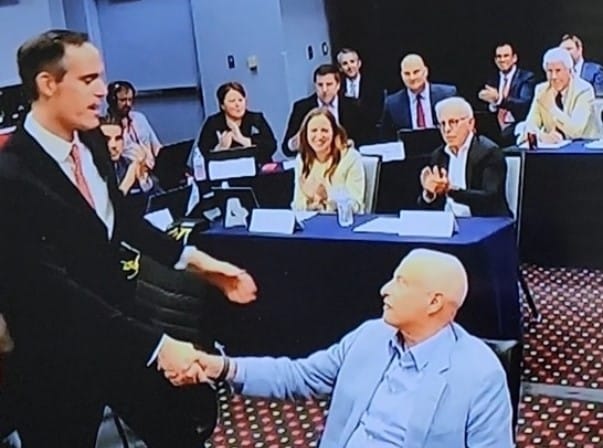

With the All-Star breaking ending today, the short vacation is over for all players not named MacKenzie Gore and James Wood. The front office never gets too many days off as they have to simultaneously have to sign their draft picks and prepare for the trade deadline. The front office led by interim-GM Mike DeBartolo seems to be much more transparent than his predecessor. We have seen it with injury announcements and quick announcements of draft pick signings. Could we see the team quickly sign their No. 1 pick, Eli Willits, and get him to Nationals Park for the upcoming homestand?
Looking around at the rankings in the draft, there were plenty of accolades for Washington’s draft. The overall feeling could best be summed up by Jim Callis of MLB Pipeline. He ranked the Washington Nationals as having the “Best draft by a team without extra picks.”
“Though the choice of prep shortstop Eli Willits at No. 1 overall caught a lot of fans by surprise, he could become the best all-around player in the Draft if he grows into more power.
— Callis wrote on MLB.com
Getting flame-throwing prep right-hander Landon Harmon in the third round was reminiscent of Washington doing the same with Travis Sykora two years ago, and Miguel Sime Jr. (fourth round) is another high school righty who can light up radar guns.
South Carolina outfielder Ethan Petry (second) stands out with his plus-plus raw power. Prep shortstop Coy James’ offensive upside sparked supplemental first-round buzz before the Nationals floated him down to the fifth round.”
Over at ESPN, Kiley McDaniel thought that drafting Landon Harmon (No. 80 overall) in the third round was the best draft value. McDaniel noted that Harmon was getting “comp-to-second-round overpay projections, and the Nats landed him in the third.” Pre-Draft, McDaniel had already connected the Nats and Harmon in his final mock.
The Nationals drafted a lot of upside high school players, but went with power-hitter Ethan Petry (No. 49 overall) in the second round. McDaniel notes that Petry should be a corner outfielder or first baseman, and “he’s a slam-dunk big leaguer who should move pretty quickly.”
Everyone heard about the Nats 4th round pick, Miguel Sime Jr. who was picked after Harmon and another prep pitcher with a huge fastball. Here is what McDaniel say in Sime, “I was so-so on Sime after the summer and early in the spring, as he seemed to be a 6-foot-4 velo sideshow without much more to offer. Down the stretch and in the MLB Draft League, he looked like a different player, flashing an above-average curveball and changeup while throwing strikes. He’s a potential mid-rotation type if he continues progressing.”
Landing Harmon, Sime, Coy James (fifth round) who had some 2024 first round buzz as a high school Junior, possibly Mason Pike (19th round) with his third round rankings, and local Frederick, Maryland product, Ben Moore who was a college pitcher at Old Dominion with fifth round buzz, and these picks all added to a really strong draft class — if they are all signed.
On some of the other picks who were not ranked — and as such are lotto tickets, the Nats drafted catcher Boston Smith (sixth round) was a high upside senior signing from Wright State University, outfielder Jack Moroknek (11th round) from Butler University, power hitter Jacob Walsh (15th round) from the University of Oregon, and top reliever, Tucker Biven, (13th round) from the University of Louisville.
When you look at the Washington Nationals’ Top-30 ranked prospects, Brady House should graduate in August about the time that Willits will be seeded into the Top-2 alongside Travis Sykora.

Now let’s talk about the Nats’ draft board. The strategy that many teams employ is Best Player Available (BPA) in Rounds 1 and 2 with a little more risk on Rounds 3-to-5 where you risk signability for high school seniors. Of course before you actually made the pick official, most draft groups try to get an agreement in principle subject to a physical.
On draft picks in Rounds 6-to-10, those are the severe underslot signings that you sign to contracts before the draft for usually under $50,000, and those deals are not subject to a physical. Of course, those players when they arrive in camp have to take a physical to be cleared to play. Those picks are crucial in slot savings to spend on the overslot players as you can see in the graphic.
Now keep in mind that the top ranked player in the draft, Kade Anderson, already agreed to a pre-draft bonus of $8.8 million per a sourced report. That bodes will for the Nationals to have enough money on an underslot deal for Willits, and all of the underslot money from Rounds 6-to-10 to spend on Harmon, Sime, James, Moore and Pike. If there isn’t enough, the Nationals have up to 5 percent in an overage without future draft penalties to spend on top of their total slot pool of $16,597,800.
The other draft picks in rounds 11-to-20 who were unranked are Moroknek, Biven, C Nick Hollifield, Walsh, LHP Levi Huesman, 3B Bryce Molinaro, RHP Owen Puk, and 1B Juan Cruz.
Per our analysis, the Nationals could sign all of their 20 players and barely tap into their overage. Moore’s girlfriend posted up photos on Instagram of themselves in the stands of Nationals Park in Nats’ gear, indicating he will probably sign with the team he grew up as a fan of. Pike is the one with a strong college commitment to Oregon State, and the money has to be enough to sway him to forego college and the N-I-L money.
Also, the Nats signed an undrafted free agent (UDFA), Jordan Williams from the University of Tampa. Williams stole 81 bases in the 2025 season. His father, Reggie Williams, was on the LA Angels. His brother Cam Williams who is in High-A with the Angels, and half-brother of Javier Reynoso who was in the Royals system.
At any given time with the 165 player limit in the minor leagues, there are only 5,730 players in pro baseball excluding independent leagues and the Dominican Summer League. Any player who makes it to a minor league level is in that fraternity of the best 5,730 active players in the world.
As the drafted players weigh the money and opportunity in their decision to sign, the true test of any draft is the results. Approximately 17.6 percent of drafted and signed MLB players make it to the Major Leagues, according to Baseball America. This percentage, however, varies significantly based on draft position. Obviously first-round picks have a much higher success rate, while the probability of reaching the majors decreases with each subsequent round.
The chance of being a star is the real measuring stick as the league is filled with neg-WAR players who get a few cups of coffee and then don’t, or can’t take advantage of their opportunity. Former GM, Mike Rizzo, had sage words he would give to first time callups, “It’s hard to get here, and harder to stay.”









Leave a Reply