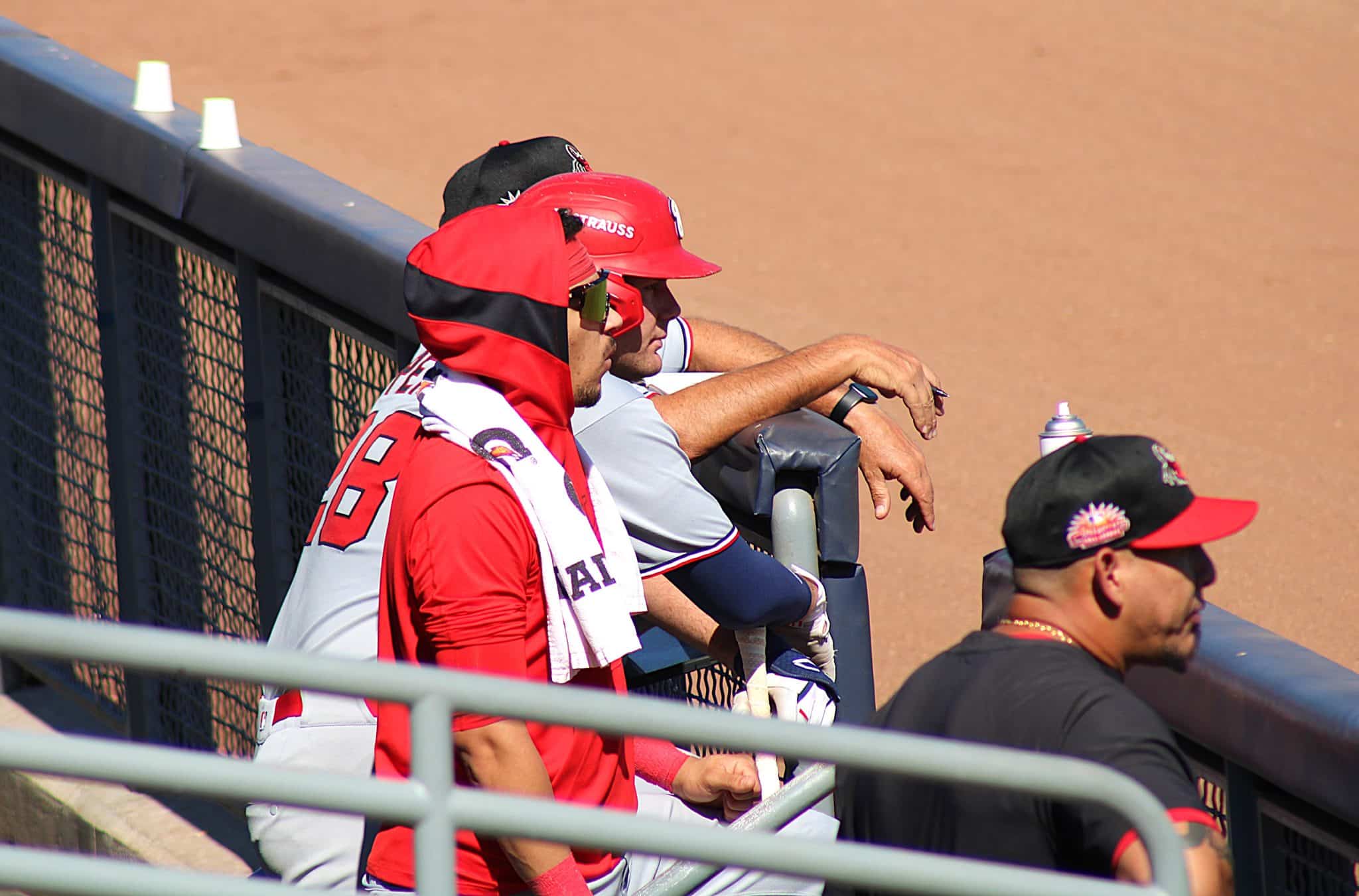

Wilson Ramos was on his first day in the MLB Coaches Program; Photo by Steve Mears for TalkNats
The Washington Nationals and the Lerner ownership group needed to hit a homer, off-the-field, with the hire of their head of baseball operations — and they did just that by agreeing to a deal with Paul Toboni. Now it’s Toboni’s turn to build his front office and coaching staff. He has to build within — both in scouting and player development, and oversee assembling coaching staffs from the MLB level straight down to the team’s Dominican Academy. Basically, everyone in the front office is a coach, and needs to have that type of mentality.
In business, they are called managers and not coaches. Layers and layers of managers. Then these businesses go outside to hire consultants and put employees into these swanky coaching programs. Why go outside for help? That’s a great question. But top players like Max Scherzer have been clients of individualized coaching programs like Cressey Sports Performance for over a decade. We wrote about this extensively back in the day. Their competition is Driveline. There are others too. You know who is working at Cressey today in Palm Beach, Florida? The Nats’ №1 draft pick, Eli Willits. He is just 17 years old.
Obviously the Nationals have to get better in providing coaches who can drill down to the granular level with tweaks that can make a difference, one by one, with each player. Then at a more macro level, you want to teach and coach overall strategy the same at every level. Bunting, base running, and other basics.
Driveline’s tagline, “STOP GUESSING HOW TO GET BETTER. Unlock your true potential with the most effective training system in baseball.”
Tanner Stokey is Driveline’s director of hitting. Look what they did last offseason with Amed Rosario. It starts with biomechanics. Then they can work on the rest. Stokey said Major Leaguers should gain on average between 1.5 and 2.0 mph of bat speed over the course of an offseason through their weighted-bat program. That is significant.
While Toronto Blue Jays’ hitting coach, David Popkins, didn’t say how he made his hitters better, you have to wonder if he employed weighted bats into his coaching. Popkins left the Twins last offseason to become the first year hitting coach for the World Series 2025 team from the American League.
Stokey said that Popkins brought in a modern model for team offense: emphasizing bat speed, measured intent, and giving hitters the freedom to compete and own their process. Gaining nearly 1.0 mph of average bat speed in a single season is impressive enough — but doing it with an aging roster, and seeing that number continue to rise deep into August and reach 72.2 mph in September? “That doesn’t happen without a real, deliberate change in process.”
Per Stokey, an average of 0.72 milliseconds of reaction time has been gained for every 1.0 mph of bat speed by their MLB players who became Driveline clients, according to the company’s internal research. In 562 instances when hitters gained between 3.0 and 5.0 mph of bat speed, an average of 2.46 milliseconds of reaction time came with it. Considering it takes a 100 mph fastball about 400 milliseconds to cross home plate, that could be the difference between swing & miss or contact.
The other secret weapon that the Blue Jays have is the Trajekt Arc machine, a highly advanced, stationary robotic pitching simulator installed at Rogers Centre, to help their hitters train against specific MLB pitchers. By using video of a pitcher’s delivery combined with their pitching data, the Trajekt Arc machine can replicate a specific pitcher’s speed, release point, spin, and repertoire to provide the most realistic batting practice possible. This allows the team to improve pitch recognition, spin, and timing, contributing to their home-field advantage because you don’t get the Trajekt Arc machines to use when you’re on the road.
This season, the Blue Jays have a .788 OPS at home and .733 on the road. That’s a sizeable disparity. You have to wonder if there are any batting cages near Dodger Stadium with a Trajekt Arc machine to simulate Shohei Ohtani or Tyler Glasnow who they will be facing when they arrive in Los Angeles.
Exactly a month ago, we published an article in which I named my coaching staff. Guess what, Popkins and Ramos were both included. My research was completed and that included making many inquiries to people in the know. Who were the best out there? Popkins name came up more than once. Hook’s name came up more than once. Schumaker’s name came up the most. “My suggestions are to bring in Skip Schumaker for manager. Kevin Long for bench coach. Chris Hook for pitching coach. David Popkins for hitting coach. Daniel Murphy for asst. hitting coach. Robin Lund for asst. pitching coach although Sean Doolittle might be the right man for the job. Brian Butterfield for 3rd base coach. Selwyn Young for 1st base coach. Wilson Ramos as bullpen coach.”
Clearly, Schumaker and some others won’t happen. All of a sudden everyone today knows who Popkins is now. Should Toboni try to get Stokey instead? How great was it to see Popkins on the top rail in the World Series with a FOX camera focused on him writing on a notepad. Yes, COACHING MATTERS. Don’t believe for a second that everything is the player’s fault like Dave Martinez tried to shift the blame.
But sure, “It’s never the coach’s fault” as Martinez claimed. Laughable. A fireable comment for sure. He embarrassed himself and his boss in the process and belittled his players. That was the same Martinez who would say “[the player] was adamant about playing.” The team at times was run like the father coaching his own kid on a travel team — a kid who didn’t earn the spot or at the very least, the playing time. Can you imagine telling parents who are paying thousands that it’s not the coach’s fault when most of the team is slumping?
❝
— Gore said on 106.7 The Fan radio in September
Everything starts at the top. So I think that’s very important going into the offseason. I’m sure they’re going to hire whoever they think the best fit is.
As a player, I just want to get the most out of everybody in the clubhouse, and I think that starts from the front office. And I think that’s something we haven’t necessarily done the past few years…We haven’t won enough games, and it’s been frustrating.
… We’ve got some guys that can play, and we just want to get the most out of this group. I think that’s what the best teams do. No matter how much the player is making — they get the most out of that player, and I think that’s something we have to figure out how to do.
❞
Okay, players have to play the game, and ultimately that is how Toboni will be judged in performance based on wins and losses — and from 2012 to 2019, former GM Mike Rizzo got that right and has a World Series trophy and four NL East pennants to show for it. Unfortunately, the basics got lost in drafting and scouting and player development, and for that reason, Rizzo is gone.
This offseason will be so telling. If Toboni follows the Red Sox plan of going after quality players — and not chasing dumpster dive pickups with the hopes they find their former selves like Joey Gallo, Nelson Cruz, etc., this team should improve. Of course, quality costs money. But as the Guardians, Brewers, and Mariners showed, it’s not all about the money.
Better coaching alone should make a difference. But there will be those who will complain about whoever is hired. And yes, we will debate managerial moves. We would have done that about Joe McCarthy! We are just 43-days until the Winter Meetings begin. Time is already short.
With Schumaker off the board, my choice for the manager would be LSU’s Jay Johnson. Even before the Giants hired Tony Vitello from Tennessee we were talking about looking in the college ranks, and yes, Vitello’s name was brought up before he was ever mentioned as a candidate for the Giants. Again, foresight is so important.
Why do I find these names like Popkins? It is the same way I find players in the draft who seem to have never been on the Nats’ radar? For decades, it is about using my eyes and ears and ask around. Opposing players, agents, coaches on the other side, and even parents of players. But mostly it is about using my eyes. Many times it is by accident. I could be scouting Kevin Parada on one team and find Zach Neto on the other. I could be watching Nick Kurtz and Seaver King on one team, and find Trey Yesavage on the other. Again, why can I do this but the Nats cannot? Fine, Kurtz was off the board before the Nats picked at №10. But Yesavage was still there. The Nats passed on him. Why?
If I expanded my top-2 picks, when Kurtz and Konnor Griffin were taken already, Bryce Rainer would have been after Yesavage for me. A tough call for sure. Remember how Baseball America was slotting them at the time. They do the rankings full-time. How often do they get it wrong?
In 2011, I talked with Rice head baseball coach Wayne Graham. He was one of the best baseball coaches in college history. He made players better. He said that Anthony Rendon was the best hitter he ever had. Well, he coached Lance Berkman. He didn’t say Berkman was his best. That was all I had to hear. The Nats got that one right. The Mariners, Orioles, and Royals got it wrong. The problem is that after Rendon, the Nats didn’t get many right.
Why is there such a high failure rate? My theory is that in drafting there is too much archetype bias in an organization, and in coaching there is too much teaching of the “one-size fits all” method. Drafting based solely on size and a 98 mph fastball versus the command of the strike zone is usually a fail. In coaching, Jacob Young should never be getting coached on batting like you would with James Wood, and Dylan Crews shouldn’t be coached like Wood. This is why these players seek their own offseason coaches. They want that one-on-one. They need that one-on-one. They should be getting it internally with the Nats.
First you must work on weaknesses to make a player better. Then you accentuate the positives. Until you break bad habits, how can you improve? For years, the Nats couldn’t fix Danny Espinosa swinging left-handed and chasing fastballs at his shoulders. We saw this over and over with Crews and Brady House. That’s a problem. Crews didn’t do that at LSU. Why is he doing it now? “See it too high, let it go by.”
Yes, there is specific training to change swing behavior. Somehow Daylen Lile made what I considered to be a miraculous adjustment. He was pulling outside pitches during his first stint in the Majors and was demoted back to Triple-A. He made an adjustment and came back and raked. Truly amazing to see that type of adjustment. One thing we knew about Crews was that he had the “hit tool” at LSU. Well, what happened to it?
“My philosophy is built off of creativity. We’re trying to become the most creative lineup at scoring runs in baseball. We do that by practicing all of the different situations and clubs that we’re going to need in the game.”
— Popkins said
You have to love the word “clubs” as a golf metaphor. Some players can do more with a 5-iron than others. This is a key from Popkins, “If you try to do everything, you’re not going to do anything.” In an instant, don’t try to turn a power hitter into a contact hitter, and a singles hitter into a power hitter. You want to slowly get both from your players. But you can’t try to flip that switch in an instant. Stay in your lane. Get better in that lane.
In college at LSU, Crews had a hitting coach but also relied on three coaches from his youth that included Josh Montero, Moe Pesce, and Bob Rikeman. For a youth player, coaches are so important. Crews was first coached by his grandfather Eddie Crews and his dad, George Crews. This offseason, who will Crews turn to? Many of them talked to us before and after the draft, and yes, that included his LSU head coach, Jay Johnson. This is a crucial offseason for the former №1 prospect to reach the potential he has within himself.
In order to choose a coach, you should go the same route as you would to acquire a player. Talk to people and vet them thoroughly. Picking the most popular name is usually the biggest mistake. The value is usually in under-realized talent. Everything also has to be judged on risk and reward. We deal in some finite numbers like 26 players on a roster. You generally have 13 position players, and you’re limited to 13 pitchers.
As you take your baker’s dozen into the lab, you better have a plan on how you can make each better. The Nats have two pitching coaches and two hitting coaches in the dugout. Again, there are smaller gains on improving what they do right. Bigger gains are made by fixing what they do wrong. Overall gains is what we can teach each player — and some of that comes from training like the weighted bats, and tools like Trajekt Arc.
“When you get in those spots, they probably felt that they didn’t want to chase, didn’t want to make a mistake. If you’re afraid to make a mistake, you lose that attack. If you’re not attacking, you’re getting attacked in this game. It’s about reminding guys that they’re dangerous.”
— Popkin wants to give the mental edge to his hitters that they control their own results
More specialized tools have to be used to fix specific problems to a player like swinging at balls above the zone. You don’t have to teach that to Wood. He has to be working on swinging at balls at his knees. Young has to be working on barrel consistency, and CJ Abrams has to stop expanding on pitches outside the zone. This is not a one-size fits all concept. Again, these are player specific micro coaching.
With my full confidence, Toboni knows all of this. He just has to hire a manager and coaching staff to get on this. Spring Training camp opens in 3½ months. By then, it is too late. This needs to be completed sooner than later. Time is ticking. The Nats have already been in their offseason for one day shy of four weeks.
“When you’re coming to a new team, you have to go out of your way. What’s that old saying? ‘They don’t care what you know until they know you care.’ [Popkins] did that in the offseason. He travelled to see guys. He came up here to hit with Bo Bichette and [father] Dante. Popkins stays in constant touch with [the players]. He’s been really good with that — and that builds relationships and trust.”
— Blue Jays manager John Schneider said of Popkins
It is these next three months that these players need to know what they have to work on. You would think they know their own weaknesses. But do they know how to fix it? That answer is probably not, because if they did, it should have been corrected already. Hence the value of the coach as the teacher.
If you want sizeable improvements, it must come from improving within and making your current players better. That is really what the Blue Jays did. Spending big money on free agents isn’t always the answer. How did the Anthony Santander signing work out for the Blue Jays? They did add closer Jeff Hoffman and they scored on their cheapest free agent deal with Ernie Clement at $1.97 million. Of course there was also Max Scherzer who didn’t really factor into the regular season with his 5.19 ERA. His $15.5 million deal was all worth it for what he did in the ALCS.
With all of that said, the Blue Jays have the 5ᵗʰ largest payroll in baseball. There are more reasons than just coaching as to why they are good. The Brewers still feel like a good blueprint to follow. On coaching, the Brewers on the pitching side, and the Blue Jays on the hitting side. Hence, my choices for coaches.
Coaches Matter. People Matter. Decisions Matter.
Leave a Reply