
Christmas is here. For many baseball players with no confirmed destination for 2026, the pressure builds to decide and then make personal plans for moving, home, family, and school, among other things. In spite of many substantial signings, the roster of available free agents is still sizeable. There are many talents yet in play that not only would upgrade the Nationals but would do so at positions of need and would work within a budget comparable to last year.
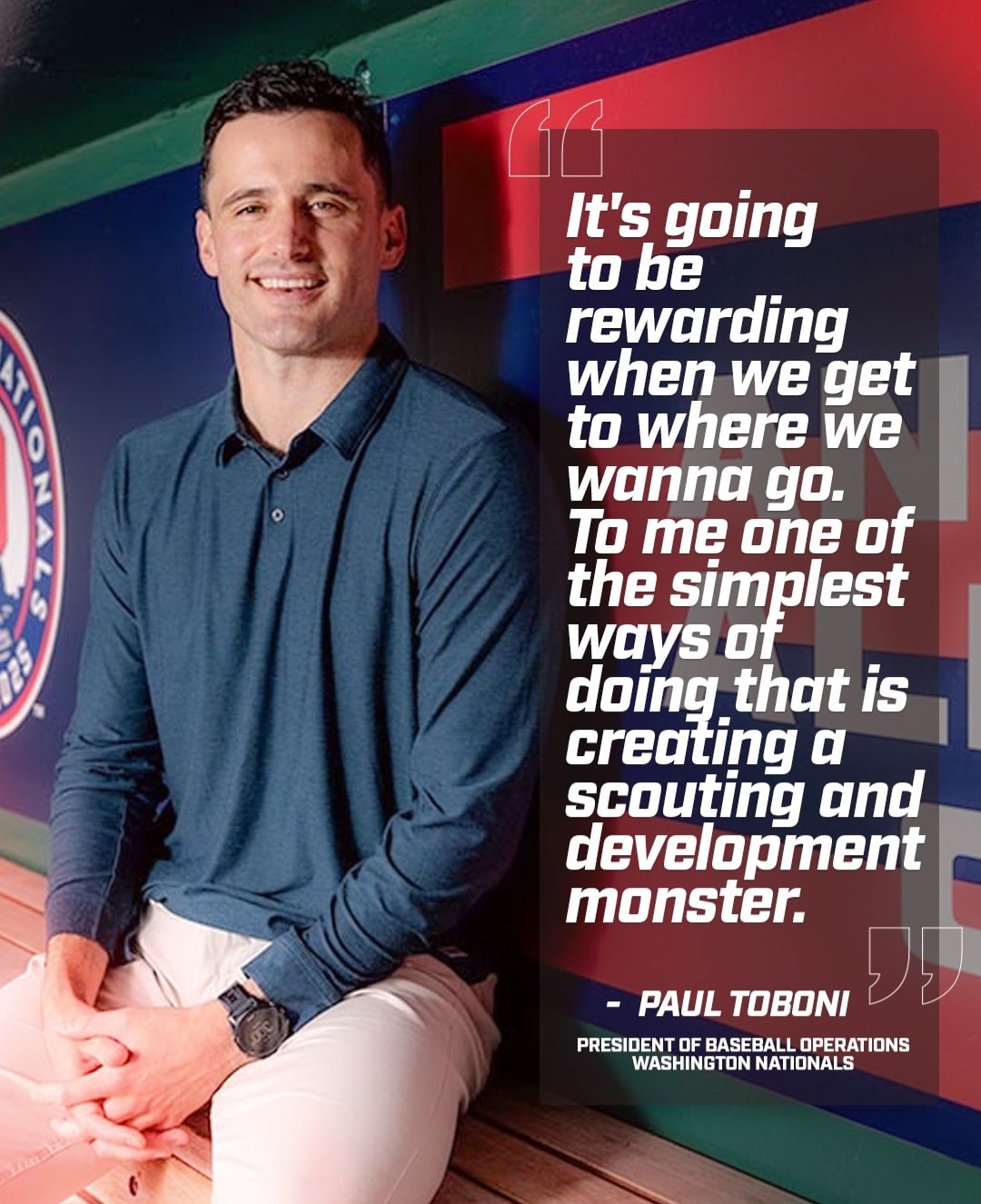
For years, the Lerner family has been dogged by criticism, however unfair, that they have run the team too frugally. With the hiring of Paul Toboni, the ownership committed to upgrading facilities, processes, and management down the line. It may be that the new hires, while large in number, they could be more affordable overall. With youth and promotions often come lower salaries. Perhaps that is part of the budgeting of paying for Trajekt Arc, force plates, and other gizmos that the nerd management class favors. Or perhaps the team is spending without restraint — but spending smart and hiring the people they wanted — regardless of the salaries paid.
Former GM, Mike Rizzo’s 24-25 offseason, by available accounts, had over 50 million dollars allocated to the budget for new acquisitions a year ago. It follows that if ownership is as committed to growth as some assert, that we can expect outlays to come.
The new management comes from major league organizations, and held responsibilities that included major league player evaluation. Mike DeBartolo fulfilled this role with the Nationals in years previous, and now a braintrust merges perspectives from within our organization with those from within the Phillies, Rays, Red Sox, and Pirates. So there are converging perspectives on the many free agent marbles or potential acquisitions, vantage points from both the American and Nationals League. From teams that spend and teams that develop and bargain hunt. (Everyone likes to think they do both).
Ani Kilambi, the named GM of the Nationals, has been showcased to a degree that we can anticipate his having a central responsibility of trade and free-agent decision-making. He has already expressed that his previous responsibilities with the Phillies afford him a running start to mind meld with existing thinking. And most important, an urgency to make acquisitions to improve the Nationals now. Urgency for us means to expect action, and that’s promising. Unlike a typical rebuild or teardown, the current Nationals leadership demonstrates a strong confidence in the existing youth within the organization. Therefore, bringing someone in means, with few exceptions, displacing the talent we know that the executives ostensibly believe in.
Then there are considerations we can’t account for that affect roster decisions: Is Drew Millas’ rehab enough to enable him to resume his career? Or do we witness the fade like we did with Israel Pineda after his finger injury? Does Keibert Ruiz get traded? Can hitting coach Matt Borgschulte along with an off-season program get Andres Chaparro to a next level slugger as Borgs did with the underachieving Orioles on his arrival there in 2022?
Can the off-season work guide Robert Hassell III to continue on an upward trajectory into an everyday bat? Or does the team ship Hassell out? Are the Nationals going to give Luis Garcia Jr. another shot? Is Nasim Nunez and his superior defense going to find a starting shot? Can the pitching lab save once-promising careers of Mitchell Parker and Jake Irvin? In what form? What do the new Nationals talent evaluators really think of the talent in the farm system?
With an eye toward who would upgrade the roster in the face of the above (and more) variables, let’s inventory the items on the shelf in the free agency store that, for reasons we can debate, upgrade the existing 40-man roster. The arbitrary (read: unqualified) ranking based on the relative impact that I think such a player would have on the team and on winning in 2026 and beyond. OK, whom did I miss? Surely there are folks I should have included. But this gets a discussion started.*
Let’s refer back to this list at the end of the 2026 season to see who performed and whom we should be glad we missed on.
1. Alex Bregman – An impact bat and proven World Series winner who can (in theory) upgrade at second base, slide to third if Brady House flames out, and has enough bat for first. A leader of men, a proven clutch performer. A mentor for Dylan Crews. In a Jayson Werth way, this signing establishes the Nationals as a free agent destination again. However, the Nationals developing a player development monster means having a replacement available for Bregman within three years. The thought of Bregman collecting 33 million dollars as a fading bench bat in four years may be impossible to stomach given the expectation that he wants a six-year deal. But if you want to guarantee a quantum leap to the Nationals in 2026, this is one way. Another, of course, is to trade for Ketel Marte. That may not be your thing, and he does not have the clubhouse aura that Bregman would have, but it’s a lot more affordable in dollars — not in trade capital.
2. Pete Fairbanks – The Nationals need late bullpen help that can dominate, and do it consistently. Shut down setup arms, shut down closer arms. In recent years this success has been elusive. We’ve occasionally seen those players over the years, and they add a lot of value beyond statistics. Late season Daniel Hudson in 2019. Sean Doolittle at his best. Tyler Clippard in the 8th. The trick is in the variability of bullpen arms from one year to the next and sometimes, within the season. Fairbanks is a dependable closer on a consistently winning team. He can fill multiple high leverage roles in the bullpen. And, Fairbanks has a lot less miles on his arm than it seems.
3. Tatsuya Imai – With no draft pick (Valdez) or player compensation attached, it would be difficult to envision acquiring a higher ceiling rotation arm. Imai’s youth, health, velo, pitch mix, and improvement are plusses here. So, too are the successes of Yamamoto and other high end Japanese starters that contribute to confidence in one’s ability to translate skills and stuff to the American game. Getting a quality Japanese import in DC will be good for the long-term strength of the Nationals. I don’t think we would outbid teams, but he can definitely help this team. A longer contract for an established starter, such as Imai will command, is especially useful if the Nationals do not envision more than two years of Gore.
4. Kazuma Okamoto – If the Nationals opted not to try for Murakami at his affordable price point, I’ll be OK with Okamoto as the reason. Okamoto is in a position to be the 2026 and beyond first base solution. He hits right-handed, has power, is good defensively. He was the captain of his Giants team and as such, fulfills a clubhouse role of playing with the example of a leader. He can establish a presence in DC for other Japanese players in years to come in the same way that the Dodgers and Padres have cultivated destinations for Asian imports. I like Okamoto’s defensive flexibility as a bit of an insurance policy if Brady House’s bat does not take the next step to establish himself.
5. Justin Verlander – I respect him enough to feel that he could help any staff, and would enhance the Nationals rotation if healthy, possibly by a lot. Even at 42, he pumped out over 150 innings last year and had some strong stretches. For whatever investment it would entail, likely reasonable, I’d do it because of the upside, especially because he would require no more than a one-year contract. He’d be a popular player on a team that needs viejos.
6. David Robertson – Given a proper spring training and playing cycle, this guy can help our bullpen and his experience will be good for the team. He knows how to pitch, knows how to use his arsenal, and flexibly fits into a bullpen where needed. That includes as a closer, which is no given. He has the mental fortitude for a job that younger arms cannot handle and can still strike guys out as needed.
7. Marcell Ozuna – For those who covet the power Eugenio Suarez could bring, I would submit the high OBP and a high power Ozuna is a more reliable option who adds more value. He has been a key cog of winning teams. Only one year removed from a dominant season, he could be had at a lower commitment of years than luminous sluggers like Schwarber and Alonso. Buy low and use him as a DH and righty power bat. If Ozuna bounces back, we’ll be happy we have him for a pennant run, or someone else will want him badly.
8. Chris Bassitt – A dependable starter who is consistent, a winner, and whom I think still has a couple of years in the tank as a regular rotation piece who can deliver innings. He is a lunch pail piece of many winning teams, including unlikely winning teams. I think he would be more affordable than bigger name or younger starters but should give a couple of years of excellent results, with a realistic expectation for him to deliver on all three years of a contract. I’ll bet on a guy who can come back from a fractured skull the way Bassitt did, but perhaps that’s my “All-Madden Team” bias.
9. Max Scherzer – For all of the reasons of Verlander, with some greater concerns because of his shaky health in Toronto, Scherzer is another potential helpful addition on a one-year deal. I cannot help but think he would be a bullpen piece once his starting days are over. But Scherzer’s unusual grit and especially his fury overshadows his excellent moxie. It is that latter quality that enables him to find answers for how to reinvent himself to get batters out next year, and I would bet on that. Fans would come to see him pitch. And he is a face of the franchise who should be spending his last days here.
10. Michael Kopech – I like him as an affordable bullpen piece who might recover into a closer-type. He couldn’t stay healthy in 2025, but he has showed high leverage success and still has dominant stuff. In the same way that Hunter Harvey eventually ripened, I can see Kopech, whom Toboni would remember well, being a high upside play for the Nationals.
11. Pierce Johnson – He’s given the Braves a lot of clutch high leverage performances over a few years, and is apparently healthy. The Braves opted this winter to stack their bullpen with high priced arms and cut Johnson and a 7m dollar contract loose to go in the direction of Suarez and a higher priced pen. Anthopolous, much as I love him as a GM, reaches for the seemingly shinier object sometimes and gets burned (see Matt Olson-Freddie Freeman). I see a bit of that potential here, given the Nats need for bullpen help, and he is a workhorse, too.
12. Kirby Yates – Another player whose underperformance may reflect just conditioning rather than decline. Maybe. His velocity lagged as the year wore on. However, Yates was so good with Texas in 2024 as their closer. If healthy and well-conditioned, he lines up well with the Nats’ late inning needs. He could be brought in affordably and given the chance to pitch his way into the closer role as he had with Texas.
13. Zach Eflin – Only a few years removed from a career year in Tampa Bay, he’s a long dependable starter who would be a cost-effective sign coming off last year’s disappointment on an underperforming Baltimore team. He’s relatively young and has far less mileage on his arm than what might be expected at this stage. (I know many of you like Zack Littell, and I respect that. I don’t want him.)
14. Jesse Winker – It was 2024 when Winker was shipped out at the deadline as one of the best hitters and leaders of the team. From clutch home runs to fire in his game, the left-handed hitting Winker could DH, PH, and play 1B as need be. He went to the Mets, and then reverted to a hobbled version of himself. If pain-free, and if the roster has room, I could see a Nats team he would help.
15. Jakob Junis – He’s been progressively morphing into a full-time reliever, and the returns for Cleveland last year were excellent. He was durable and offers multiple inning potential.
16. Walker Buehler – We’re a few years removed from Beuhler’s Cy Young-caliber work in LA. But last year demonstrated that Buehler is slowly making his way back. He’s a buy-low option who is still young enough (31) to work to blend the abilities he still has with the data mindsets now in house in the hopes of returning to successes. If Kilambi identifies pitching talent, he brought Buehler in for three successful starts last September in Philadelphia. Is that enough to think Beuhler is a pitcher that if properly managed (like Soroka) he can really help a staff? I think he is a cheaper and safer bet than the ’25 Soroka.
17. Andrew Chafin – Chafin rolled out of bed, stepped into a depleted Nats bullpen, and did what was asked of him in ‘25. He was very good, and even better with the Angels. He’s seen it all and can still fool hitters. Everything for us to gain and little to lose in his age 36 year.
18. Danny Coulombe – There’s a lot to like about his consistent year to year performance, limiting home runs and hard contact. He faltered with Texas down the stretch and he’s 36, so there may be some questions of aging. But he was fantastic with the Twins earlier last year, so there is reason for optimism.
19. Hunter Harvey – He was very effective in his Nationals career and is only 31. When first brought here, he had been oft-injured but blossomed and maintained his health for the most part. Even in Kansas City, he was getting guys out when he was healthy. Given the team’s late inning needs, I’d love to see Harvey return.
Of course, free agents have to want to sign with the Nationals. The top names on this list, at least, are players for whom the franchise must compete. This is the benefit of the revolution that the Lerner family has undertaken with the Toboni and Butera regime. Don’t take for granted that change, or even “good people,” is persuasive to a free agent who is being wooed by “good people” of other franchises. The players whom the Nationals have targeted will have to decide that coming here will be best for their career and development.
All of the data science may be quite enticing to players who see what labs have done for themselves or for others. Some may already have a relationship with coaches Andrew Aydt or with Simon Mathews.
But there will also be those on the defense and base running side who have pause at the limited major league coaching experience on the major league staff. They will have to bet on the composition of the staff with far more at stake than us fans. And you never know which one of those players reads Talk Nats with diligence to grasp what is really going on with the team and its city and fans — I am completely serious.
Thus, it’s not just about who is on this list, but who on this list will bet on the Nationals. We aren’t free agents, but for now, we best be the first ones in the boat!
*PS – Since you have read this far, you would know that I would include Trevor Bauer at #3 if I didn’t think it would start an argument. So we won’t argue and I’ll just keep him down here. Happy Holidays and Go Nats!
Leave a Reply