
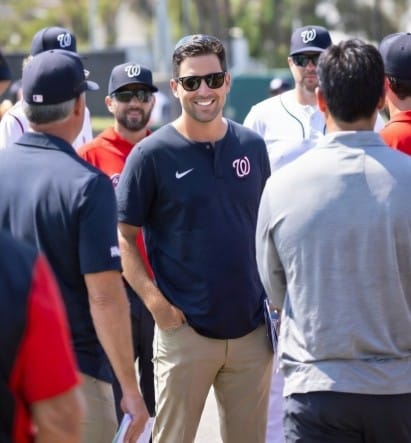

The word ‘humility‘ was talked about a lot when Paul Toboni was first hired as the President of Baseball Operations of the Washington Nationals. I was fortunate enough to have been at his presser, and got the opportunity to talk with him one-on-one. A very nice young man. I felt old next to him since I have children older than his chronological age.
Away from the bright lights, and in a few minutes of time, I had to remind Toboni that when he talked about Georgetown and Howard for basketball at his introductory press conference, he forgot to mention the University of Maryland — the last college team in the region to win NCAA Championships in basketball — both for the men (2002) and women (2006). He laughed at his faux pas. He said that won’t be the first time he swings and misses. That is humility.
Yes, life has swing and misses. At the end of the day, you just need to win more than you lose. Swings and misses will happen, and in risk management — there is a level of acceptance for that. In business that is known as ‘risk acceptance.’
Toboni and I also talked about spending on player payroll. That is where it got very interesting because he said that he would never ask ownership to spend to a point where they were losing money. There aren’t many baseball executives who would say that. But even Ted Lerner knew that sometimes you have to take on risk and spend to win with the hopes that you will be rewarded at the turnstile. It goes to that Field of Dreams quote, “If you build it, they will come.”
As a retired CPA and a former CFO, I dealt with many P&L pro formas that tried to predict the future. You are dealing with revenue and expense projections that you personally cannot fully control. Toboni has no idea what the paid attendance will be for 2026 — the largest component of the Nats’ overall revenue. But one player acquisition that is met with overwhelming positive fan approval could turn into fan excitement and additional tickets sold, hence boosting revenue. So while Toboni’s player payroll is the largest expense on the P&L — the right acquisition could boost revenue and that in turn could give him more flexibility on spending in the future.
In the good ole days of the previous decade, the Nats CFO probably modeled in revenue based on making the postseason. That windfall of money could pay for extra payroll expense. Everything that Toboni does matters. Some teams build up fake excitement to sell tickets by giving the fans hope, and with no intention of actually doing it. Toboni hasn’t done any of that.
Jason Sinnarajah was hired earlier this month as the team’s President of Business Operations, and gave his two weeks notice to the Royals. Sinnarajah, per our sources, officially started work on Monday for the Nats. For his job, he is very co-dependent on building excitement to sell tickets — and raising revenues.
Most baseball teams set a goal of winning. Not all. Some are just fine to stay in their lane, and know their own truth. The Nats know they aren’t a playoff team, today. They are still in a rebuild. This will make Sinnarajah’s job more challenging. And since our belief is that Toboni’s budget is tied to projected revenue, he has a vested interest in seeing revenues expand. This is where Sinnarajah and Toboni have to work hand-in-hand.
Behind the scenes, work is being done to improve. Just because you don’t see it, that doesn’t mean people aren’t working. The Nats have a new RSN TV deal and hopefully Sinnarajah has ideas for new sponsorship opportunities. You can bet his background in strategy and growth and his five years working at Google shaped him for success to get his current role with the Nationals.
While the Nats were ranked by Forbes with the 9th lowest revenue of any MLB team at $325 million in 2024, we know that was adjusted down because of the early 2025 RSDC ruling that the Nats TV revenue from MASN dropped by 20 percent to $58.3 million from $72 million. The Nats were most likely only ahead of the Tampa Bay, Chicago White Sox, and the A’s in revenue. All of that is a problem, and the Nats are not eligible per the CBA to receive revenue sharing because they are not considered to be a small market team.
Much of the Nationals problems are self-inflicted like going the past 17 years without a stadium naming rights deal, and not taking advantage of corporate sponsorships. Some of it is not self-inflicted. The Nats had no control of their TV future when times were great in the RSN business and teams like the Phillies in a similar market size got a $125 million a year TV deal. The Nats were making less than Tampa in TV revenue. You can thank the Angelos family for that. On top of that, the Nationals were spending millions, per sources, in the MASN lawsuits at the time. The lawyers were getting rich — not the Nats.
Even Sinnarajah couldn’t tell you at this point what the Nationals will make on their new TV deal because they don’t know their subscription base for streaming nor do they know what their cable money will be. Everything is a projection. If there is any good news, the Nats were not making much from MASN with that $58.3 million, and they have an opportunity to make more going forward.
With all of the revenue uncertainty around the TV deal, has this impacted Toboni’s budget? That is also an unknown. TalkNats sourced that he had about $30 million to spend on player payroll. He has spent about $5.5 million of it.
To date, these are the Nats 40-man acquisitions:
- Foster Griffin $5.5 million + incentives (acquired as a free agent)
- Harry Ford $780,000 (acquired via a trade)
- Luis Perales $780,000 (acquired via a trade)
- Griff McGarry $780,000 (acquired from the Rule-5 draft)
- Joey Wiemer $780,000 (acquired as a waiver claim)
- Paxton Schultz $780,000 (acquired as a waiver claim)
- Mickey Gasper $780,000 (acquired as a waiver claim)
There are no guarantees that beyond Griffin and Ford that any of those other players will make the Opening Day roster. Griffin is the only player on that list who is guaranteed to make more than league minimum.
None of those names are the type to give Sinnarajah and his staff the marquee type of name to excite the fan base to sell additional tickets. On top of that, the team’s biggest name on the pitching side, MacKenzie Gore, could be traded.
There are still so many unknowns. The good news is that Toboni says that his roster is not set for West Palm. The team still has holes to fill, and more holes to fill if Gore is traded.
That statement by Toboni that “By no means do we view this like, ‘Hey we’re set going into West Palm’.” You might say little is set, and there is still a lot of work to be done.









Leave a Reply