

A lot of attention goes into ranking prospects and debating them. So it’s only natural to clear the table of our own charts, presumptions, MLB.com, Law-BBA clickbaiting and get a feel for whom the Washington Nationals really value in their system, and perhaps, whom they don’t.
If you reside in last place and decide you are sick of it, the first thing to do is get to work and improve. The initiative to draw young players out of their autumnal and early winter rest and recreation to learn and drill their way into customary spring training is clearly constructive. Purists and medical staff might caution that too much early-work increases the potential for injury or fatigue later in the season, as pitch counts accumulate, for example. For me, though, opting to arrange more instruction and development is a great endeavor, particularly when the organization has been staffed with coaches hand-picked for their instructional talent and ability to drill winning into players’ heads.
The Toboni era Nationals have shattered a paradigm with the minor league instructors they brought in this winter. A raft of teachers from baseball labs and coaches who win at all levels coalesced from all corners of America, from obscure or low-level colleges to hole-in-the-wall baseball gyms to upscale baseball labs. For those like me who are old-school, it is meritocracy meets baseball. The organization shows a recruiting philosophy open to all, but commits to hire only those who approach baseball the way the leadership does, those who teach brilliantly, inspire their players to win and to better themselves.
The Nationals are showing they are prepared to hire Cinderella if the glass slipper fits. And the Nationals have. To me, this is the biggest explosion of the off-season. It will translate into improvements across the system much more than the players brought in will. I don’t know whether the major league Nationals will win 70 games this year, or 90. If they win less than 70, I won’t be surprised. If they win 90, I will be less surprised than many who do not share my view of things. But I will tell you this:
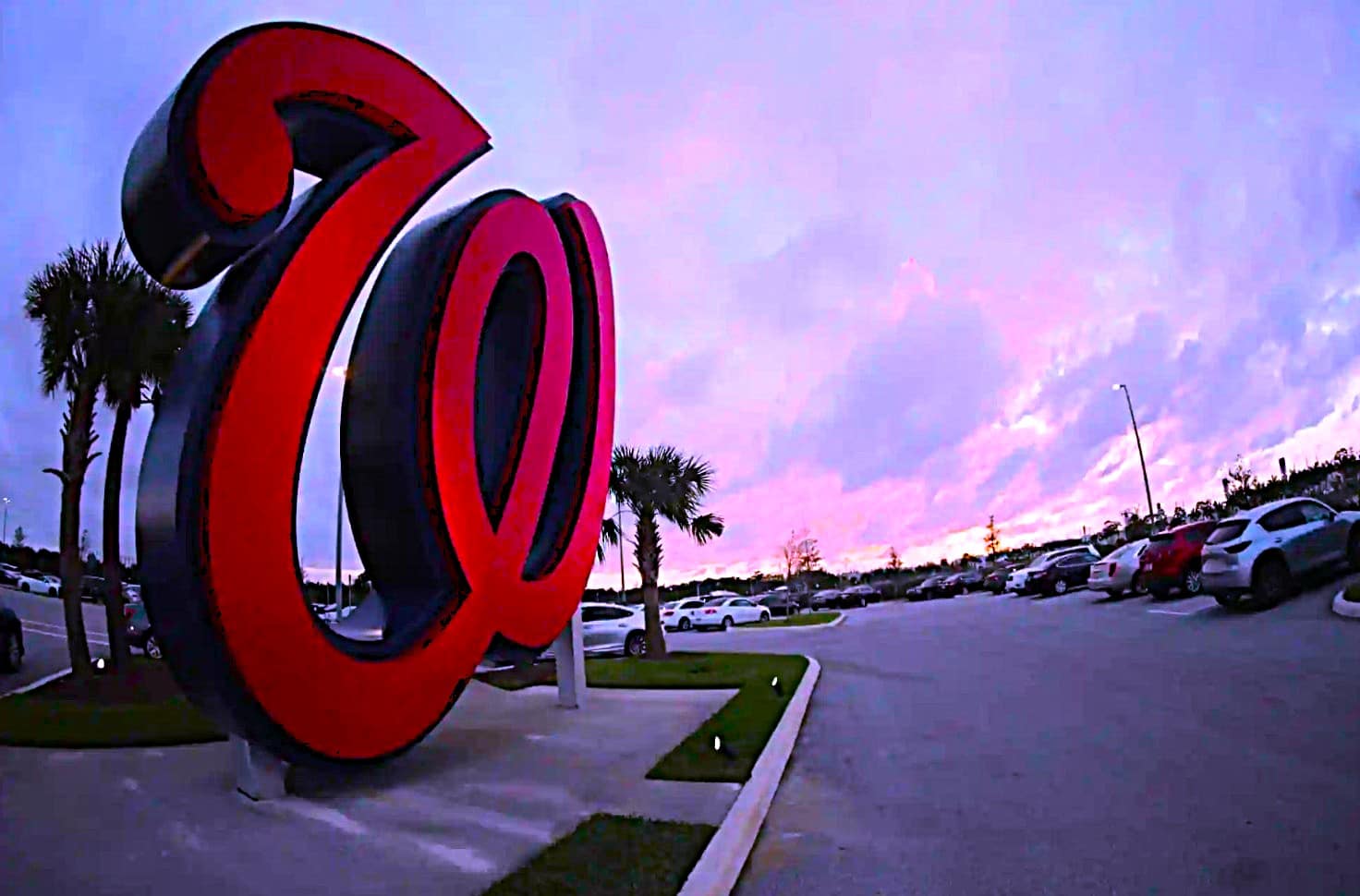
Forget about the prospects brought in for a moment – the Nationals will be, by year’s end, one of the very top minor league systems in baseball precisely because of the people they have brought in to coach up the players in the system now. And “The Ball of West Palm” will certainly shape the developmental orientation of spring training for the major league and upper minors talent that is not there now. What does the Love List represent? To me, a combination of those that the staff feels have the most to invest in, those who are the best learners, those who have important skills and tools and pitches that, if refined much further, will make a huge difference in their ceiling. Or all of the above and more.
Will all of those on the Love List improve? Their fate depends on it, in a system that is now overstuffed with lower minor league infielders and the offensive swamp of Wilmington waiting to chew up their confidence.
The most compelling unresolved story line for the Nationals this year, right now, is the starting rotation without MacKenzie Gore. The Love List, with no Andrew Alvarez or Riley Cornelio or Luis Perales on it, will shed no more insight than emerging candidates for the next wave of starting pitching beyond those (healthy ones) we know, like Alex Clemmey and Jackson Kent. By design, it’s a Non-Roster Love List without players on the 40-man roster.

The most intriguing byproduct of The Ball of West Palm figures to be the competition at first base. We watch to see who and how, and whether any of the candidates for the major league starting job will separate themselves even before spring training officially starts. It’s no doubt an intriguing bunch of non-roster invitees, with Warming Bernabel, Matt Mervis, and Yohandy Morales all reporting early for duty. Each of them has bonafides.
Bernabel started his major league career in Colorado, and respectably. Somehow the Nationals snagged a player who may not have fully ripened without needing an actual roster spot. Mervis was a top Cubs prospect not long ago who was exposed with high end velocity after a good major league start last year. And Yohandy Morales, forgotten by many when his hyped power did not manifest at lower levels, just won the Puerto Rican Winter League World Series MVP and had a fantastic winter to follow the accelerating momentum he had in Triple-A as 2025 advanced.
Bernabel and Morales are multi-position candidates. Mervis is a local DMV product. At some point, they be joined by Abimelec Ortiz who was just acquired by the Nats in the Gore trade. Ortiz was the lone player in that trade on the 40-man roster. This is a genuine horse race of players viewed up-close for the first time. Good luck to all and may they all head into spring training with the momentum needed to displace Ortiz, Andres Chaparro or any possibility of Luis Garcia Jr. playing first. And yes, the possibility still exists that Toboni could acquire another first baseman.
“I think there’s a chance we could sign a player here in the next week or two, but we’ll see kind of how the market evolves for these players — and we’ll go from there.”
“… And we have a number of different options [at first base]. Even off-roster options that are going to compete at first base as well. Who knows if we’re done? I frame it that way intentionally. But we’re going to be active in trade conversations, active on waivers, in minors and majors free agency from a first base perspective and roster perspective as well.”
— Toboni said in an interview on 106.7 Radio
What else can we learn from who is — and who is not part of the Love List? The first to catch the eye, of course, are the more hyped players in the system. That’s understandable. And from the most recent prospect lists, those in the system are almost all there. This includes those whose bloom fell off the rose, like Elijah Green. And some whose names are no longer on the Top-30 prospect list also made it like T.J. White and Cristhian Vaquero, and you hope they can reach their potential. Then you have to go back to the top prospect lists of a couple of years ago to see that there was no room made for Dustin Saenz, Brenner Cox, Armando Cruz, and Branden Boissiere (even as the latter had likely his best season as a Nats farmhand).
Drill down a little closer, and the first hint of selectivity comes from the most recent 2025 draftees. Top position players Eli Willits, Ethan Petry, and Coy James are there, as are top pitching prospects Landon Harmon and Miguel Sime Jr. All of that was to be expected from the hype. But after that, things got selective. Draft picks 8 (Riley Maddox), 11 (Jack Moroknek), 12 (Ben Moore), 13 (Tucker Biven), 14 (Nick Hollifield), 15 (Jacob Walsh), and 18 (Owen Puk) were invited. But picks 6 (Boston Smith), 7 (Julian Tonghini), 9 (Wyatt Henseler), 10 (Hunter Hines), 17 (Levi Huesman), and 20 (Juan Cruz) were not. The pattern is consistent with the Nationals husbanding monies with picks 6-10 to help pay out the bigger bonuses for the top high school picks we know well. The pecking order translated in who saw the field last year as well. Hollifield played, Smith did not.
And the list looks like it will grow a little larger with the addition of two players from the Gore trade as TalkNats broke the news that both Gavin Fien and Devin Fitz-Gerald would both join the camp on Tuesday. Fien was the 12th pick overall in the 2025 draft, and TalkNats wrote extensively about Fien and Willits who were teammates on Team USA U18 in 2024, as well as facing each other in showcase games. Both go from the 2025 top of the MLB amateur draft to pro teammates in just over six months time.
The 2024 draftees are generally more of the same, with nearly all of the position players invited. Pitchers, not so much. One surprise absentee, Robert Cranz, may be missing for the same reason as Travis Sykora. Perhaps it is too soon after his surgery to have him on a field. Surprise absentees included a number of 2023 draftees, however: Elijah Nunez (who performed well at Wilmington last year after a bump up from Fredericksburg); and pitchers with track record or apparent confidence from management that include Liam Sullivan, Thomas Schultz, Jared Simpson, Austin Amaral, and Merrick Baldo.
At the same time, all of the 2025 Rule-5 minor league draftees were invited. So beyond merely development, the camp distinguishes itself to prioritize acclimating players who are less acquainted with their peers and teammates. It leaves one wondering whether Isaac Lyon, who came over in the Harry Ford deal, is part of that thinking in his being rostered – even as 2022 draftee and Nationals Futures Game representative Marquis Grissom Jr. was not. He was not protected in the Rule-5 draft, but many considered him close to making it to an MLB Debut. His absence along with a few others mentioned are the ones you hope to get more clarity on.
There is even a rehab list, and it includes only a partial list of those known to have been on the shelf. We also learn that most of the rehabbing players have been there since January 5. As Daylen Lile proved, hard work and supervised rehab eventually can blossom into an even better player.
Unfortunately, there are no players from last year’s promising DSL team with a complement of stateside-ready youngsters. No Marconi German, Nauris De La Cruz, Brayan Cortesia, Juan Obispo, Juan Reyes, Jhondel Salas, Juan Lopez, not even the mysterious Yankee import Browm Martinez (although he was rehabbing a knee at year’s end in 2025). Perhaps this means that the Nationals are still assembling a complement of Spanish speaking teachers who have the qualities of those added for the fluent English. Or, perhaps there is already a program underway in the DR that enables these younger players to be at home for just a little longer before they depart for spring training. Or, perhaps they are headed to West Palm and visas are taking a bit longer. We’ll leave that to Ghost or Nationals Source to get skinny on. Going forward it would seem that a group that features fresh high school talent should likewise have the notable international players in West Palm earlier, too.
Clearly, there are those who are elite or benefit from the pedigree of having been paid highly. The new regime is so different all across the organization that the remaining players can only lean on so much history. And the influx of players this winter creates important competition for those remaining. Learning builds, and competition refines – iron sharpens iron.









Leave a Reply