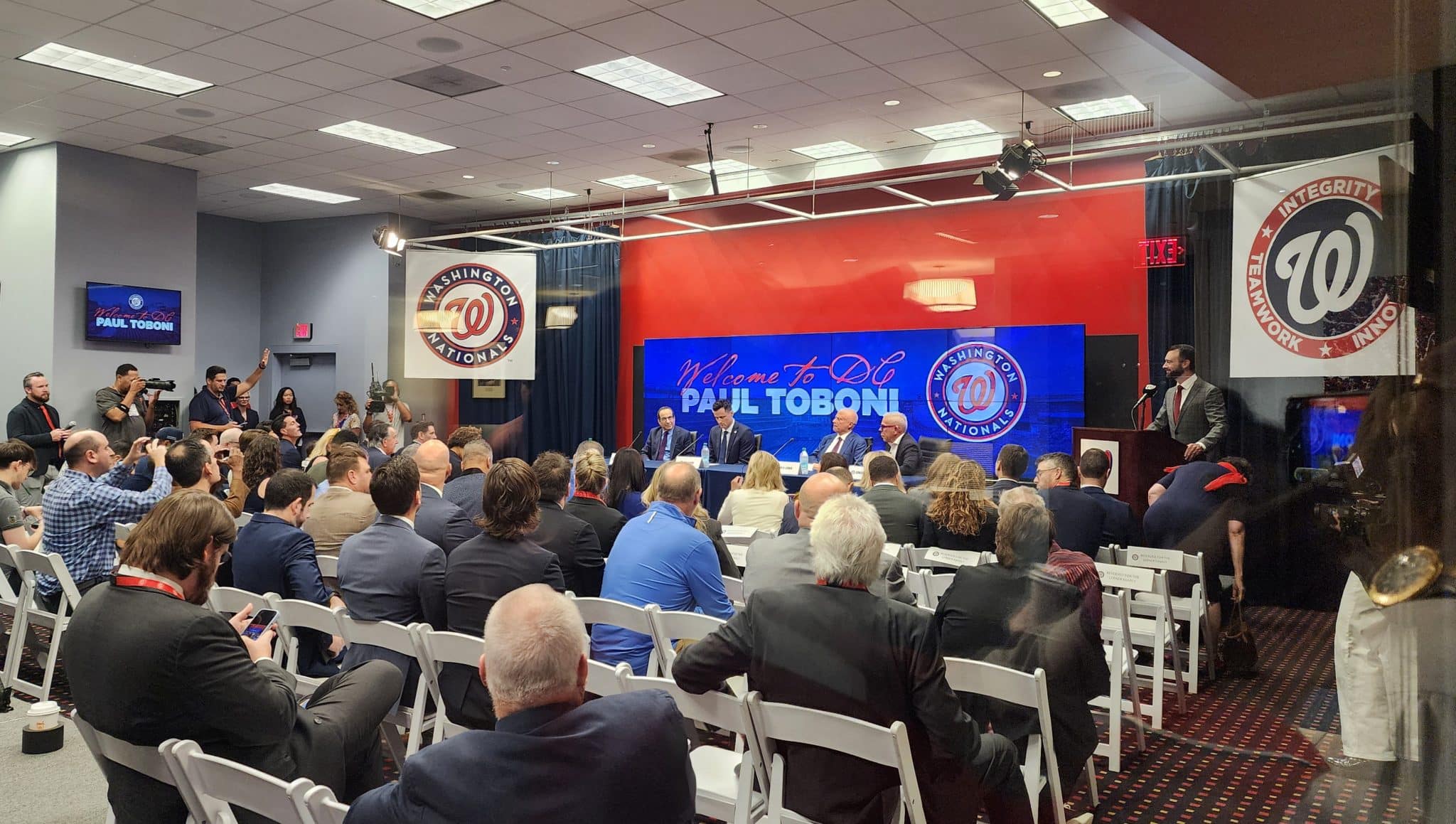

Photo by Andrew Lang for TalkNats
Baseball has a class system like American society of upper, middle and lower. The fuzzy math to get to the narrative is always the same old story that all baseball owners are billionaires who don’t spend enough on payroll — except for the Dodgers. Fans of their favorite teams don’t care what level of wealth you have, they want their owners spending it to improve their teams. There is a level of romanticism in that — but also some delusion.
The problem is that every team, but the New York Mets, seem to run their teams like a standalone business — and they try not to lose money. With a few exceptions, yes there are some owners known to line their pockets with profits derived from revenue-sharing money they receive from the richest teams. That is baseball’s Robinhood approach. It doesn’t work. That has to change in the future. Hence, the upcoming battle in the collective bargaining agreement (CBA) that will expire on December 1 should hopefully amend or eliminate the revenue sharing model if they are able to go to a new construction of parity.
“A lack of a salary cap in the [MLB] has also hurt the bottom line. The NBA, NFL and NHL, all of which have salary caps, boast margins for earnings before interest, taxes, depreciation and amortization, or EBITDA, of about 20%. In contrast, MLB, which does not have a salary cap, has an EBITDA margin of 5%, according to CNBC’s calculations.”
— Mike Ozanian wrote in CNBC
Since only the Atlanta Braves are publicly traded, they are the sole team that is required to post their financial statements. They lost a lot of money in 2024, and made money for 2025 in the same season they hosted the All-Star game. The 2026 season will be a pivotal year to see what their financials look like. For the rest of the teams, we must rely on CNBC and Forbes as both publications do profit & loss estimations as well as team valuations.
The newest crisis in baseball revenues has actually been brewing for years — and that is in the value of team TV broadcasting. The Nationals TV money has been in decline for years now. The number reached a high of only $72 million as a “large market” team then the MASN payout dropped to $58.3 million. Sources say this is going to decline further. Meanwhile, the Phillies are on a long-term deal paying out over $125 million. What the Nats have dealt with for years, sank them to the bottom-5 in total revenues per Forbes, is now hitting most of the league in plummeting TV revenues. But again, some teams locked in lucrative and stable TV deals when the market was good. This has set-up the “haves” and the “have-nots” among baseball owners.
Not all baseball owners are struggling. Some are thriving. The struggling teams will have to rely on attendance and team corporate sponsorships to carry them through these tough times. And commissioner Rob Manfred has made it clear that he wants MLB running all TV by the start of the 2029 season in a system similar to the NFL. TV money is now the great divide in baseball.
Not only will salary caps be a debate in the CBA, team owners will be at odds with each other on TV money. This is the current state of baseball that has separated the upper class even further from the rest. At some point, TV revenues will find its proper level at some point. Until then, revenue uncertainty will affect team payrolls for at least a dozen teams. Half the league, including the Nationals, will have their broadcasts run under this new MLB package.
The same baseball writers who just lost their jobs at the Washington Post clung onto a narrative about the Lerner family, who are the majority owners of the Washington Nationals, that they are rich and need to spend more. It seemed like if a player left for free agency or an employee was fired that money was always the reason. It is never simple as to the reasoning. Well, the second richest man in America per AI, Jeff Bezos, is worth over 50 times what the Lerner’s familial wealth is, and as Alanis Morrisette would sing, “Isn’t it ironic.” Bezos gutted the sports section of the Washington Post, and none of those laid-off people talked about Bezos’ wealth or greed in public.
From my perspective, I’d like to see the Nationals spend a lot more money. Why do I care, it’s not my money — and yes, I am a season ticket holder since the team’s first season. When the late Ted Lerner owned the team, he seemed to spend to get to breakeven, and took some chances that backfired because the big payoffs come when you go far in the playoffs, and even with all of the Nats winning seasons from 2012-to-2019, the team only went past the first round one time. They won the World Series once, and never capitalized on it as COVID wiped out any chance of celebrating in front of fans as the stadium stayed empty the following season in 2020 and much of 2021.
What you learn is that people who want to stay wealthy expect their businesses to make money — no matter the asset value. The same people keep saying the Lerners are rich and the Nationals are worth $2 billion. Yes, both are true. Simple math, lose $100 million annually for 10 years and you just lost $1 billion. It’s not smart to do that unless your goal is to run your team like a hobby.
Yes, the Lerners are rich, and that seems to be a fact. But nobody knows what goes on behind closed doors. They are mainly invested in commercial real estate that has been tanking since COVID, and their baseball team has a gross value of $2.05 billion and per CNBC. They also have a net cash value of under $1.5 billion due to their initial investment in the team. Then there is the issue per CNBC of the enormous debt of 27 percent of their total gross valuation. That would mean they are carrying approximately $553 million in debt. That’s the second largest exposure in baseball by percentage, per CNBC. And while CNBC projected that the Nats made $10 million (EBIDTA) in 2024, the math is kind of simple that after paying the interest on their debt — they lost double-digit ($millions) money.
The Washington Post and the Washington Nationals are alike in many ways. Both have been losing money per reports, and the Post said they made their deep cuts to get them profitable. The Nats can’t really cut anymore, and their revenues have been dropping year over year due to the combination of poor attendance, declining TV revenue, and poor corporate sponsorships. Yes, some of that is self-inflicted, but the MASN debacle KO’d this team even when TV money was booming for everyone else.
None of this is to make up excuses for Bezos or the Lerners. What Bezos did was probably avoidable and a complete failure. What the Lerners have done was really the fault of Major League Baseball for concocting that horrific MASN deal from the beginning. But not finding other avenues of revenue to build this team on the business side was the Lerner’s fault. The team has gone their entirety into their 21st year without a stadium naming rights deal. They took years to get a jersey patch sponsorship completed, and if they measured team approval ratings within their geography — that might not look pretty. Even when the team was winning — the media found plenty of negatives.
Sportico says the Nats are worth $2.25 billion. That is the highest valuation out there. Who knows, you’re worth what someone is willing to pay. Of the four major sports in DC, the Nats are worth the least per Sportico. You would think the Nats would be worth more than the Wizards and Capitals. In fact, the Wizards, per Sportico, are worth more than double what the Nats are valued at.
The mind boggling part is the DC Government is spending nearly $600 million in taxpayer money to renovate the arena that houses the Wizards and Capitals, yet their arena is half the size of Nationals Park. All the Nats have received in renovation money is new LED lights and a scoreboard upgrade. For that, the Nationals pay more in rent than the Wizards and Capitals. Make that make sense? A good guess is that the squeaky wheel gets the grease, and the Nats might have to threaten to leave the city like the owner of the Wizards and Capitals did. Unfortunately, the Nats’ lease doesn’t expire until after the 2037 season. So about 6-to-8 more years before they can threaten anything.
Meanwhile the Orioles in Baltimore have been getting that Maryland taxpayer money for years to use for upgrades. They got a major renovation on their 20th Anniversary in their stadium, back before the 2012 season — but they also had the go-ahead to do the renovations years before that. And now the Orioles are using $400 million of taxpayer money to re-do several parts of their ballpark. The Nats are two years from their 20th anniversary in Nationals Park, and might not get anything. And by the way, the Nats pay more in rent than the Orioles. More irony.
The treatment of the Nats by the DC Government won’t get better because the city just committed billions to bring the Washington Commanders back to the RFK site. Good luck to the Lerners if they think they will get anything but some cosmetic changes to Nats Park. Meanwhile, the Orioles management group were in Washington, D.C. in December at an economic conference trying to get D.C. businesses to buy seats in their stadium while trumpeting their new luxury club that the Maryland taxpayers just paid for. And get this, the WASHINGTON Business Journal expects that new premium luxury club will be sold-out.
The Baltimore Orioles are going hard after Washington, D.C. businesses to support their team. They brought Cal Ripken, Jr. to that economic conference. And per reports, they claim that it worked. Who knows. But good marketing and selling a winning product is a great combination. Now the Orioles lost last year, but signing Pete Alonso and some decent pitching helped sell tickets for sure. The Orioles were also holding fan events around the D.C. Beltway with stops in Bethesda at Montgomery Mall in January as well as other spots in the DMV.
But if you think winning really benefited the Nats, look at this chart and what the Nats spent on payroll and it’s relation to attendance:

Even when the Nats were winning and were in the Top-3 of spending, they didn’t even break into the Top-5 or anywhere close to it in attendance. The 2019 season’s attendance was pathetic to be honest — and the Nats won the World Series. In 2015, the Kansas City Royals beat the Nats in attendance on their way to a World Series win. And 2013 was the high mark for Nats’ attendance in that span, and look at the teams in front of the Nats. In 2015, the team signed Max Scherzer, and they couldn’t sell-out every game — or anywhere close to it, and actually stayed 20 percent below the sell-out level. Third in spending, and 11th in attendance. That seems like a pattern.
History shows that winning brought attendance up on a temporary basis as it fell significantly from 2018 to 2019 after the All-Star game season of 2018. But even signing Scherzer barely moved the numbers up by 1.6 percent over the previous season. It then dropped 5.6 percent the following season as the Nats fell to 14th in attendance for the 2016 season.

Photo by Andrew Lang for TalkNats
The Nats hired a President of Business Operations last month with the addition of Jason Sinnarajah. He recently did an interview with Mike Mazzeo of the Sports Business Journal, and Mazzeo wrote, “[Sinnarajah] plans to work on improving the in-game experience and concessions (via partner Levy).”
“We’ve got to hit our revenue targets, … I need to get involved in; and on the market side, what is the creative, distribution and brand identity and how we’re communicating it out and getting ready, because it’s two months away.”
— Sinnarajah told the Sports Business Journal
Yes, there is a lot work ahead of Sinnarajah, and my best advice to him is that the team has always had a perception issue and too passive on their public relations. When you are winning, the team should be getting positive press. But in both 2015 and 2018, the Washington Post ran stories on what they described as a dysfunctional clubhouse. For years, there were plenty of articles that pushed the narrative that the Lerners don’t spend enough. Well, history showed otherwise in the chart until you hit the rebuild that began to hit the payroll fully in 2023 when the team fell to the bottom-half of spending.
With what could be a work-stoppage after the current CBA expires, expect owners to clash internally. Can 75 percent of the owners agree on a direction? Listen to what agent Scott Boras had to say about the TV disparity in baseball:
MLB and the player’s union have a lot to work-out. But if they can’t fix that 5 percent profit line that will probably fall this year, baseball could be headed for unprecedented trouble.
Leave a Reply