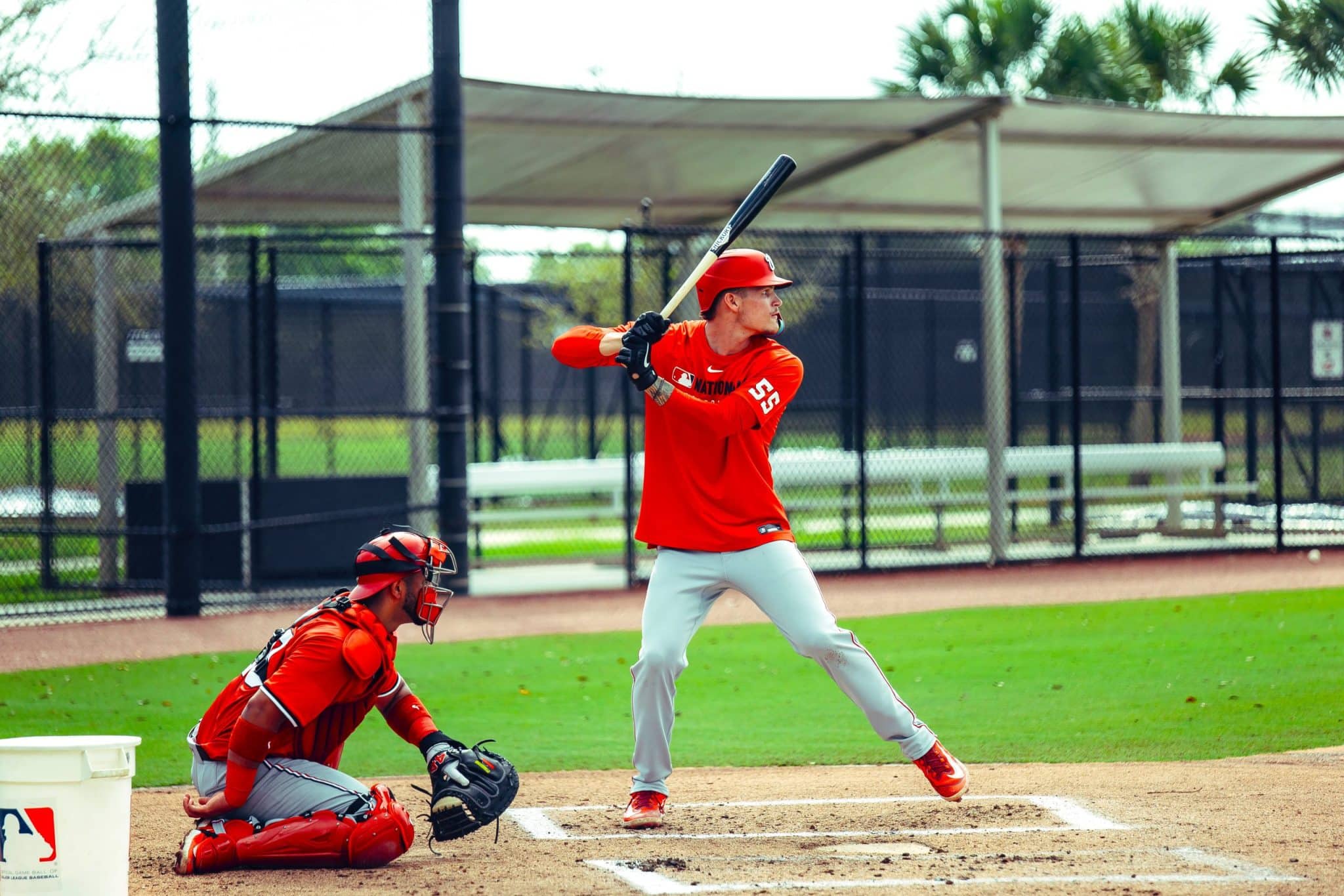

Photo by Bailey Accorto for TalkNats
Baseball is cruel. The game will humble you quickly. On Sunday, Brady House was the talk of the town. Two homers in his first game, and people were crowning him as a star. Then in his second game, Cardinals starting pitcher Andre Pallante did some research on House. The Cardinals put an 0-2 on House with a K and a sawed off double-play ball.
Last year, Pallante faced House three times, and House got him for a single and two outs in-play. Pallante knew that House hit two homers against the Marlins two days before. He also knew that House loves to chase fastballs above the zone and inside as well as down and away. Pallante got lucky on his first pitch to House which was a strike down the middle. Then he went upstairs for a swinging strike and went up there again and broke House’s bat for a tailor-made double-play ball.
Player charts for scouting are available in more detail than what we could pull from Statcast. The charts (below) are more of a sampling of zone coverage. This will give you an idea of where pitchers induced swings and strikeouts on House during his 2025 season.


During House’s 2025 debut season, he had an O-Swing % which measures swings on balls out of the zone at 36.5 percent. While that might seem high, league average is actually 31.8. House was exactly 15 percent worse than league average. Not awful for a first year player.
Does yesterday’s Pallante v. House at-bat portend that he is doomed to be the next iteration of Danny Espinosa and can’t lay-off those pitches? Obviously not. Elite batters often stay below 25 percent on their O-Swing, while higher numbers indicate a tendency to “chase” bad pitches.
House was a -0.3 WAR in his rookie season, and his offense was well below average with a slash of .234/.252/.322 and only a .574 OPS. He comes into 2026 as a question mark, and the great vibes of Sunday had everyone feeling great. Yes, throw a mistake pitch to House, and his 6’4 215 chiseled pounds will make you pay. That shows what House can be with plate discipline.
Everything so far is a small sample size in Spring Training. This is not a time to panic on any player based on six at-bats. But you have to ask the question, can House adjust from what he did last year? Maybe the worst part of that at-bat against Pallante was that the ball out of the hand was even higher than where the ball ended up. They were sinkers, meaning they went lower by design on a vertical plane.
At 50 feet away the eyes have to tell the brain to lay-off that high sinker pitch because it’s not a pitch to swing at. Espinosa was labeled as a “poor disciplined” hitter because he chased those pitches too often. But Espinosa started his career with better plate discipline with an O-Swing of 29.8 percent in his rookie season then worsened to 37.2 percent in his sophomore season.
Espinosa stuck in the bigs because he played a premium position at shortstop, got on-base at a decent clip his first two seasons at .323 and .315 respectively, and his slugging was over .400. That gave him an OPS of over .700 in those first two seasons, and his WAR was very good to start his career. Then everything slipped from there after an injury in his third season. Again, baseball will humble you. His final nail occurred when Dusty Baker became his manager during the 2016 season, and just threw him under the bus. Weeks later Espinosa was traded.
“Well, who else do I have? That’s my answer. If you can give me somebody better, than I can play somebody instead of [Espinosa]. Certain times, you have certain people on your team and that’s what you got. … ”
— Baker on Espinosa in the 2016 NLDS
The great managers demand more, and if they don’t get it — changes will be made. This wasn’t supposed to be an Espinosa discussion. You could actually take the House comparisons to other current Nats’ players like Dylan Crews and James Wood too. They all suffer in their predictive chase zones. Crews chases are similar to House, and Wood chases below his knees. Remember, baseball is a game of adjustments. Can these players adjust from what plagued them in 2025?
For years in D.C., we were treated to the disciplined strike zone of Juan Soto. By not chasing, he forced pitchers to walk him or pitch a ball in the zone. If they missed their spot off the edges, Soto would make you pay for it. That was the Barry Bonds approach, and Tony Gwynn too. The great hitters all had a plan and plate discipline. You need both.
Can the new hitting coaches assist in changing the O-Swing behavior? That is the hope that something can help these players make different swing decisions.
“… Taking a good at-bat, taking our walks, and really owning the zone. … executing the plan that they’re set out for. … We need to own the strike zone. Trim the edges. We’re going to force pitchers to the middle of the plate, and when they go there, we’re going to do some damage. … We don’t want to attack the pitcher’s pitches on the corners because those are pitches that are really challenging to put in-play [with damage]. Laying off those pitches, and to not chase — and force them more to the middle. We get in better counts and raise pitch counts … .”
— New Nats’ hitting coach Matt Borgschulte
In theory that all sounds great. Putting it into practice in a results business is what will matter in the end. As sample sizes get larger, we will be able to judge on the results.
A new Nationals hitting philosophy has been created and shared at every level of the organization in its early stages, and that starts from the lowest rungs of the system to the big league players. It is a collaborative effort with coach and player. Out with the old and in with the new in a system lauded as progressive and innovative. And a pre-at-bat plan and swing decisions are the foundation with good results as the goal.
Leave a Reply