
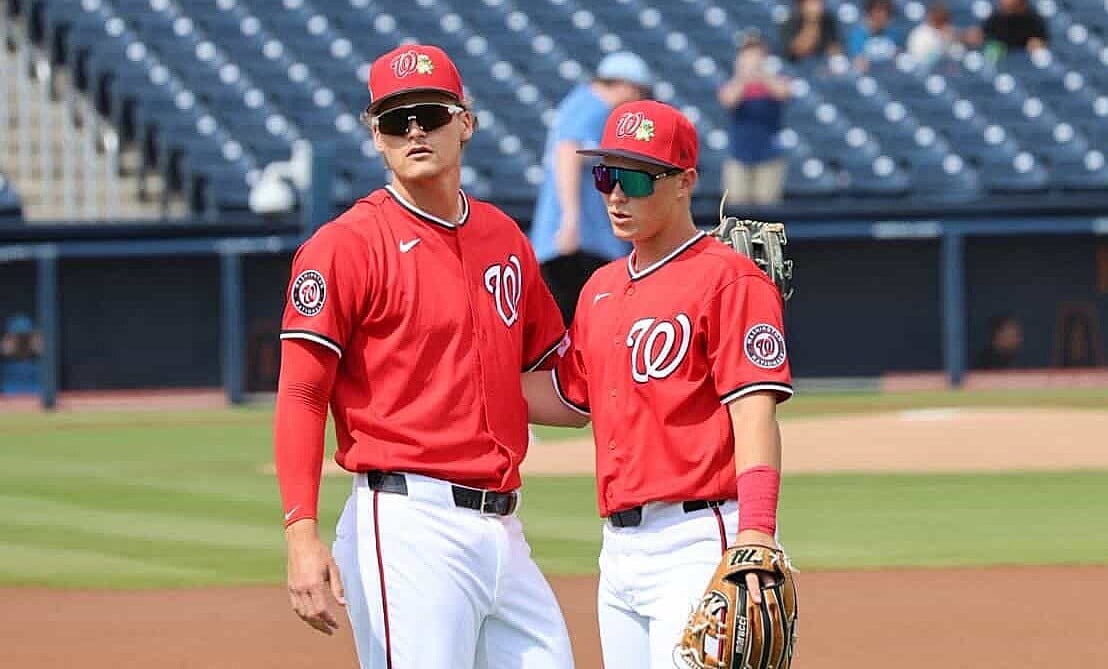

Photo by Nathan Hansen/TalkNats
A statistic that trends heavily towards one extreme is skewed. As a baseball analytics person with a degree from MIT would tell you, “better skewed up — than screwed up.” On one extreme you have Brady House, and on the other you have Dylan Crews. Two sophomores finding a little different type of the luck of the Irish. This doesn’t appear to be a case of Simpson’s paradox.
When statistics are outside a reasonable range, you should analyze the results further. Maybe there is a logical explanation. When analyzed graphically, the skewed numbers can represent an asymmetrical distribution. Try to explain nearly four weeks of baseball in Spring Training with House batting .438 and a 1.363 OPS, and Crews on the other side at a .107 batting average with a .295 OPS.
While nobody believes House is the second-coming of Ted Williams, hopefully nobody believes Crews is a bust. Players with track records tend to regress or progress to the mean. Some call it the back of the baseball card reasoning that a player will reach their normal statistics by the end of the season. For younger players, they reasonably should progress. But of course that isn’t always a guarantee. Baseball can be cruel. Baseball is a game of failure — and those who fail the least are the best in class.
Crews’ BABIP of .158 is a clue that he should be better than his .107 batting average. But the team is at a critical juncture to decide in the next several days if they keep Crews on the Opening Day lineup or decide to send him to Siberia Rochester Triple-A for a chance to slow things down and build up some confidence in a lower stress environment.
A week ago, this type of talk about demoting Crews would have felt like blasphemy. In today’s broadcast, Nats’ play-by-play announcer, Dan Kolko, gave his locks for the outfield and named James Wood, Daylen Lile, and Jacob Young if he is healthy. No mention of Crews. That’s how far things have sunk. Crews has made weak contact, chased pitches out of the zone, and is piling up the strikeouts. He has zero extra base hits in Spring Training.
There is also an additional clue here that the Nats have been playing other players in right field including Wood and Lile, and even Joey Wiemer and Christian Franklin. Playing both Wood and Lile there seems like a divergence in planning with some purpose. A week ago it seemed like blasphemy to suggest a demotion of Crews, but today, this seems like a distinct possibility. When the final roster is set, pick two of Crews, Wiemer and Franklin, and don’t be surprised if Crews is the one left off the final roster. We are just nine days to Opening Day.
That is true that the new front office didn’t pick Crews. That was the previous Rizzo regime. This is the same Dylan Crews who was the first position player selected in the 2023 draft at No. 2 overall out of LSU. The same kid who won every trophy the year he was drafted from The Golden Spikes Award to the Bobby Bragan National Collegiate Slugger Award. Crews didn’t forget how to hit. So what’s the problem? Well, the front office has to figure that out.
We have similar numbers with pitchers. On one extreme you have Cade Cavalli with a 0.00 ERA and Miles Mikolas with a 6.52. Overall, the Nats are the best in all of baseball with a team ERA of 2.97. Even better if you include the 1-run game they held the Venezuela WBC team to as the Nats dominated them in an exhibition game two weeks ago. Yes, the same Venezuela team in the World Baseball Classic finals tonight. That’s how mind-boggling some of the stats are.
On one hand, you want to believe that pitching coach Simon Mathews and his staff are working miracles and turned most of the staff into aces. But we know that isn’t the case across the board. Yes, we hope that they have made improved pitchers. Jake Irvin threw 5.0 scoreless innings today, and we also know that Irvin has been good the past two years to start his seasons.
Again, overall, a lot of these stats are skewed by the competition they have faced. This is Spring Training, and the bullpen pitchers have mostly been facing fringe players and minor leaguers. That’s how it works in Spring Training. When the Nats pitched Rule-5 pickup, Griff McGarry, in the second inning yesterday against some starters, he served up a meatball that got crushed for a long home run. So yes, the competition isn’t anything close to what you will see in the regular season — and even the weather has been a factor with balls blown back.
In smaller sample sizes, there will be weather issues as we see every Spring Training as the wind can affect the game. Here is a prime example of a home run getting blown back:
There are no asterisks to explain what happened to Yohandy Morales‘ stats. That’s what happens in small sample sizes. People will just think he had a very poor Spring Training and batted .059. If he gets that home run, he’s batting .118 or maybe better because he then has more confidence. Baseball is cruel. But how many gusts of wind helped a Nats pitcher and hurt a Nats hitter? This is why process is so important, and why a healthy dose of skepticism has to go into much of the statistics.
Sometimes you can’t explain the statistics.











Leave a Reply