
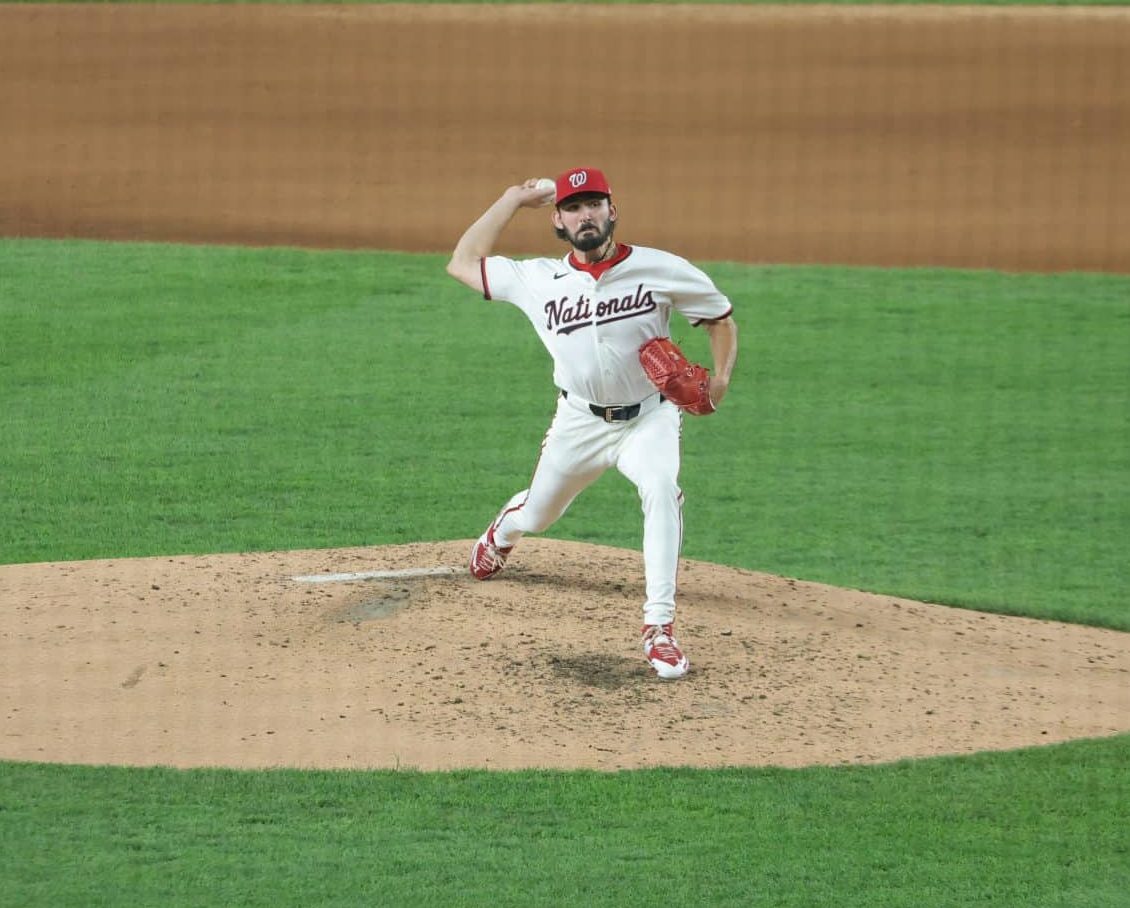
Technically, this year’s bullpen is better in terms of ERA and WHIP if you can believe that. Still, the Nats bullpen has to improve!

Photo by Sol Tucker/TalkNats
Recency bias might have you thinking this is the worst Washington Nationals bullpen in their history. Not even close if you compare the first 55~ innings to other years in Nats’ history. And guess what, the 2019 bullpen was so putrid through their first 55~ innings that they hold the crown as the worst of all of Nats’ bullpens. Even during this small sample size of the 2026 season, the Nats bullpen is ranked as the 4th worst in MLB — not even the worst in baseball. Can you believe that there are three teams that are worse? While that might not make you feel better, all of this is not an excuse, because some teams have great bullpens — and the Nats have to perform better. But if we’ve learned anything in the past: Give it time.
Let’s go through some historical numbers so you can see where some Nats’ bullpens were at similar points in time at their first 55~ innings of each season:

Now let’s add 2005 and 2012 for comparison for that same 55~ innings comparison:

How much of that surprises you? Personally, 2005 was a year that you’d think would have been better to start that season with Chad “The Chief” Cordero and his 1.82 ERA and relievers like Gary Majewski, Jon Rauch, and Hector Carrasco. In the end, that Nats inaugural 2005 bullpen finished as the 8th best in baseball that season with a 3.55 ERA and a 1.360 WHIP. But here is the reason why the numbers were at a 5.30 ERA to start that season. The team had two struggling relievers Antonio Osuna (42.43 ERA) and Joe Horgan (21.00 ERA) who inflated those numbers, and each player was taken off the roster after just a few bad outings. The other relievers were fantastic in that timeframe. It just shows you that bullpens can improve when smart changes are made.
That leads to us to discuss how building a bad bullpen during a contention period will cost you in trade capital and in other ways. In 2013, the Nats signed closer Rafael Soriano to a record contract for a reliever, and the Nats had to forfeit their first round draft pick due to the free agent penalty. In 2015, the team traded Nick Pivetta for Jonathan Papelbon, and then in 2017, they traded Blake Treinen and Jesus Luzardo in a package for Sean Doolittle.
Most teams internally build the bulk of their bullpens, and do it on a tight budget. But the cost of closers in the free agent market is skyrocketing.
Highest-Paid Closers/Relievers (2026 Season Basis)
- Edwin Díaz (Dodgers): $23M AAV ($69M over 3 years) — Joined the Dodgers after opting out of his Mets contract, setting a reliever AAV record.
- Josh Hader (Astros): $19M AAV ($95M over 5 years) — Signed a record-setting deal in terms of total value.
- Devin Williams (Mets): $17M AAV ($51M over 3 years).
- Raisel Iglesias (Braves): $16M AAV.
- Ryan Helsley (Orioles): $14M AAV ($28M over 2 years).
- Robert Suarez (Braves): $13M AAV ($45M over 3 years).
The Braves spent most of their offseason money on their bullpen, and they have by far, the best bullpen in baseball with a microscopic 0.82 ERA. The Astros spent on Hader, and they have the worst bullpen ERA in baseball.
They say that relievers are hit-or-miss, and the Nats know that from 2019 when they signed Trevor Rosenthal and Kyle Barraclough to add them to a bullpen with Doolittle. Last year’s Nats team was terrible, but at least they had Kyle Finnegan, and they promoted a few good arms. The bullpen still finished as the worst group in MLB.
Some fans want to place all of the blame on the Lerner ownership group as to why the bullpen stinks. But last year the Nats had invested nearly $20 million in a bullpen, and they chopped three free agent relievers before the end of May of 2025 if you remember Colin Poche ($2 million), Lucas Sims ($3 million), and Jorge López ($3 million). That was over $8 million dumped onto the DFA pile as they had to replace them with new pitchers and pay double salaries for much of the year.
It is never about how much money you spend — rather it is how you spend it. Sure, we had our eyes on Pete Fairbanks, and that didn’t happen. Did anyone in the media ask President of Baseball Operation, Paul Toboni, why he built the bullpen without a proven closer? He traded away the team’s presumptive closer, Jose A. Ferrer, to Seattle, and signed retreads like Cionel Perez ($1.9 million) and hoped for the best. But manager Blake Butera has missed some key matchup spots, and has left some relievers in far longer than the mandatory minimum number of batters.
Still, you hope Perez can be serviceable, and Clayton Beeter and Cole Henry should be able to close games. PJ Poulin had shown when used in strategic matchups that he can get the job done. And Brad Lord has been used more as a long reliever instead of in setup roles. The team already optioned Andre Granillo back to Triple-A. That leads to why did Toboni trade George Soriano for Granillo? That’s just one of the questions in this odd bullpen construction by Toboni as well as the use and usage by Butera.
There are already several glaring examples of “use and usage” question marks like leaving Henry in for the 9th inning on Wednesday to face the top of the lineup and all of the lefties when Henry already pitched the 8th inning. But then when you have Henry hitting the wall in the 9th inning with 2 outs, you have him face the lefty, Alec Burleson when Poulin was ready? The same goes for Tuesday when Poulin faced four batters over two innings and had two outs with the bases empty and a 3-run lead, why have him face the hot righty hitter, Jordan Walker? You had Gus Varland already warmed, why not go to him? Instead you’ve leaned heavily on both Poulin and Henry and the results by pushing them were not good at all. There are other examples too. The first two series of the season, the matchups made more sense. Every run is crucial and that Walker home run changed everything moving forward in a game that eventually went to extra innings.
You have to fix this on the fly, and possibly get out of your comfort zone if you are Toboni. Starting pitcher Miles Mikolas has a 0.00 ERA in his first innings. Why not move him to the bullpen and have Andrew Alvarez take his spot in the starting rotation. Then you can bring back Mitchell Parker for the struggling Ken Waldichuk. Toboni probably won’t do this, but what about converting Luis Perales and Jarlin Susana to hi lev relievers? Both have been hit hard by the injury bug and could get real MLB experience in the bullpen. Perales is on an innings limit, making this an easier transition. Again, this discussion on converting starters to relievers has always been contentious, and I will say it again, nothing has to be permanent.
Most of the great managers know how to get the most out of their bullpens. During the regular season of 2012, Davey Johnson had Tyler Clippard as his primary closer, and Drew Storen as his second closer. He had Craig Stammen as his hybrid reliever, and Ryan Matheus was often the fireman he called on. The team converted Tom Gorzelanny to the bullpen, and their biggest name in the bullpen was Brad Lidge, and he struggled and was DFA’d in June of that season after a long stint on the IL. He only pitched in 11 games.
❝
— Drew Storen said on the importance of a veteran leader in an interview on the TalkNats Podcast
For me, I had Matt Capps [as a mentor] and Jason Marquis, and you have Livo (Livan Hernandez). … They all had [veteran] experience.
❞
The starting pitching staff for the 2026 Nats has lots of veterans, but in the bullpen, there is no Capps or a Ron Villone who Tyler Clippard said was a mentor to him. Clippard also said that keeping relievers fresh was a key, and that Davey Johnson also knew how to strategically lose and not burn his “A” bullpen. Clippard said Johnson was the best manager he ever had. Storen reiterated that as successful bullpen arms that you need that structure, and they were “routine freaks.”
An oldie but a goodie, FanGraphs wrote two years ago about the Brewers key to building a playoff-worthy bullpen came from mostly internal candidates. That gave them cost-effective pieces. Again, the Nats spent $20 million last year which was more than the Brewers invested, and yet they had a top-3 bullpen. Of course if you cannot replicate what the Brewers put together, you can go the way of the Dodgers and just throw a ton of money at it. But fair to say, the Nats might have been wise to have at least spent money on a closer with experience.
Again, there are ways to pivot to fix this bullpen. We will see what adjustments are made, and expect better days ahead. Will Toboni do it sooner than later or not at all?










Leave a Reply