

Few executives ever turn down money to spend that isn’t coming out of their own pockets. In big business, cash leverage and OPM has been the subject of books. OPM a.k.a. other people’s money is a strategy to boost ROI while also leveraging cashflow. They say cashflow is the lifeblood of a business. Everything begins with careful planning and the budget.
Baseball isn’t like your typical Dow Jones company, and there are vast differences between MLB and the other major sports’ leagues. There is no hard salary cap in baseball. Not spending money in the budget might seem like a failure. Usually you hear the stories of general managers who push the envelope on their budgets and exceed their limits.
Baseball players are expensive. The average of the top 125 salaries in baseball last year was over $22 million. A brain surgeon in Washington, D.C. makes an average of $417,791 per Zip Recruiter. That’s 52 years of work to equal one-year of what a Top-125 baseball player makes on average. Baseball free agent salaries are funny money. It only makes sense within the context of baseball and big sports.
The Washington Nationals, with their seven arbitration-eligible players, have a projected CBT payroll of $110.6 million for today. On Opening Day of this year, the Nats’ payroll was just under $140 million. Effectively on the field, it was under $105 million since the team was carrying dead payroll of $35 million for Stephen Strasburg. For CBT purposes, next season (2026) will be the final year to carry Strasburg’s burden in that calculation.
Within the Nationals boardroom, it is a closely held secret regarding the exact parameters on long-term contracts. Are you allowed to sign a player to a 7-year deal? We know under ex-PoBO/GM Mike Rizzo that he spent over $50 million this past offseason on new deals. And he had no long-term deals on players he acquired. Some guessed that Rizzo didn’t have the greenlight to do long-term deals. Who knows what the real truth is. What he did was sign 11-players for that $50 million. It felt like a typical Rizzo quantity over quality in the moves. The majority of the money was wasted. Nine of those 11-players are out of the organization — and the two that remain ( Trevor Williams and Shinnosuke Ogasawara) aren’t expected to be on the 2026 Opening Day roster.
Rizzo’s starting point was $90 million in existing payroll to start his offseason. Paul Toboni‘s offseason starts $20 million higher than that number at $110 million. Part of the reason is potentially more dead payroll if you think Williams and Ogasawara won’t pitch this year for the team. That’s nearly $9 million and add another $6.25 million to that figure, if Keibert Ruiz doesn’t play again.
Just giving Toboni the same $50 million had to spend as Rizzo would push the total spending up $20 million to $160 million. And really, you probably want about $70 million to put a winning team on the field and buy your way to 82-wins. Within that $70 million, you’d also want the ability to sign at least one long-term player. But will the Lerner ownership group agree with that? Will Toboni even want to go long-term?
Prior to the 2011 season, Jayson Werth said, “Yes” and took Lerner’s money. But since Strasburg’s 7-year $245 million deal was signed before the 2020 season, the Nats only known long-term offer was for $440 million to Juan Soto in the 2022 season.
Yesterday, we published an article of how some of us would spend $50-$60 million of Lerner’s money. We all wanted a long-term players signed. Getting a player to say, “Yes” like Werth is never a given. The situation feels similar though to 15 years ago. A newer head of baseball operations coming off a losing year. Okay, Rizzo had two years at the helm of the Nats when Werth was signed. Toboni hasn’t even had two months under his belt. But the amount of wins between 2010 and 2025 are similar when you consider they were at 69 and 66 wins respectively.
Somehow the late Ted Lerner and super agent Scott Boras came to terms in 2010 on that Werth deal, a mega 9-digit contract at the time — and Werth was 31 1/2 years old when he signed. Alex Bregman, also a Boras client, is the same age as Werth was at the time. Using inflation in baseball dollars to present value, we are also talking similar projected money — especially if Bregman gets a 7-year deal like Werth received at the time.
The best way for the Washington Nationals to improve would be to internally improve the current players on their roster if you believe they under-achieved. And many think that is exactly what happened. Toboni believes it begins in finding great players but also having great coaches, “I believe in the power of great coaching.” Toboni’s belief starts with great coaching and in turn that his players can find an extra gear.
“I feel great support. Is it easier to win if you’re spending a lot of money in free agency? … Yes, that is objectively true. To us, the cleanest path to winning — and creating a sustainable winner is: identifying, acquiring, and developing talent. Regardless of what our payroll is, you have to dominate that to be a contender deep into the playoffs.”
— Toboni said on October 2
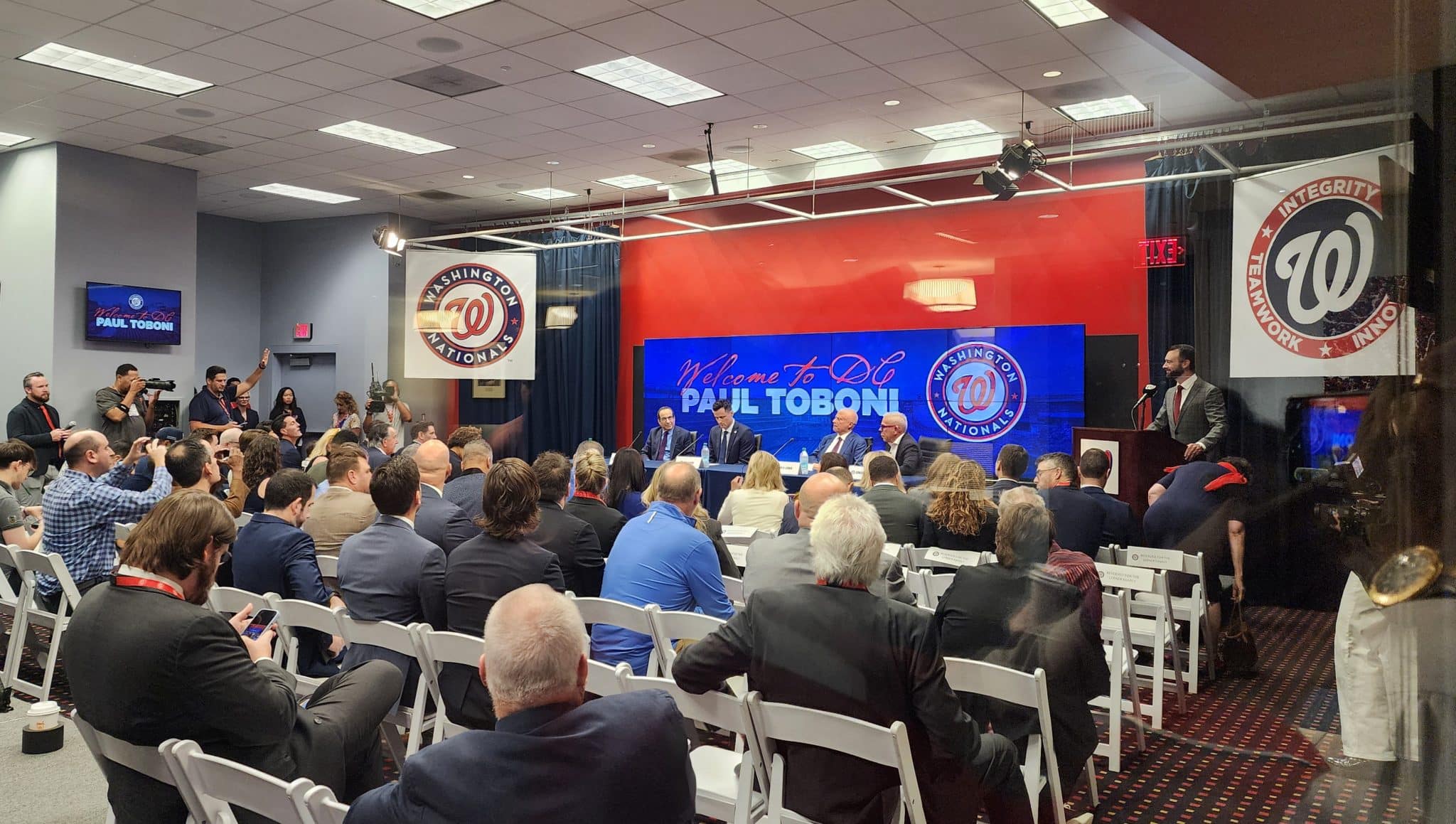
But what if Toboni doesn’t believe this is the right time to spend? The day of his introductory presser, he certainly left Chuck Todd, former moderator of NBC’s Meet the Press, to tweet us this:
The GM Meetings open this week in Las Vegas. Toboni will be the top Nats’ representative there since he currently doesn’t have a general manager. What he does or doesn’t do will mostly be an unknown at this point, as little percolates to the surface. His actions, in the end, will speak louder than words. He said at his introduction on Oct. 2 that he didn’t even know what his budget was going to be.
With some creative cashflow management on new acquisitions, the team could take advantage of backloading some contracts while circling the 2027 season as one to frontload money in case there is a lockout. Again, cashflow is a key.
Time will tell on this — a lot of the story. We never get the full story. In the meantime, fans just want a team that they can cheer for and have the belief that they can win.









Leave a Reply