
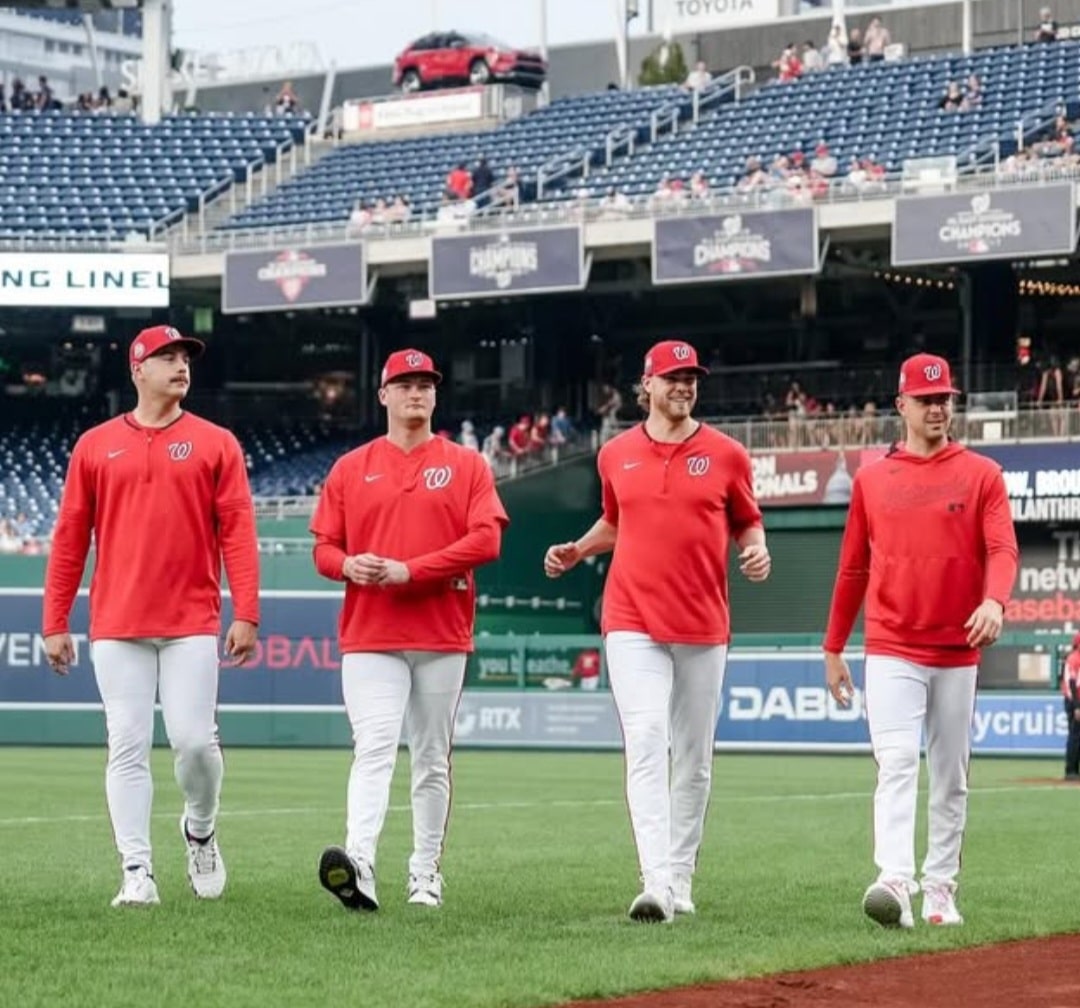

The Washington Nationals starting pitchers as a group escaped being the worst in baseball only because Colorado pitches half their games in the highest altitude in baseball. With a combined ERA of 5.18 and that placed the Nats’ starters at 2nd from last in MLB.
Who will be the Nats starters named on Opening Day of 2026? That is a great question, and President of Baseball Operations, Paul Toboni, doesn’t even have that answer right now. At least we know that Toboni named starting pitching as his top priority in the offseason.
If we want to honestly talk about the starting pitchers, we have to talk about the team defense (second worst in MLB) as well as the catchers (worst in MLB). If we peel back the onion, what we find is that the starting pitchers were the fifth worst in baseball if neutralize the defense using the FIP stat. If you dig further into the process, maybe use and usage along with the bullpen were contributing factors to the failures.
Manager Blake Butera has named Simon Mathews as his new pitching coach to replace Jim Hickey. If you want immediate improvement in your pitching staff, pair up the pitchers with competent catchers and at least a league average defense in the infield and outfield. By doing that, you just improved your ERA from 5.18 to 4.62 with little effort. That’s over a half run per 9.0 innings.
❝… We’re going to be really open-minded [on offseason signings]. I don’t think you can ever have enough pitching. … We’re going to see how it plays out, and what opportunities present themselves.❞
— Toboni said this week at the GM Meetings in Las Vegas
Again, this isn’t rocket science. It is commonsense. Toboni believes he has added better coaches. Fix the defense and catching. Now, can you add better pitchers to the mix? There’s the million dollar question. A 4.03 team ERA was the MLB middle in 2025 for starting pitchers. The Nats only had one starter at or better than that number, however if you go by FIP both Andrew Alvarez and MacKenzie Gore were better than 4.03.

Of the nine Nats’ starters used in 2025, Jake Irvin was the workhorse of the staff at 33 starts and 180.0 innings. But his 5.70 ERA won’t cut it on a team that wants to be taken seriously. Is his arm ruined or is there something there that can be fixed? Irvin’s average fastball velo dropped from 93.9 mph in 2024 down to 92.4 mph this year. That’s a 1.5 mph drop and troubling for a 28 year old pitcher who is arbitration-eligible with a projected price tag of $3.3 million.
Some would say that Gore, a 2025 All-Star, was the team’s best starter. Depending on how you subjectively judge that, of the full-time starters, Gore was the best, but he was certainly inconsistent. Great at times, and disappointing at times. He allowed his bad defense, some bad umpiring, and other extraneous factors affect him on the mound. When you have the worst catchers based on framing pitches, you will lose some legitimate strikes. Maybe the new ABS challenge system will help Nats’ pitchers. It isn’t a full-time system, just a limited challenge system. Objectively, the Nats received the fourth worst ranking in baseball over the past five years in bad calls. So you aren’t imagining it. As pointed out, it’s overall impact of when the bad call was made. A 3-2 pitch that is botched can change a game.
Back to Gore, the rumors are swirling that he could be traded. With two years of team control remaining, it isn’t crucial to trade Gore at this point in time. Now if you can get a Garrett Crochet type of haul for him, then you should probably move him like the White Sox did a year ago with Crochet. But you don’t trade Gore unless you’re blown away by a trade package offer. The Nats will get three more bites at the apple if they don’t trade Gore this offseason, right? You could trade him at the July 31 trade deadline, a year from now, or even the 2027 trade deadline. What’s the rush?
So we can’t assume that Gore will be on the Nats’ 2026 Opening Day starting rotation. Who are the other candidates? You have Cade Cavalli, Alvarez, Brad Lord, Josiah Gray, Mitchell Parker, and Irvin. Possibly even one of the Nats’ top pitching prospects, LHP Jake Bennett, could factor into the rotation. He is №6 on Baseball America‘s rankings that were just published. Out with injuries are Trevor Williams and DJ Herz. Both could factor into the mix at some point in the 2026 season. Gray hasn’t thrown a pitch in the Majors since April of 2024. We have no idea what he has in the tank. And we talked about Irvin’s issues already. Lord was used as both a starter and a reliever in 2025 during his debut season. Add to that, Parker was relegated to the bullpen in September. That leaves us with a bunch of question marks.
Further away are Travis Sykora and Jarlin Susana as the Top-2 pitching prospects in the Nats’ system. But neither are healthy as they both had surgery this past season. Sykora with TJ surgery on his torn UCL, and Susana had an upper latissimus dorsi tear. If you watched the Baseball America video on the Nats’ top prospects, you might think the world is ending.
Here is a lengthy list of all of the free agent starting pitchers ranked by their FanGraphs WAR for 2025. Each player’s 2026 seasonal age is included in parentheses next to their names with their 2025 ERA. The ordering is based on their WAR over the past two seasons:
Dylan Cease (30 years old, 3.4 WAR, 4.55 ERA)*
Framber Valdez (32, 4.0, 3.66)*
Ranger Suárez (30, 4.0, 3.20)*
Nick Martinez (35, 2.1, 4.45)
Chris Bassitt (37, 2.4, 3.96)
Michael King (31, 0.8, 3.44)*
Shota Imanaga (32, 0.9, 3.73)*
Zac Gallen (30, 1.1, 4.83)*
Merrill Kelly (37, 3.1, 3.52)
Zack Littell (30, 1.5, 3.81)
Patrick Corbin (36, 1.9, 4.40)
Erick Fedde (33, -0.2, 5.49)
Justin Verlander (43, 2.2, 3.85)
Zach Eflin (32, -0.3, 5.93)
Miles Mikolas (37, 0.3, 4.84)
Nestor Cortes (31,-0.9, 6.29)
Adrian Houser (33, 2.3, 3.31)
Tyler Mahle (31, 1.9, 2.18)
Lucas Giolito (30, 2.0, 3.41)
Andrew Heaney (35, -0.3, 5.52)
Michael Lorenzen (34, 1.2, 4.64)
Jose Quintana (37, 0.8, 3.96)
Aaron Civale (31, 0.9, 4.85)
Chris Paddack (30, 0.7, 5.35)
Brandon Woodruff (33, 1.8, 3.20)*
Tyler Anderson (36, 0.1, 4.56)
Michael Soroka (28, 1.1, 4.52)
Jon Gray (34, -0.4, 7.71)
Martín Pérez (35, 0.8, 3.54)
Griffin Canning (30, 0.9, 3.77)
Chris Flexen (31, -0.3, 3.09)
Marcus Stroman (35, 0.1, 6.23)
Max Scherzer (41, 0.4, 5.19)
Austin Gomber (32, -0.4, 7.49)
Cal Quantrill (31, 0.4, 6.04)
Dustin May (28, 0.8, 4.96)
Paul Blackburn (32, 0.2, 6.23)
Jordan Montgomery (33, 0.6, 6.23)
John Means (33, N/A, N/A )
JT Brubaker (32, 0.4, 3.77)
Alex Cobb (38, N/A, N/A)
Germán Márquez (31, 0.3, 6.70)
Tomoyuki Sugano (36, 0.1, 4.64)
Ryan Yarbrough (34, 0.1, 4.36)
José Ureña (34, -0.1, 4.58)
José Urquidy (31, -0.1, 7.71)
Tony Gonsolin (32, -0.1, 5.00)
Kenta Maeda (38, -0.2, 7.88)
Mike Clevinger (35, -0.2, 7.94)
Kyle Hart (33, -0.5, 5.86)
Wade Miley (39, -0.1, 6.75)
Walker Buehler (31, -0.4, 4.93)
Anthony DeSclafani (36, -0.1, 5.12)
Drew Anderson (32, N/A)
Kohei Arihara (33, N/A)
Foster Griffin (30, N/A)
Tatsuya Imai (28, N/A) — could be posted by NPB club
Anthony Kay (31, N/A)
Cody Ponce (32, N/A)
Kona Takahashi (29, N/A) — set to be posted by NPB club
*Received qualifying offer (players have until 4 p.m. ET on Nov. 18 to accept).
To honestly answer who the Nats starting pitchers will be on Opening Day in 132 days is far from set in stone. That’s the answer. Tell us who Toboni acquires this offseason, and we find a little more clarity. Maybe we can give you two names with Cavalli and Lord. Maybe we can give you three names if Gore isn’t traded. This discussion will be ongoing for the next 132 days until the Opening Day roster is published for March 26, 2026.










Leave a Reply