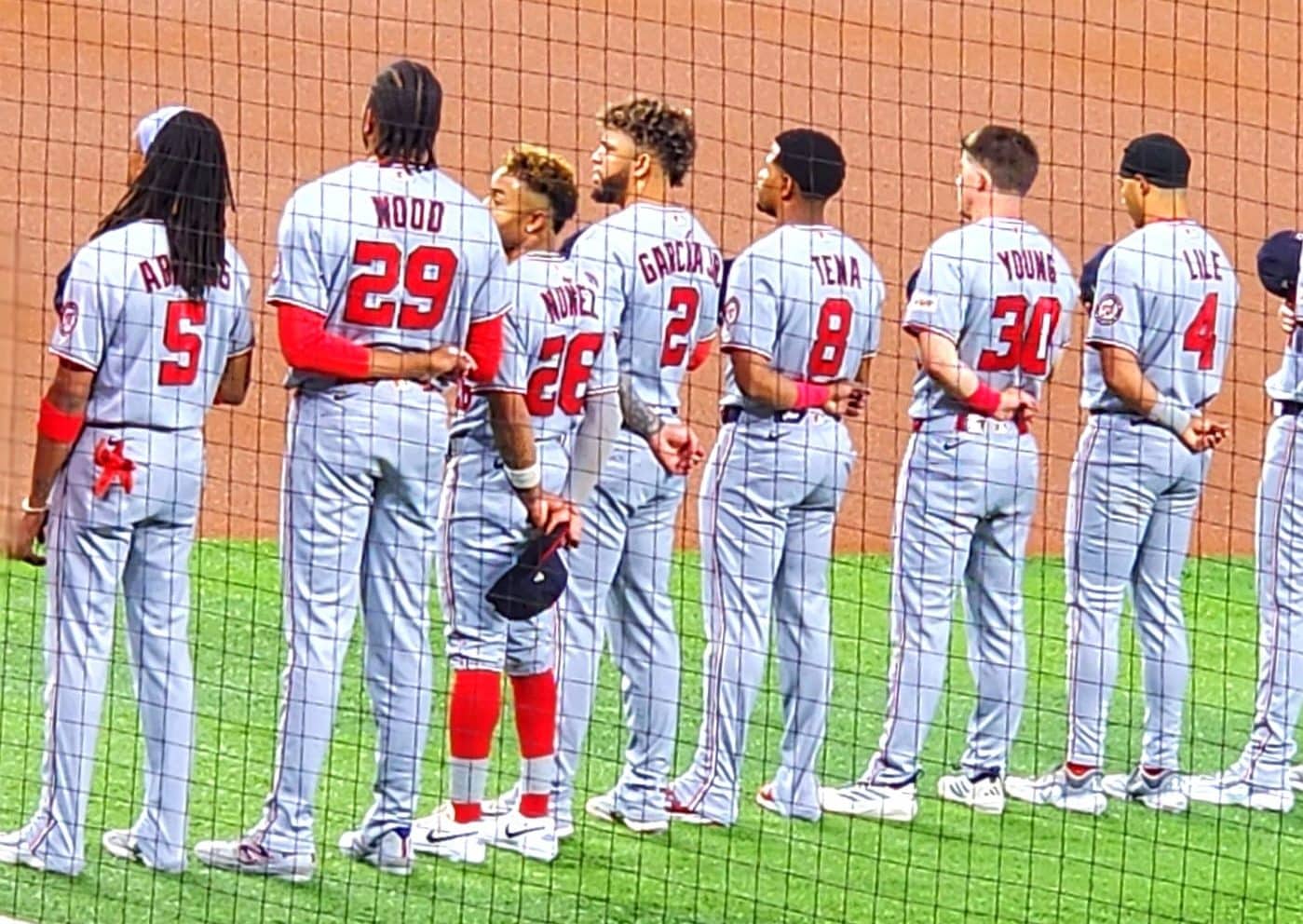

Photo by Andrew Lang/TalkNats
Team sports generally require most of the team to play well to result in a win. In 1964, Ken Johnson of the Houston Colt .45s became the first MLB pitcher to throw a 9-inning no-hitter and lose. The Washington Nationals had a 6-inning team shut-out going that unraveled quickly in the 7th inning. A groundball to shortstop resulted in an infield hit followed by a walk, a single past the first baseman, and a bunt single that resulted in a blown save and a 2-1 deficit for the Nationals.
In the clutch, CJ Abrams tied the game as he homered in the next inning off of bullpen stud, Robert Suarez for a blown save. In the 10th inning, Abrams picked his team up again and tripled home two more runs. It should have been enough. And should have been more with Abrams standing on 3rd with just one out — the Nats needed a productive out at the very least to score Abrams. That would have won the game if the Nats scored that extra run because in the bottom of the 10th inning, the Braves scored two runs to push it to the 11th inning when they won it on a 2-out single.
There are people who say that when you lost by 1-run that you didn’t lose due to just one run. They say you needed to score two more runs to win the game. But that isn’t accurate in all situations. The value of just 1-run often changes a game. If the Nats scored just one more run in regulation, they win that game. If they scored one more run in that 10th inning, they win that game.
Last night in the loss, the Nationals were an horrific 1-13 with RISP (runners in scoring position) in the game with the Abrams triple as the only hit in that situation. They had multiple opportunities including a chance to win without a hit — just a productive out with a runner on third base and less than two outs.
Even though the Nationals lead all of baseball in runs scored, they have been very middle-to-bottom of the heap in situational hitting on average. We have been pumping this theme literally for weeks and sounding the trumpet. Some players live for the clutch moments and others shrink in those moments. And not to single out Jorbit Vivas, but come on, he’s 0-for-22 in RISP spots. And it’s not just Vivas, there are five players who are hitting under Mendoza in RISP spots.

Some players live for those RISP spots. Those walk-off moments. Those clutch cameos. Others not so much. Whatever Daylen Lile had in Cincinnati, he needs to replicate in Washington, D.C. His stat line at .167 would be .140 if we didn’t include him dominating near his hometown. On the other hand, Luis Garcia Jr. has been one of the best hitters in clutch spots, and Keibert Ruiz has the second highest RBI rate on the team in RISP situations.
The Nationals lost back-to-back one run games mostly due to poor situational hitting. Combined on Thursday and Friday, the Nats were 1-21 in RISP situations. Seems strange that a team can lead in runs scored but stink in situational hitting — and the full story is that they score plenty of runs in RISP spots — and that’s because they give themselves many more chances than the average team. They have a knack for getting in scoring position — they just have to be better about getting a high percentage of hits in those situations.
“Everyone always talks about pressure, pressure, pressure.”
— Derek Jeter was considered a clutch player
“But if you’re not thinking about yourself, you’re thinking about how you can help your team win…it takes a lot of that pressure off.”
Would you rather have a hitter with a .250 batting average up to bat in a RISP spot or a .220 hitter? But what if that .250 hitter only knocks in an RBI in 21.8 percent of the situations while the .220 player converts RBIs at a 36.6 percent pace? Or do you go situational lefty on righty or righty on lefty late in games regardless? Manager Blake Butera pulled arguably his hottest hitter this week, Jacob Young, twice in key spots for pinch hitters. Not only did he lose his best defender, but he removed his best home run hitter this week. Neither move worked, and in the process last night, Butera lost his DH because Wood had to play the outfield.
Would Young have thrown out the game-winning runner if he was in center field? Maybe if you consider that he threw out a tagging runner from third base at about the same distance, maybe he does. Young has 12 outfield assists in his career — and while his arm strength (85.7 mph average) is just above league average for center fielders this year, his max at 94.2 mph is actually the 14th best in baseball. Here is the video link of the Crews throw.
Baseball is a game of inches. It’s also a game of who plays better. Who steps up and who shrinks in the moment. Twice, a less-known player, Chadwick Tromp, had key hits in extra innings for the Braves and hit the walk-off single in a 2-strike count. That’s clutch.
Leave a Reply