
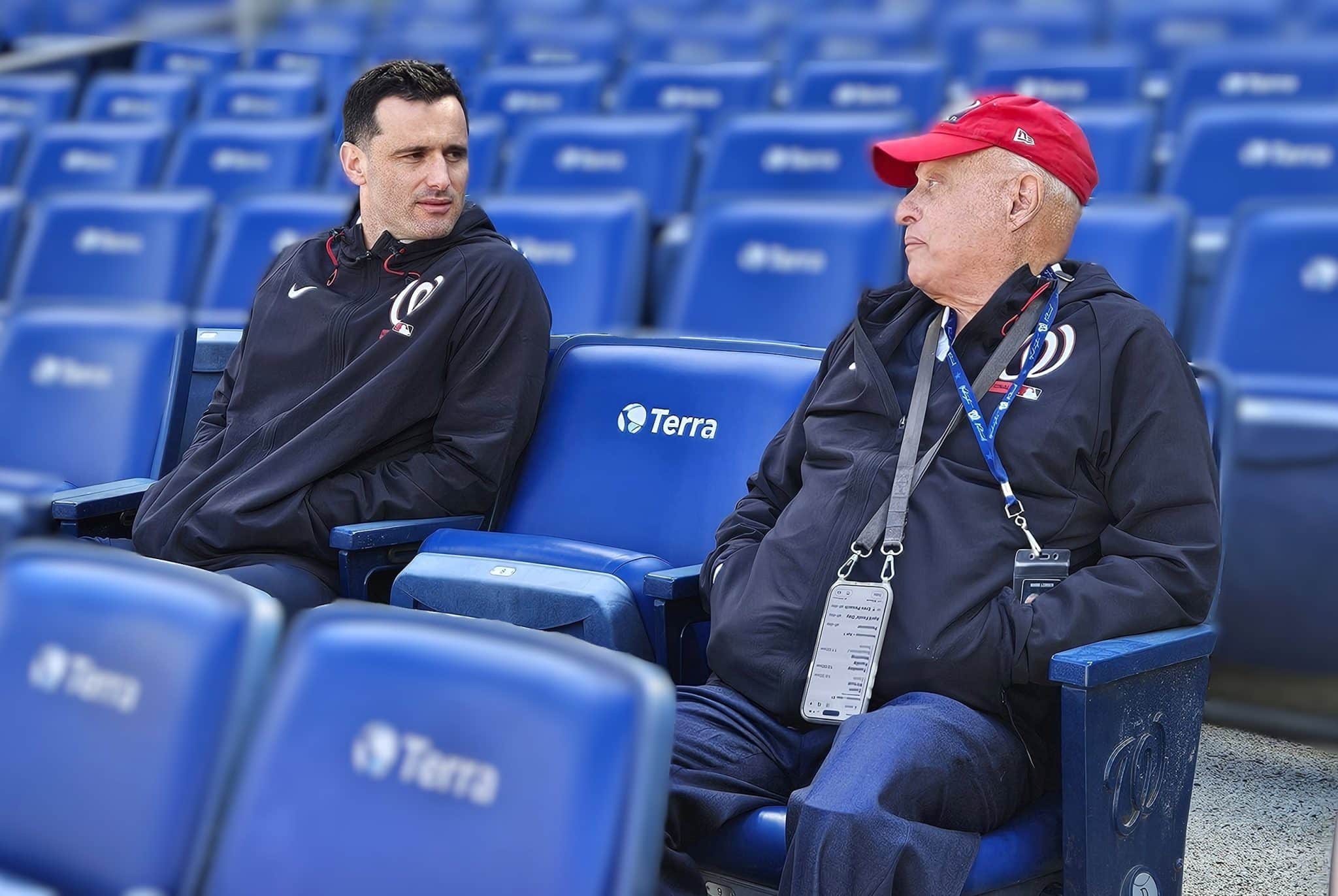
Photo by Intrepid/Nats.Talk
Few people realistically expected the Washington Nationals as a contender in 2026 as the clear thinking from the analysts going into the season was that this was a rebuild of the failed rebuild from the prior regime. Now with the Nats sniffing at a wild card berth, will ownership respond to this success?
Fans of the Nationals have wanted to see the Lerner ownership group wake-up and open their wallets with a large financial commitment and a long-term signing. Since the team didn’t do that in the offseason with any sizeable free agent signings, the team can take any of their core players -or- even a short-term stand-out like pitcher, Foster Griffin, and agree to an extension.
What would a deal like that cost now? We figure $15 million a year for three years seems to be in the right zip code. That would be financial freedom for Griffin. Wait longer, and that price will just go up.
On Sunday, team president, Paul Toboni, appeared on The Front Office show on MLB Network Radio, and was straight up asked if he has engaged in extension talks with young stars like James Wood or CJ Abrams. After an awkward pause, Toboni responded, ❝Those are conversations that we will keep internal.❞
The complications with a Wood and/or an Abrams extension is that the team has probably waited too long and almost certainly should wait for a new CBA. The issue going back to the prior front office is that you cannot wait for players to prove they are stars — you extend them when you believe they will be stars.
And besides all of that, Wood is tethered to the Boras agency, and their reputation is that they rarely will do an extension with a player as they prefer to get into open-market bidding in free agency. There are exceptions to that like Stephen Strasburg‘s deal with the Nationals that he quickly opted-out of and chose free agency after the 2019 World Series season, but that extension was rare for a Boras client.
What about Abrams? He is already making millions in arbitration. What incentive would he have to do an extension? Abrams is repped by Roc Nationals Sports. There were even rumors that the Nats discussed an extension during Spring Training of 2025 and nothing got done. In fact, if you go back four years ago, my suggestion in an article on the subject was to extend Abrams back in 2022. Many disagreed with me at the time. Now you all wish it was done. Foresight is the key. Hindsight is easy.
In my writings, I’ve only suggested six early extension candidates: Ryan Zimmerman, Strasburg, Bryce Harper, Trea Turner, Abrams, and Wood. But now, do you look at other players since Abrams and Wood would be a challenge to extend? Most likely the Nationals would have to look to Griffin, Cade Cavalli, Daylen Lile, and Jacob Young for an extension.
Remember, “it takes two to tango,” a common saying from former Nats’ GM, Mike Rizzo. And the team went down that road with Juan Soto in 2022 and offered him $440 million reportedly — the largest offer ever to a baseball player (at the time), and Soto reportedly turned it down. Hindsight says Soto was smart to do it since he eventually signed the largest deal in baseball history. You can hear Rizzo speak to the Soto offer:
Griffin, like Young, is repped by Excel Sports Management. Lile is repped by Evolv Sports Management, and Cavalli is with CAA. None of them are Boras clients.
Now, also keep in mind that the prospect pipeline in the Nats’ system is loaded with shortstops and middle infielders. Start with Seaver King, Devin Fitz-Gerald, Ronny Cruz, and Eli Willits. They are all Top-100 prospects. That might be a reason to just enjoy the remaining time with Abrams and strategically deal with his team-control through the 2028 season. By the way, Wood is controlled through at least the 2030 season — and there really is no equal to him. He is a local DMV resident growing up in Montgomery County, Maryland. He would be the top choice if you go big!
The Proposed CBA
There is a slight complication in getting too aggressive in extensions and that is the collective bargaining agreement (CBA) that expires after the season. But if the players somehow agree to a hard cap — it would certainly include a hard floor too. A floor would almost force teams like the Nats to start spending to where many thought they should have been as a team in a large market.
But truth be told, the Nats are a bottom-5 revenue team. The good news is that the new CBA would also create parity in revenue with local TV funds spread evenly. That would be exactly what the Nats need to increase spending since they had been exempt from the current CBA’s revenue sharing program.
Moving Forward
The Nats have an opportunity, even with a possible CBA lockout, to tie up young players and get ahead of the new cap. Obviously if there is a lockout, no salaries will get paid to players. But imagine how much easier it would be to sell stadium naming rights and other partnerships if you could point to larger attendance.
Again if Lerner wants to change his reputation, extend a player and show the fans you are willing to spend some long-term money.












Leave a Reply