
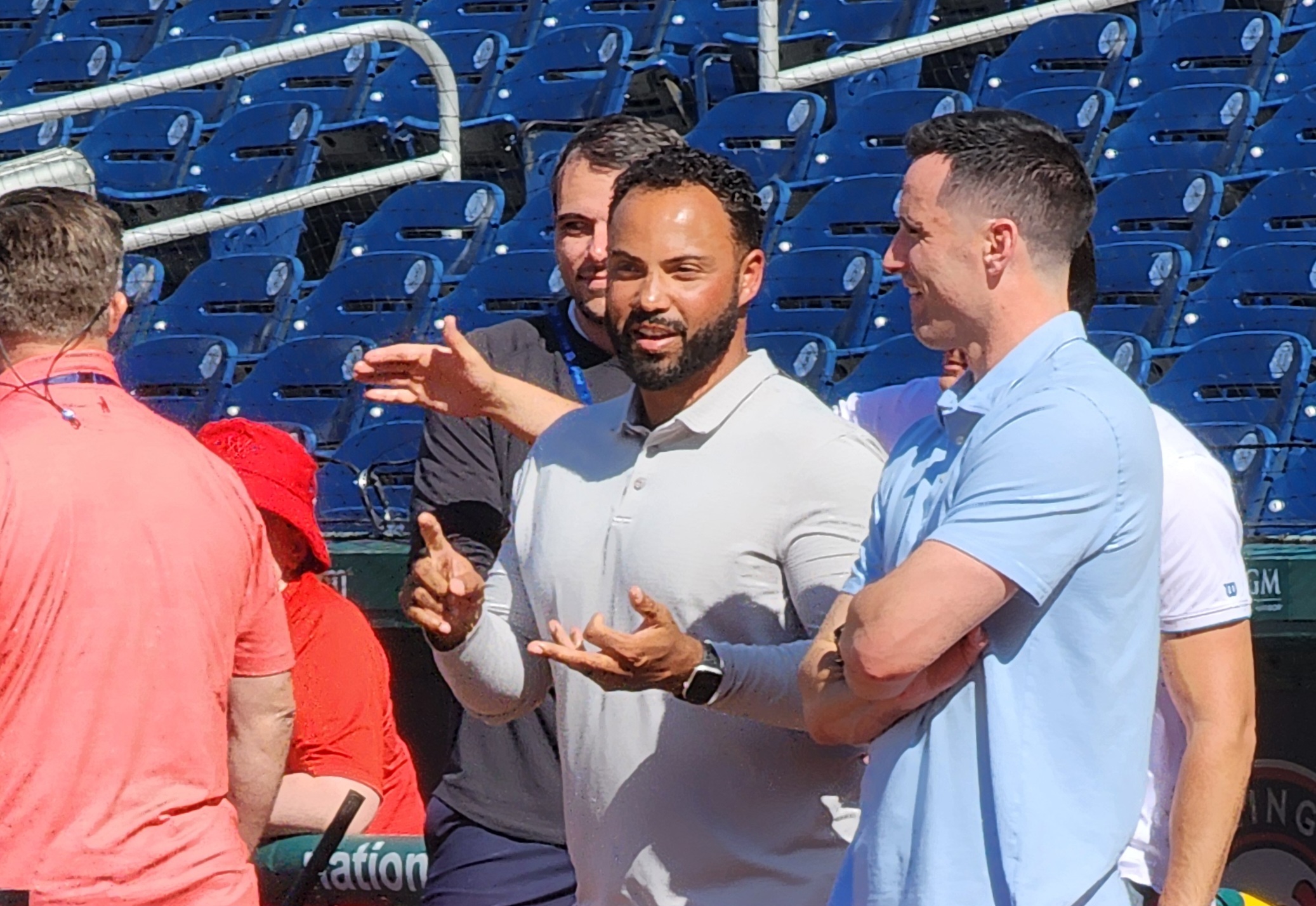
Photo Andrew Lang/Nats.Talk
What a vision by President of Baseball Operations, Paul Toboni, of the Washington Nationals to have a draft group that not only includes his entire draft personnel — but also his top executives from player development and pro acquisitions. Toboni wanted VPs, Devin Pearson and Justin Horowitz, giving input respectively from player development and pro acquisitions perspectives into the draft picks. Pearson has to make sure that his PD group can develop scouting director Desmond McGowan‘s choices into star players. In that photo above is Pearson and Toboni with McGowan and Horowitz in the background.
Toboni also said that they have 11 names leading into that pick the Nats hold at №11 in the first round. But clearly you can cross off Roch Cholowsky, Grady Emerson, Vahn Lackey, Jackson Flora, Jacob Lombard and the other locks in what seems to be players who will be gone in a consensus Top-7. But what if a player like Tyler Bell and Gio Rojas aren’t chosen in the Top-10? Those are our Top-2 names as we hope at least one of them to be available.
The issue will be the names picked before №11. The only team with certainty is the one choosing at №1 overall like the Washington Nationals last year when they got Eli Willits.
The name most closely linked to the Nats is Chris Hacopian who happens to live in DMV in Potomac, Maryland. He was almost college teammates with Seaver King as Hacopian was committed to Wake Forest. Instead, he decommitted from Wake and chose the University of Maryland and was instantly their best player after former first rounder, Matt Shaw, of the Cubs in 2023 left the vacancy for Hacopian. After the 2025 season, Hacopian chose to transfer to Texas A&M. What was troubling is that his batting average and power both dropped off. Some say it was due to a back injury. Or was it the competition of going from the Big-10 to the SEC or something else? While a .319 batting average sounds great for pro baseball, that wasn’t even Top-40 in the SEC nor was his .983 OPS that didn’t even crack the Top-50.
Possibly more troubling was Hacopian’s Cape Cod League 2025 season. We know from last year’s draft what Ethan Petry did in the Cape in 2024. In fact, Petry played on Yarmouth-Dennis just like Hacopian — just a year apart. Petry put up gaudy numbers as the MVP with a .360 batting average and a 1.240 OPS with the wood bat. Hacopian only hit .258 and a poor .697 OPS. Petry was the Nats second round pick last year. Hacopian is ranked as a first rounder.
Maybe the draft gurus see something else in Hacopian. I saw him play live in college. Good bat to ball skills with a low K rate — but he just didn’t look like the best player in some of the games we saw.
Look, the Nats seem to like Hacopian from what we’ve heard. He almost certainly is in the Nats Top-11. But who else do the Nats have ahead of Hacopian?
Every year there are 5-to-6 busts in the Top-15. Look at the 2018 draft for instance. The best performing pick from that Top-15 is Logan Gilbert who was picked at №14. Both Nico Hoerner and Brice Turang were picked after Gilbert in the 20’s.
One of the best №11 picks in baseball history was Max Scherzer. And Andrew McCutchen and George Springer were picked at 11th overall. And so was Brady House in 2021. Nobody expected he would be unpicked at that point.
While the Nats might think they can fix Hacopian, is there a McCutchen or a Scherzer who will be overlooked? The top prep pitcher is Rojas, and the big lefty from Stoneman Douglas High School led his team to a Florida High School championship several weeks ago. We got an exclusive interview with him. What a story of how he got to Stoneman Douglas. He wasn’t always 6’4 with a big left-handed arm. He needed better competition so his family moved in 2023 from Colorado to Parkland, Florida after his first year of high school. A perfect match with coach Todd Fitz-Gerald who coached him the past three years — and each year they won the state championship.
Rojas led Team USA to a gold medal at the WBSC U-18 World Cup, pitching 11 scoreless innings last year. His complete game shutout against Korea led to his All-World Starting Pitcher honors. He throws 3-plus pitches, fastball clocked in the upper 90s, a great changeup and slider. He just turned 19 and models his game after Chris Sale. You have to like that three-quarter delivery that gets that left-to-right movement on the slider just moving away on lefty batters.
Maybe it shouldn’t be surprising that Rojas has never been to Washington, D.C. as he told us. He got to travel a lot with Team USA and certainly for showcases and travel ball.
“I haven’t been to Washington, D.C. I would like to make a trip there though.” — Rojas told us
When I asked Rojas if he would like to pitch for the Washington Nationals, he said that he didn’t have the control of who drafts him. That’s true, however we do know through a source that the Nats were scouting him. Again, if he is drafted in the Top-10, we will never know if the Nats would have chosen him at pick 11.
“I could [envision] myself throwing on any mound no matter what jersey it is.” — Rojas continued
The words from Rojas show a maturity. For a high school player, he is advanced in his poise and how he handles an interview. We noted the same when we interviewed Paul Skenes and Dylan Crews before their 2023 draft. Although they were college players and the consensus Top-2 players in the country.
“The [draft] experience is once in a lifetime. I can’t wait [to hear my name called]. And I’m excited that I have worked my entire life for this opportunity to make my achievement and goals come true.” — Rojas finished up with
Again, Rojas might not be available. Will Kentucky shortstop Bell be available at pick 11? He ranked 14th in OPS in the SEC at 1.118. A big year for the Kentucky star and well-ahead of a few 1st round names and just behind Ace Reese of Mississippi who has been rumored to the Nats also. What we like about Bell is his lack of chase and K rate of 18.6 percent. Bell crowds the plate and was plunked 20 times. Sometimes pitches just nailed him so they didn’t have to walk him.
Bell just turned 21 two weeks ago. He is a switch-hitter who was drafted in the 2nd round by Tampa in 2024 and chose the college route. Now after just two college years, he moved his draft stock up to the top of the 2026 draft class. He play only five games on the Cape last year and put up good numbers in the small sample with a .316 batting average and an .883 OPS as a younger player.
“We’ve had high-profile players just want to come in and just watch [ Bell hit],” Kentucky head coach Nick Mingione told the Lexington Herald Leader back in February. “I go, ‘Hey, man, you probably should have showed up at 5:45 this morning, because he was here at 6 o’clock this morning, hitting on his own.’”
Here is why Bell dropped in rankings, and it is reminiscent of Anthony Rendon in his draft class that a shoulder injury was worrisome. We believe Bell had a slap tear in his left shoulder. He sat out two weeks then played through it. Ryan Zimmerman had that same injury while playing for the Nats. Sometimes strengthening the shoulder capsule is the ticket. Sometimes surgery is needed. If Bell is the pick, we will follow this up with a consultation with our staff orthopedic surgeon.
Another up-the-middle player, Ryder Helfrick, is an SEC catcher from Arkansas. He batted .283 with a .979 OPS. Certainly not Top-50 in either category but what we loved was that he led the SEC in walks and was 2nd in sacrifice flies and tied with Derek Curiel and Jaxon Willits. It was the little things with Helfrick where he accepted his walks, drove in runs with productive outs, and called a great game as a catcher. His K rate was a small issue and much of that was umpiring if you ask his coach. Still, he walked as many times as he struck out. But he also struck out less than Ace Reese and Justin Lebron who are both in that Top-15 discussion.
Let’s face it, there’s no perfect player. How will they translate to a wood bat and the grind of pro ball? Helfrick played in the Cape as a 19 year old in 2024. He put up a .261 batting average and a healthy .837 OPS on the strength of 11 homers. He tied Ethan Petry with the most Cape homers in 2024 as a younger player. Helfrick had a better 2025 college offensive year than 2026 which needs to be looked into further. So the potential is there. And there is what you have to like about Helfrick. Again, what happened in 2026 and why Helfrick struggled against right-handed breaking pitches is an issue. He also needs some final work on his defense.
You can see why scouts are conflicted on Helfrick, just as I am. Walks are great but contact skills are great too. The power potential is obviously huge. But but but there are legitimate concerns. Then you look at his comps to Cal Raleigh. That’s what some scouts see in potential. Similar size and Raleigh was drafted in the 3rd round in 2018. And Raleigh hit 9 homers and walked the same amount as his strikeouts in his 20 year old season at Florida State.
But there was a reason that Raleigh fell to the 3rd round, and maybe Helfrick isn’t on that same trajectory. Raleigh was terrible in the Cape at 19 years old with only one home run in 98 at-bats — the same age as when Helfrick dominated in the Cape.
From ESPN’s Kiley McDaniel, check out some of his names of his 45 FV and 40+ FV draft prospects:
8. Justin Lebron (21.7), SS, Alabama
9. Tyler Bell (21), SS, Kentucky
10. Derek Curiel (21.1), CF, LSU
11. Jared Grindlinger (17.2), RF/LHP, Huntington Beach HS (CA), Tennessee commit
12. Liam Peterson (21.1), RHP, Florida
13. Chris Hacopian (21.9), 2B, Texas A&M
14. Ryder Helfrick (21.4), C, Arkansas
15. Hunter Dietz (21.4), LHP, Arkansas
16. Trevor Condon (18.5), CF, Etowah HS (GA), Tennessee commit
17. Ace Reese (21.2), 3B, Mississippi State
18. Zion Rose (21.1), LF, Louisville
19. Cameron Flukey (21.2), RHP, Coastal Carolina
20. Daniel Jackson (21.6), C, Georgia
21. Gio Rojas (19), LHP, Stoneman Douglas HS (FL), Miami commit
22. Mason Edwards (21), LHP, USC
23. Eric Becker (21.2), SS, Virginia
24. AJ Gracia (21.7), CF, Virginia
25. Rocco Maniscalco (17.2), SS, Oxford HS (AL), Mississippi State commit
26. Cade Townsend (21.2), RHP, Mississippi
27. Logan Reddemann (21.3), RHP, UCLA
28. Cole Carlon (21.1), LHP, Arizona State
29. Logan Hughes (21.2), LF, Texas Tech
30. Cole Prosek (19.1), 3B/C, Magnolia Heights HS (MS), Mississippi commit
31. Coleman Borthwick (18.2), RHP, South Walton HS (FL), Auburn commit
32. Tegan Kuhns (21.1), RHP, Tennessee
33. Jack Radel (21.8), RHP, Notre Dame
34. Tyler Spangler (18.8), SS, De La Salle HS (CA), Stanford commit
35. Bo Lowrance (18.8), 3B, Christ Church Episcopal HS (SC), Virginia commit
36. Sawyer Strosnider (21), RF, TCU
37. Trey Ebel (17.8), SS, Corona HS (CA), Texas A&M commit
38. Chase Brunson (21), CF, TCU
39. Will Brick (18.1), C, Christian Brothers HS (TN), Mississippi State commit
40. Archer Horn (18.4), SS, St. Ignatius Prep HS (CA), Stanford commit
41. Carson Bolemon (19.3), LHP, Southside Christian HS (SC), Wake Forest commit
42. Ben Blair (21.3), RHP, Liberty
43. Caden Sorrell (21.3), CF, Texas A&M
44. Carson Tinney (21.3), C, Texas
45. Taj Marchand (18), SS, James Island Charter HS (SC), Mississippi commit
46. Ty Head (21.1), CF, North Carolina State
47. Aiden Ruiz (19.3), SS, Stony Brook HS (NY), Vanderbilt commit
48. Taylor Rabe (21.9), RHP, Mississippi
We have all heard the name of Jared Grindlinger. The high schooler is either a pitcher or a corner outfielder or a first baseman or a DH. What if he is all of them? Why not see if he could be two-way player because otherwise, where’s the real value here. He could DH and give you some bullpen innings as an extra lefty. Nobody is Shohei Ohtani to be a starting pitcher and DH. But throwing three innings a week would be a real add-on after we saw Jack Moroknek do this once for the Fredericksburg Nationals in Single-A when they needed an inning. Moroknek made the Shorebirds batters look bad as he earned the save. Tampa once tried this, and it didn’t work — because that isn’t easy.
Don’t you want a “sure thing” when you are picking at №11? Yes. You take a player who is projectible and near a finished product. The flaws you take are only the ones you know you can fix.
The Nats will draft a player with 45 FV rating in the first round and should get a 40+ FV in the second round. Both of the Nats first two draft picks at №11 and №42 will immediately seed into the team’s Top-15 we would expect. Because of the depth of this year’s farm, the first round pick probably will not make it into the Nats MLB Pipeline Top-6.
Rounds 1-4 of the draft will begin at 1 pm EDT on Saturday, with the first 10 selections televised by NBC Sports and Peacock, and the remaining selections televised by MLB Network and streamed on MLB.com.
Rounds 5-20 will be held starting at 11:30 a.m. EDT on Sunday, and they may be viewed on MLB.com.










Leave a Reply