
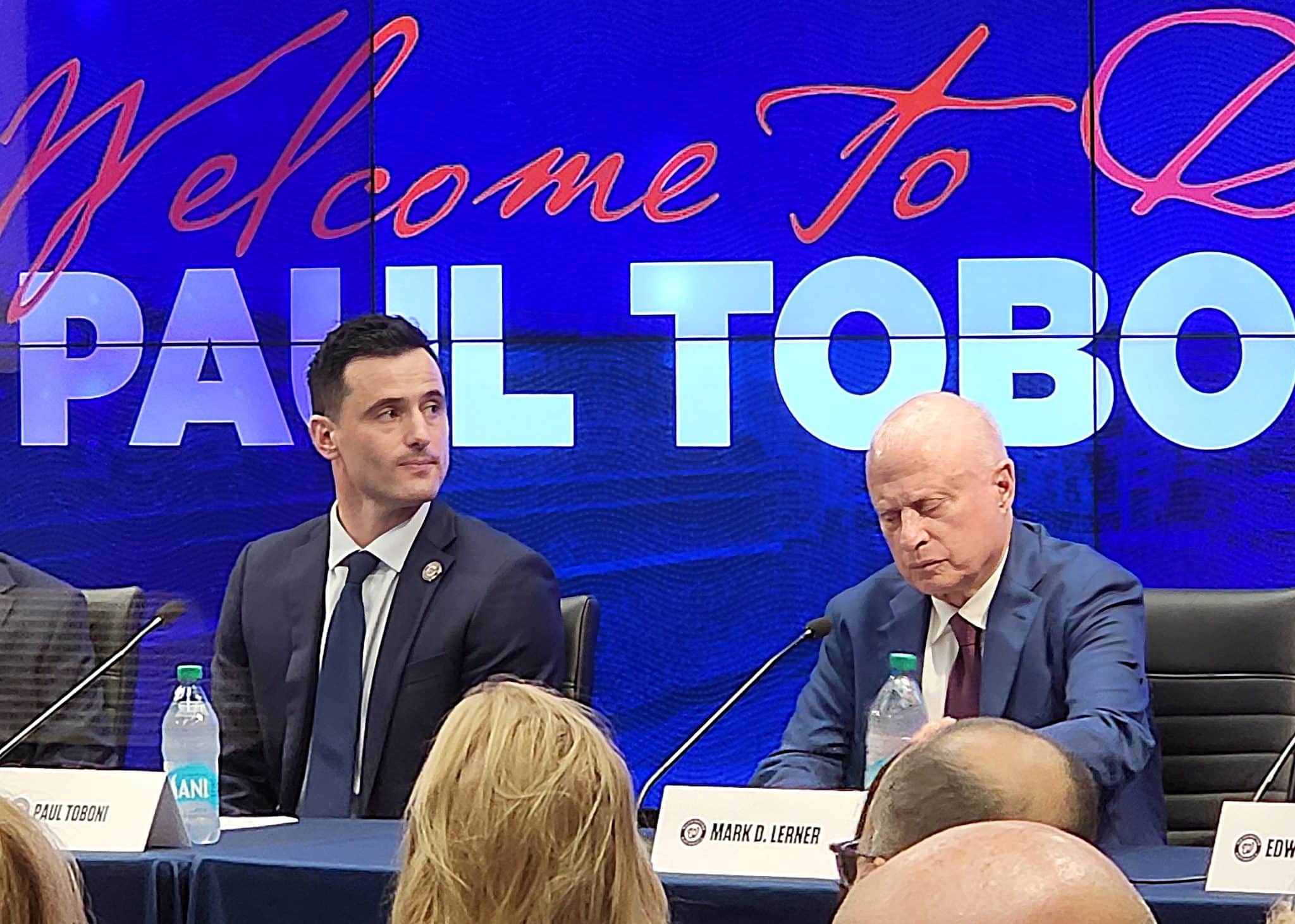
Narratives shape perceptions and become a reality for many. The joy of a winning season has now turned into another trade deadline sell-off. The Washington Nationals traded four players at the trade deadline. One trade went under the radar since it was a minor league trade. All four of the trades were to add pitching depth to the starting rotation and the bullpen for the future.
While Paul Toboni cannot wave a magic wand to fix all of the holes he inherited, he has done an excellent job to get the roster and minor league depth to the point we are at today. The Lerner ownership group now has to step up with their checkbooks to get the rest of this fixed for the 2027 season and beyond.
First, we need to look at the current roster, and every key player is controlled by the Washington Nationals through the 2029 season except for CJ Abrams who is due to become a free agent after the 2028 season. Cade Cavalli and Jacob Young are both controlled through the 2029 season. James Wood and Nasim Nunez are controlled through the 2030 season. Every other active position player is team-controlled beyond 2030.
When we talk about the heir apparent to take CJ Abrams spot, Toboni could have two years to groom his roster for Abrams’ replacement. Don’t expect Abrams’ replacement to put up a 4.0 WAR in his first year. But expect that there might be a transition period. It could be Seaver King getting reps at shortstop in 2028 with the team’s №1 prospect, Eli Willits, arriving in 2029. But maybe this new collective bargaining agreement (CBA) will be exactly what the Nats need to retain a player like Abrams. Read on for the thinking on that.
So where does the money need to be spent?
For near-term needs, the greatest financial need will be to look on the outside for that true №1 starting ace. A no-doubt top-of-the-rotation starting pitcher is at the top of the list for Toboni. They are expensive at about $35 million a year. This is what the Lerner ownership group has to commit to.
The starting rotation should look like this:
- Free Agent
- Cade Cavalli
- Connelly Early
- TBD
- TBD
Those ‘TBDs’ could certainly be filled by (alphabetically) Andrew Alvarez, DJ Herz, Jake Irvin, Jackson Kent, Luis Perales, and/or Jarlin Susana. The issue with a few of those names are that they are on an innings limit for 2027. One other name is Josiah Gray, and he is eligible again as an arbitration player. He got paid $1.35 million this year. That brings us to the 2027 payroll situation.
The 2027 offseason payroll
With no collective bargaining agreement signed (CBA), there are only guesses at what the payroll will look like. The Nats, as of now, would have 20 players projected into the offseason at the league minimum salary, and let’s call that $1 million for 2027. For comparison, this year’s minimum salary is $780,000.
There are six Nats’ players who will be above the league minimum salary for 2027 to include only Keibert Ruiz and Cade Cavalli with their salaries set. The other four are all arbitration eligible. Those four players are: CJ Abrams, Jake Irvin, Jacob Young, and Josiah Gray. And with the help of Don H. and Stever20, we have assigned arb salaries of $10 million, $3.75 million, $3 million, and $1.35 million to those four players respectively.
We also came up with the other add-on numbers to the payroll for pre-arb bonus pools, 40-man costs, and player benefits to arrive at an offseason payroll of $76 million — and of course adjustments will need to be made to conform to the new CBA. For now, this is a working number to start.
If the minimum player salary in the new CBA went to $1.7 million then that $76 million number goes up by $14 million in total. By the way, the MLBPA union proposal wants a minimum salary of $1.5 million. That would change that $76 million number to $86 million. Every team will be affected by the new minimum wage. Again, the actual CBA numbers will change. Right now, it’s a moving target.
MLB owners proposed a minimum payroll of $171.2 million as part of a new hard cap system for the next CBA. This initial economic offer was presented to the players’ union on May 28, 2026, to begin in the 2027 season.
Do that math from that $76 million number. The Nats would be approximately $95 million under that minimum capped floor number. And this is where the secret sauce is for the Nats.
They would have a tremendous amount of cap space to offer long-term deals to both CJ Abrams and James Wood. This would come at a time when there could be six to eight teams perilously close to the hard cap ceiling. You figure that the Dodgers, Mets, Yankees, Phillies, Blue Jays and Red Sox couldn’t sign either player. This is where a hard cap system would greatly benefit the Washington Nationals in the next few years.
In the NFL, a league with a hard cap, small market teams like the Kansas City Royals Chiefs can retain their homegrown talent like quarterback Patrick Mahomes and tight end Travis Kelce. This is the perfect timing for the Nationals if the CBA passes with a hard cap. But this also shows how fast the Nats could spend $95 million to get above the cap floor. You could literally spend that money on three players: an ace, Abrams and Wood. That money goes quick.
The New CBA
Most of baseball and its future will hinge on the new CBA. There is no reason right now for teams to hand-out lucrative deals to their players nearing free agency except for teams above the cap. You have to figure that the CBA will allow for teams to ease back under the cap over several years.
For teams under the cap, the CBA will probably give them years to ease into the cap. Again, this should all benefit the Washington Nationals. You would expect that the current revenue sharing system would end, and teams would share local TV revenues equally as well as some portion of seat sales. In the NFL, roughly 40 percent of standard ticket sales (gate receipts) from home games are pooled together and split evenly across the league. And what they call ‘local retention’ is kept by each team for their local revenue streams, which include luxury suites, stadium naming rights, local corporate sponsorships, and stadium parking and concessions.
Love it, hate it, debate it, the NFL model has worked in parity and the way their league has thrived in the cap system. The MLB model is not working. Their valuations on average are below the NBA, and now there are many teams in the NHL that are surpassing MLB teams in valuations. In fact, per Forbes, your four top D.C. sports team valuations are: $7.6 billion for the Washington Commanders (NFL), $4.7 billion for the Washington Wizards (NBA), $2.55 billion for the Washington Capitals (NHL), and $2.15 billion for the Washington Nationals (MLB).
The Economics of the Nats
When Forbes and CNBC both have the Washington Nationals in the bottom-5 of revenues in Major League Baseball, that means you are a small market team in terms of the money the team is bringing in. Yes, it is that bad. Something that no media site will discuss — but us. Why? It goes against the popular narrative. This should not be a surprise to anyone with a brain.
The team is in the bottom-third of attendance (currently 8th from the bottom), near the bottom of local TV money (Nationals.TV), and never sold their most lucrative sponsorship: Stadium naming rights.
For nearly the first half of the season, they didn’t even have enough TV commercials between innings so they showed the incessant replays of players guessing if Mordecai 3-Fingers Brown was the real name of a baseball player. Watching that five times a game got to be a bit much. This situation ain’t pretty.
Watching this new clip on DC sports station 980AM, Kevin Sheehan says that the Nats operate like a “mid-to-smaller-market team.” Hate to say the truth here, the Nats aren’t even mid — they are a small market team operating within a thriving large populous.
The DC area, as a whole, has never supported the Nats commensurate to their spending — when they spent like a large market team. That is a fact. The Nats never got into the top-10 of attendance in any of the winning years — and those years they were spending big.

Those years with the third largest payroll in baseball, the Nats were 11th in attendance. Again facts. How are you supposedly pocketing millions when you don’t have the revenues? Per Forbes, the Nats lost $15 million last year in operating income.
In all of those winning years, the Nats were also constrained by the MASN lawsuits. They never got to close to the top-20 in TV money even though the population of the Washington, DC MSA is still Top-10. Meanwhile, the Phillies were able to sign a 25-year deal for $2.5 billion for their TV rights. Easy math, that’s $100 million a year. That’s a huge competitive advantage.
But the narratives have never told you the truth. You just hear that the Lerners are rich and they’re cheap, and they are charging the highest beer prices. Who cares if they were. And by the way, that wasn’t even true. Nobody forces you to buy the beer or eat the hot dogs. And we all know that every game has Happy Hour pricing to first pitch where beers are just $5.
For those who think a new ownership group is going to fix everything and spend big, how could they financially do that unless there is a belief that they can magically get to the top of attendance. Revenues have to be above expenses to be financially viable in the long-term. You can’t operate in a perpetual loss and stay afloat. That is the current dilemma.
So yes, Sheehan is right that they operate like a mid-to-small market team, and that is because they are a small market ‘revenue’ team by every financial definition. The CBA could change all of that. With local TV money shared equally, like the NFL, the Nats would have the same money as every other team in TV rights. Then the Nats can work on getting attendance to where it needs to be. We know by winning they can get to the Top-11. That’s a start.












Leave a Reply