
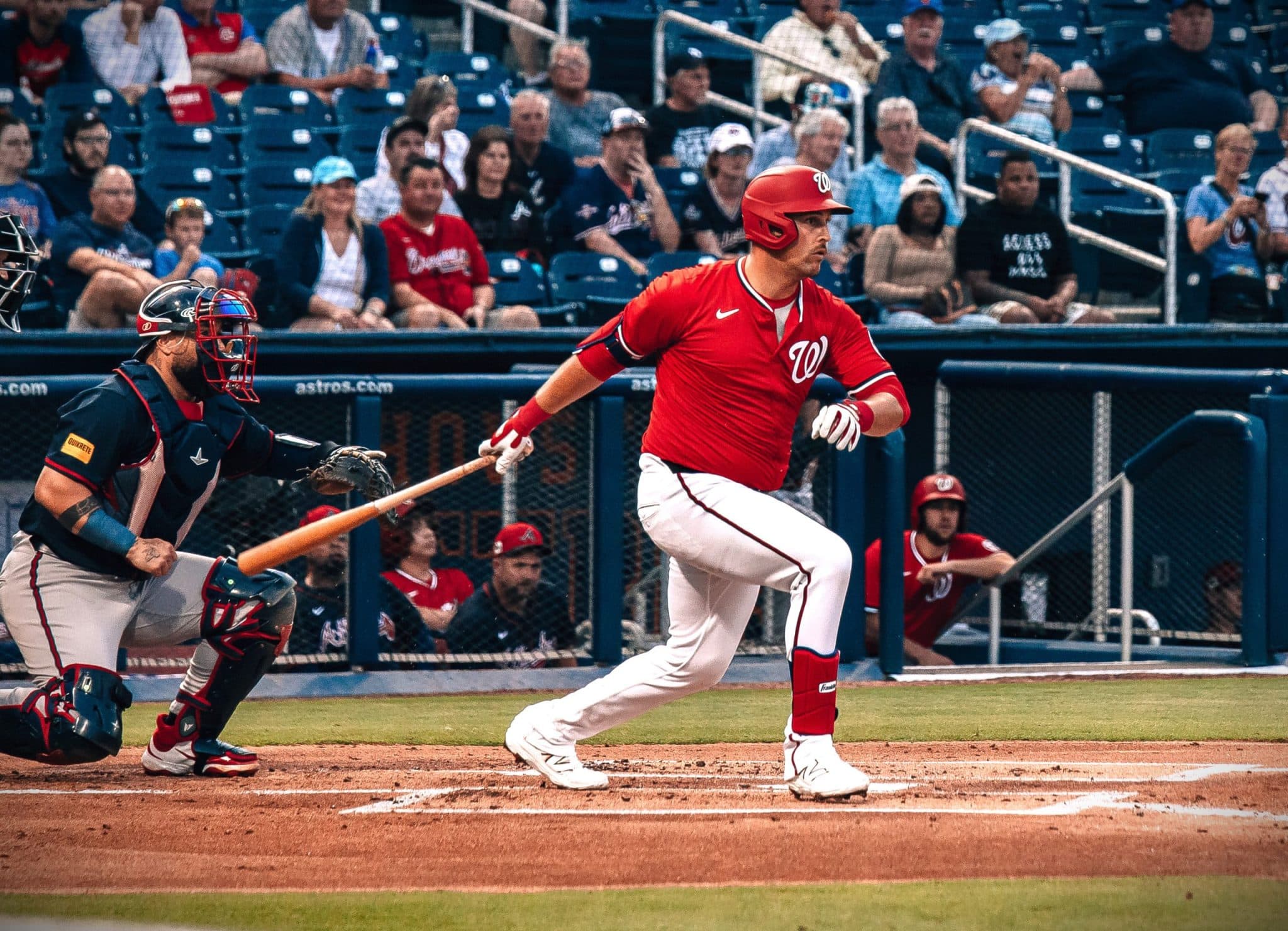
When Nathaniel Lowe speaks, it’s time for me to plug my ears. Heard it before. The same guy who dissed the Uncle Sam home run celebration hat in his brief stint with the Washington Nationals. After he showed his disdain for it, the team stopped doing it. Lowe must be a lot of fun at parties. But he does seem to enjoy winning.
“There’s not a competition issue. There’s truly not. If owners wanted to spend, they would, and teams that might not spend the money on a roster still find a way to win. So look at the four [teams still in the MLB playoffs]. It’s not a payroll issue. It’s commitment to winning. And now being on this side of it, having spent time in Tampa, the payroll isn’t really the issue. It’s just the commitment to winning.”
— Lowe said to ESPN
The problem is the word “commitment” is not measurable. It’s an intangible and subjective. Are you telling me that the Mets weren’t committed to winning? Winning is a combination of factors.
Nathaniel Lowe’s quote was from a piece in ESPN about competitive balance and spending in MLB. His perspective represents a classic, player-centric defense of MLB’s structural balance for those who oppose any spending cap in baseball, but it highlights a complex tension between financial investment and front-office ingenuity. Given that he made these comments during the 2026 League Championship Series, his points can be analyzed through two distinct lenses:
1. Where He Is Right: Clever Front Offices Matter Most
Lowe’s core argument — that a massive payroll isn’t the only path to the postseason — is routinely validated by teams like his former club, the Tampa Bay Rays, and his current team, the Cleveland Guardians.
- Roster Efficiency: Teams with lower payrolls often cultivate elite player-development pipelines, prioritize analytical edges, and find arbitrage value in the trade market.
- The “Commitment to Winning” Argument: For small-market contenders, commitment isn’t measured in dollar amounts spent on free agents; it’s measured in organizational infrastructure, precise coaching, and a coherent baseball philosophy.
2. Where the Argument Is Challenged: The Safety Net of Spending
While Lowe is correct that smart small-market teams “still find a way to win,” relying strictly on efficiency leaves a razor-thin margin for error.
- The Payroll Advantage: High-spending franchises can afford to make massive free-agent mistakes or absorb devastating injuries because they can simply spend more to plug the holes.
- Sustainability: Lower-payroll teams often face immense pressure to trade away their stars as they approach salary arbitration or free agency, making long-term windows of contention much harder to maintain than they are for financial juggernauts.
Ultimately, Lowe’s quote captures the pride of a player who has thrived in hyper-efficient organizations. It proves that elite scouting and a strong clubhouse culture can conquer a massive financial deficit in any given October—even if the structural debate over MLB’s wide spending gaps continues.
Would you like to look closer at the 2026 payroll data or historical success rates for low-payroll teams compared to top spenders in the postseason?Try without personalization
The 2026 MLB League Championship Series (LCS) highlights the massive financial divide in baseball. The Los Angeles Dodgers represent the sport’s ultimate big spender, while their three remaining opponents rely on strict financial efficiency.
The 2026 Postseason Payroll Disparity
The financial gap between the four remaining teams is staggering. The Dodgers’ luxury tax penalty alone ($180.8 million) is higher than the individual payrolls of the other three franchises. We aren’t even comparing payrolls in the CBT formula. This was season-end cash payroll.

As the data shows:
- The Los Angeles Dodgers are outspending the other three remaining teams combined by nearly $25 million on cash payroll.
- The Cleveland Guardians reached the ALCS despite carrying the lowest payroll in Major League Baseball ($74.4 million).
- The Tampa Bay Rays (25th) and Milwaukee Brewers (18th) both sit comfortably in the bottom half of league spending.
Historical Playoff Success: High Spenders vs. Low Payrolls
While the 2026 final four supports Nathaniel Lowe’s argument that “teams that don’t spend still find a way to win,” historical trends tell a slightly more nuanced story.
- Getting to the Playoffs vs. Winning It All: Spending heavily heavily correlates with making the dance. In 2026, 7 of the top 10 payroll teams made the 12-team postseason field. However, the actual championship rounds often turn into a high-variance crapshoot.
- The World Series Hurdle: While low-payroll teams routinely disrupt the early rounds, going all the way is rare. The last team with a bottom-tier payroll to win the World Series was the 2015 Kansas City Royals. Since then, champions have almost exclusively ranked in the top-10 (and often top-5) of MLB spending.
- Widening Revenue & Spending Gaps: The modern luxury tax system hasn’t stopped the divide from growing. The spending ratio between the top-5 and bottom-5 payrolls has sharply widened over the last decade, hitting a historic multiple of 4.8 to 1.
This stark contrast explains why MLB owners are aggressively pushing for a salary cap and floor system ahead of the upcoming collective bargaining agreement expiration on December 1, while the Players Association points to this exact final four as proof that the system doesn’t need to be restricted.
This was the perfect storm for the player’s union to prove their point that spending isn’t the problem — it’s commitment! And especially if the Dodgers lose to the Brewers as the National League representative for the World Series, the MLBPA can point to that in their argument that payroll caps aren’t needed.
While the average MLB salary has surged to a record $5.34 million, the distribution is heavily skewed toward a small number of elite, high-earning superstars. The vast majority of the union’s rank-and-file players earn far below that average, as illustrated by the league’s salary distribution structure:
- The Median Reality: The median salary in baseball hovers between $1.35 million and $1.4 million. This means that half of all active players on Opening Day make less than $1.4 million—far below the $5 million threshold.
- The $10 Million+ Tier: Only about 177 to 185 players across the entire league make $10 million or more depending on final bonuses gives a range.
- The “Middle Class” Crunch: The group of players earning between $5 million and $10 million is relatively small. The bulk of the league consists of the 45% of players who make under $1 million, combined with early-arbitration players tracking between $1 million and $4 million.
On top of that, the MLBPA made a smart maneuver to propose a minimum player salary of $1.5 million to appeal to the populace of their union. Roughly 75 percent — of Major League Baseball (MLB) players make under $5 million annually per ChatGPT, heavily driven by pre-arbitration and early-arbitration players earning near the league minimum.
- League Minimum (2026): The MLB minimum salary is $780,000.
- Players Earning Under $1 Million: Roughly 55% of Opening Day MLB players earn $1 million or more, meaning around 45% make under $1 million (and thus well under $2 million). Other seasonal tracking estimates show that early-to-mid season active rosters feature an even higher percentage of pre-arbitration and minimum-scale players making under $2 million.
- Arbitration & Pre-Arbitration: Players with under three years of service time (pre-arbitration) or those in their early arbitration years make up the bulk of the lower-salary tiers before jumping significantly once reaching multi-year veteran contracts or free agency.
The MLBPA could not have written the script better if the Dodgers lose two more games this week to the Brewers. And their proposal for a $1.5 million minimum salary was brilliant. They have out-smarted commissioner Rob Manfred who ultimately represents the 30 team owners who make up MLB — a country club for billionaires. Yes, if the goal is parity, Manfred should have offered more money for entry level players.
When the 1,200 union members cast their votes, most will side with the union who offer them the most hope. MLB careers don’t last long. You have to make your money now. Nobody wants a work stoppage, but Manfred really botched this one. Parity begins by taking care of the majority and when 75 percent make less than $5 million, that’s where you target.
So while the Guardians and Rays are guaranteed to be one of the teams in the World Series, they will be more of an outlier if either wins it all. The Brewers on the other hand, spent money near the MLB middle, and have been building for years towards the day they win their first World Series. Their story is a great one as they come from the smallest baseball market of all 30 teams.
This whole argument now going to spending does not matter takes a lot of starch out of the narrative that the Washington Nationals must spent $10’s of millions more to make the postseason. It does go to show that spending wisely is also a key. The answer is not how much you spend, rather how you spend it.
Manfred is on the clock. Get it right.












Leave a Reply