
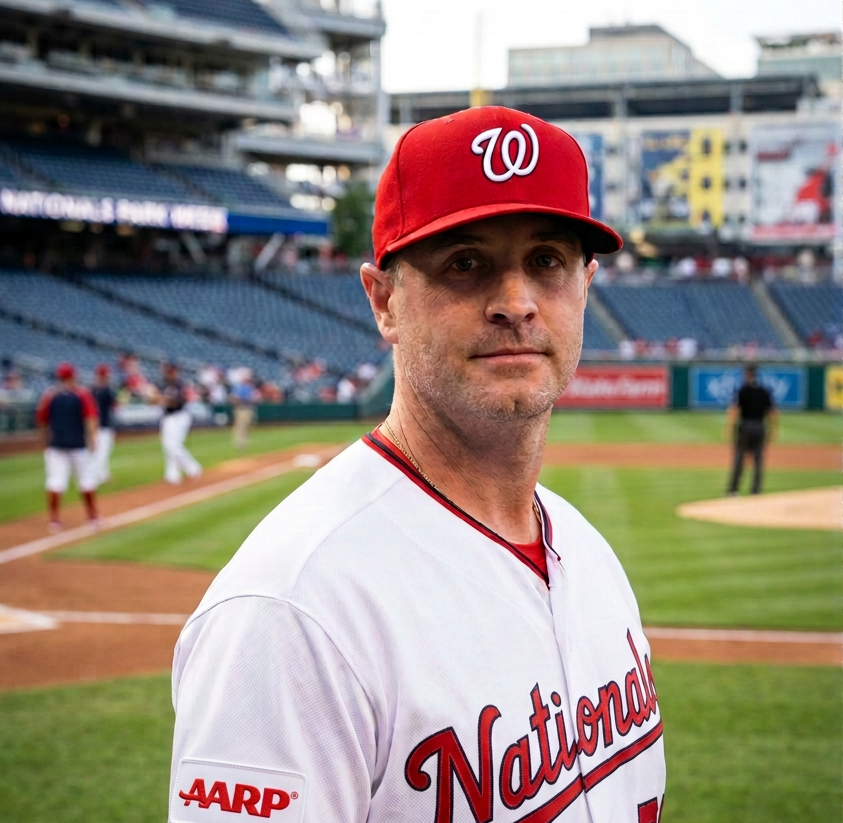
The Washington Nationals completely modernized their hitting department by hiring a young, data-driven staff consisting of Matt Borgschulte, Andrew Aydt, and Shawn O’Malley. This progressive trio combines Borgschulte’s “Own the Zone” strategic approach, Aydt’s advanced biomechanical expertise utilizing cutting-edge technology, and O’Malley’s practical major league experience to optimize the team’s offense.
With all the changes in the front office and coaching staff, there was little change to the roster, other than the bullpen and the starting rotation. Curtis Mead, Jorbit Vivas, and Joey Wiemer were the only changes to the position roster to start the season. The Nats essentially kept the majority of the position players from the previous team and did exactly what they promised that they would get an “extra gear” out of each player. That was the company line from President of Baseball Operations, Paul Toboni, when he was hired and then echoed by his manager, Blake Butera.
Again, the “extra gear” statement sounded gimmicky and BS. You hear it all the time in sports with little tangible proof of achieving the goal. But it absolutely worked with the Nationals’ offense. Coaching mattered. Execution mattered. The analytics mattered. The technology mattered. This is the blueprint. The key going forward is evolving and improving.
Now we have the final numbers from the 2026 season, and it’s impressive when you look at the returning full-time players of which there were seven of them in the lineup. OPS increases for the seven players: Dylan Crews (+5.1%), James Wood (+8.0%), CJ Abrams (+11.5%), Jacob Young (+21.3%), Brady House (+23.7%) Luis Garcia Jr. (+24.5%), and Keibert Ruiz (+27.6). Take those numbers, and that is an increase of 17.4 percent in an unweighted average.
Full-Season Offense & Record Comparison
| Statistic | 2025 Season | 2026 Season | Net Change |
|---|---|---|---|
| Team Record | 66–96 | 77–85 | +11 Wins |
| Runs Scored (R) | 687 | 821 | +134 Runs |
| Run Differential | -212 | +6 | +218 Differential |
| OPS | .693 | .744 T-No. 3 in MLB | +.51 |
| Stolen Bases (SB) | 132 (73.3% success) | 178 No. 1 in MLB (81.7% success) | +46 Steals |
| MLB Runs Ranking | No. 20 | No. 3 in MLB | Jumped 17 spots |
Matt Borgschulte – Hitting Coach
- The Strategic Mind: At just 35 years old during the season, Borgschulte brought a highly regarded MLB pedigree to D.C., having previously served as the co-hitting coach for the Baltimore Orioles and the primary hitting coach for the Minnesota Twins.
- The Philosophy: His approach centers on “owning the zone.” Borgschulte emphasizes hunting pitches over the middle of the plate, prioritizing high-value walks, and instilling a disciplined, simple mental approach to maximize overall run production.
Andrew Aydt – Assistant Hitting Coach & Assistant Director of Hitting
- The Tech & Data Specialist: Transitioning directly from the private sector to the Major Leagues before turning 30, Aydt represents the vanguard of modern baseball analytics. He previously served as the Assistant Director of Hitting at Driveline Baseball, the premier data-driven training facility.
- The Specialty: Aydt is the staff’s expert on swing mechanics and movement efficiency. He builds highly individualized, technology-backed programs utilizing advanced tools like Trajekt Arc pitching simulators to physically optimize each hitter’s swing characteristics.
Shawn O’Malley – Assistant Hitting Coach
- The Player’s Perspective: Complementing the heavy analytical backgrounds of Borgschulte and Aydt, the puzzle fit for O’Malley provides crucial, practical major league experience. A former MLB utility player who spent parts of three seasons with the Seattle Mariners, O’Malley spent years coaching in Seattle’s highly respected minor league system.
- The Specialty: O’Malley bridges the gap between data and reality. He focuses on the day-to-day grind of a Major League season, game-planning, and helping young hitters translate advanced metrics into real-time, in-game adjustments on the field.
The Hitter’s Meetings
Detailed hitter’s meetings begin approximately 3.5 hours before first pitch with the Washington Nationals. They do this before the actual batting practice in the pre-game.
“The information that we discuss in the hitter’s meetings is basically what the pitchers got — where he likes to attack — and what he likes to use in certain counts. Kind of come up with a plan collectively to go out there and attack [the pitcher] that day. I feel like [these meetings] have helped a lot especially being [the third] best offense in baseball. ” — Dylan Crews said this season

Expanding the Blueprint: Getting to Next-Level Offense
While the Washington Nationals have undeniably discovered a modern offensive baseline, the path from a 77–85 record to true championship contention requires full-team balance beyond just the offense. The coaching staff has engineered an elite environment for baseline run production, but translating those raw metrics into situational success is the next frontier.
Before we take a victory lap, there is work to be done here. The Nats finished in the bottom-half for hitting with Runners In Scoring Position (RISP) at (.250) and tied at No. 16. The Top-10 teams in RISP all made the playoffs but two teams. Situational hitting is where the Nats must improve going forward.
Breaking Down the RISP Problem
RISP hitting is situational hitting. You would like to see hitters performing at or better in RISP spots as compared to bases empty situations.
- The Stat: A .250 team batting average with RISP (tied for 16ᵗʰ in MLB).
- The Contrast: While their overall OPS jumped significantly, their situational approach was better for some players and worse for others versus their normal OPS.
- The Postseason Context: Out of the top ten teams in RISP average across Major League Baseball, eight secured playoff spots.
Individual Progression Plans
To unlock the next layer of potential, the hitting brain trust of Borgschulte, Aydt, and O’Malley will need to tailor individual adjustments for the young core over the offseason. Sources have told us that each player will have a personally tailored PowerPoint presentation.
The Next Phase of the Strategy
Coaching and execution is a key. While this might sound simplistic, that is where this all begins in the coaching, planning and the pre-game work. One crucial intangible is the mental part of this. It has been shown that stress levels go up for some players in higher leverage situations. While tactical planning and flawless execution are the foundation of any game plan, mental resilience under pressure is often what separates players.
High-leverage situations naturally trigger a psychological and physiological stress response, which can severely impact physical performance if not managed properly. Most teams now employ mental performance coaches and the Nationals had Adam Wright as the director of that department. This past season, Noelle Torres worked directly with players in the organization.
By combining a concerted joint effort here with O’Malley’s practical advice on handling tight in-game situations, the Nationals aim to make situational adjustments second nature. If the staff can successfully replicate their overall development victory within high-leverage situations, Washington will possess a top-to-bottom blueprint capable of increasing run production further.
How Stress Affects Execution
While some constantly fight the notion that “clutch” exists, do you believe in the opposite that some players fail or choke at a higher rate in those high-leverage spots? We consulted with a sports performance coach (in football) who agreed to write his thoughts on the subject on the condition of anonymity:
When the stakes rise, the body’s autonomic nervous system kicks into overdrive. If a player cannot regulate this stress and anxiety of the situation, it manifests in two distinct ways:
- The “Choke” Response: High anxiety causes players to overthink motions that are normally automatic (muscle memory). This shift from implicit to explicit processing disrupts fluidity.
- Tunnel Vision: Elevated stress narrows a player’s visual and mental focus. For example, this makes a quarterback miss critical cues, like an open receiver, a subtle shift in the defense, or a clock ticking down. This can also be applied to any sport like a basketball player with a foul shot or a baseball player trying to hit with bases loaded and the game on the line.
Bridging Coaching and the Mental Game
To turn the mental game from a vulnerability into an asset, coaching staffs focus heavily on pressure simulation and psychological conditioning during pre-game work:
- Extra Practice: Coaches intentionally create high-stress environments in practice. While nothing simulates a real-game situation, detailed practice situations can help.
- Familiarity Breeds Calm: Pre-game scouting and thorough preparation lower situational anxiety. When a player knows exactly what to expect from an opponent, the brain perceives the situation as less threatening.
- Routine as an Anchor: Developing strict pre-shot, pre-pitch, or pre-snap routines gives players a familiar psychological anchor. It resets their focus back to the process rather than the outcome.
Ultimately, tactical coaching provides the “what to do,” but mental conditioning dictates “how well it can be done” when the lights are brightest.
The Next Mechanical Frontier: Improving the Nationals’ O-Swing Issues
While the Washington Nationals’ newly minted hitting department engineered an undeniable offensive surge this past season, there are issues beyond improving in RISP hitting. The Nationals should strive to improve their O-Swing percentage which measures the amount of swings where a batter chases pitches outside of the strike zone — also known as plate discipline. The Nats ranked 19ᵗʰ in chasing pitches outside of the zone.

“The overarching philosophy is the goal of the offense to score runs.”
“We’re going to value every aspect of hitting that we can to maximize that run-scoring potential of the offense, whether that’s hitting the ball over the fence in the gap and driving for extra bases, or whether that’s taking a good at-bat, taking our walks and really owning the zone.”
“So having a simple approach, giving the hitters what they need, information-wise, and working with them on their swing, on what they need to do to improve, but also keeping it simple and making sure that when they go into the box, their mind isn’t on what they need to do in their swing. It’s simply on the approach, staying in the present moment — and executing the plan that they’re set out for.” — Borgschulte said when he was hired
To excerpt what Borgschulte said: “We’re going to value every aspect of hitting that we can to maximize that run-scoring potential of the offense … taking a good at-bat, taking our walks, and really owning the zone.”
Young hitters are supposed to improve with more repetition. The Nats brought in three expensive Trajekt Arc machines into the organization to simulate opposing pitchers. Machines were place at the West Palm Beach facility, Nationals Park, and Triple-A Rochester. Pitch recognition and a solid approach would certainly help. We say it all the time, “Walks are fine — move the line” and “take your walks.” Sometimes taking your walks is the most unselfish part of baseball.
In 1,188 plate appearances with a 3-ball count in the 2026 season, the Nats took 555 walks and that was 12ᵗʰ best in baseball. The best were the Cubs and Brewers in taking their walks — and guess what, they were also the two best teams in scoring runs. The Brewers had the highest OBP and the lowest O-Swing rates in baseball.
To reiterate again, the Nats were really good offensively. What we are talking about here is getting even better. This can be done. The Brewers are the model here. They don’t have any big-time free agents. That Brewers team won 103 games with a payroll of $154 million.
Almost everything here is inter-related. Improve 0-Swing — and you get more walks with higher OBP, fewer strikeouts, and more RISP opportunities while putting higher pitch counts on the opposing pitchers to get into their bullpens quicker — all of that potentially leads to scoring more runs and winning more games.
The final numbers reveal this developmental hurdle remaining for Borgschulte’s crew. For all of the progress made under the “Own the Zone” mantra, the Nats as a team struggled in this area. Not every hitter was a problem, but enough were.
If this young lineup wants to evolve from a surprise top-three offense into a sustainable postseason juggernaut, decreasing their chase rate is the ultimate key.
Understanding the Chase Metric
To truly “Own the Zone,” a batter must first improve plate discipline. When looking at the 2026 data, the Nationals’ overall aggressive nature fueled their high-octane run production, but it acted as a double-edged sword. Out-of-zone swings actively torpedoed their efficiency in high-leverage situations, feeding directly into their lackluster .250 batting average with runners in scoring position (RISP).
Chasing boundary-line breaking balls and elevated waste fastballs does two things that kill rallies:
- Generates weak contact: Even when a hitter makes contact with an O-Swing pitch, this can result in a low-velocity groundout or a lazy ball in the air.
- Inflates strikeout rates: It actively bails out opposing pitchers and gives them count-leverage advantages while too often giving away high-value walks.
Individual O-Swing Profiles: The Major Culprits
The data-driven programs built by Aydt will need a heavy dose of visual discipline training this winter, specifically targeting a few crucial young pillars. Daylen Lile went from being a great disciplined hitter to the worst drop in MLB from season to season going from an O-Swing in 2025 of 26.7% to 38.4% in 2026. His stats can be seen here in FanGraphs.
The Blueprint for a Fix
Correcting an O-Swing issue isn’t as simple as telling a player to “stop swinging” at bad pitches. It requires reshaping a hitter’s neurological recognition timing and sometimes their actual vision to assist in pitch recognition. But training the vision is the start.
This is exactly where the Nationals’ tech stack must come into play. Expect the hitting coaches to heavily utilize the Trajekt Arc pitching simulators during Spring Training to combat this exact issue. By programming the machines to replicate the exact release points, spin axis, and movement profiles of division rivals, hitters can physically train their eyes to recognize out-of-zone tracking much faster.
Players like Dylan Crews, Brady House, and Yohandy Morales have struggled with fastballs above the zone. Others chase under the zone and away. Every hitter could benefit from this improvement. Repetition is supposed to help with pitch recognition. This is a young team.
One aspect we have discussed is that the team is targeting player acquisitions in trades, free agency, and the draft for players who excel in pitch recognition and plate discipline. Look no further than Eli Willits and Chris Hacopian who were acquired in the draft, and Devin Fitz-Gerald who was acquired via a trade. Expect any big name free agent acquisitions to excel in this area and to mentor the younger players.
End Result
Yes, 2,450 words to get you here.
Borgschulte and his staff have been incredible so far. More work has to be done. Elite improvement and winning more games are the goal in the next chapter.
Photos by Washington Nationals of the hitter’s meeting; Cover photo by Marideth Sandler/Nats.Talk












Leave a Reply