
We are officially in the offseason as the World Series has ended. Baseball’s future moves into uncertain times with an expiring collective bargaining agreement (CBA) that gives us just a little over 30 days until the calendar hits a second after 11:59:59 on December 1.
At some point, there will be a new CBA. What that will look like is anyone’s guess. When it will be signed is another guess. Who knows. Both sides are ready for a long lockout.
This year’s World Series, not by design, gave a glimpse into what parity would look like with the Milwaukee Brewers from MLB’s smallest city, emerging as this year’s winner. In all the other main sports, it’s commonplace as smaller markets can compete with NYC and LA. In hockey, Carolina can win the Stanley Cup, teams like Kansas City and Buffalo almost made it to another Super Bowl, and we are a year removed from Oklahoma City winning an NBA championship.
Baseball had that small market feel this year as an outlier. The last time a small market team won a World Series was in 2015 with the Kansas City Royals. Baseball has no hard cap, as you know, and the real small market teams just cannot raise the same revenue under the current CBA like the Dodgers and Yankees.
The new CBA will certainly dictate a lot of the future spending — specifically if there is a salary cap ‘floor.’ MLB has proposed a floor of $171.2 million. But in order to have a floor, MLB has to redefine the revenue sharing to look more like the NFL. The MLB Players Union (MLBPA) does not oppose a spending floor, they vehemently oppose a hard cap ceiling. That’s the main issue here even if independent economists can show that salaries will continue to grow with a capped ceiling.
The opposition is really from the top-end agents and their players who are the loudest voices getting their message out to the heads of the MLBPA. They want more Kyle Tucker style deals at $57 million a year, and Juan Soto type deals that will pay him past his prime at 40 years old on his 15 year, $765 million deal through the 2039 season at $51 million a year.
The NFL has a hard cap, and Patrick Mahomes can make up to $522.25 million through incentives and escalators. Yes, part of that is non-guaranteed. Beginning in 2027, his deal averages $64 million per year, setting an NFL record for average annual value. He signed that deal to basically remain for his entire career with the team that drafted him in Kansas City. If the NFL, with a hard cap, can pay Mahomes that much money, why are MLB agents concerned? Mahomes AAV is higher than any MLB player.
Now let’s talk about the Washington Nationals. Life was great from 2012 to 2019 when the Nationals were spending near the tops of baseball. That continued into 2020 and 2021 except those were years of losing. Point is the Nats used to spend with the big boys — but that was also a time when the CBT cap felt like a hard cap.
The Mets changed the whole system of spending and the Dodgers have kept up with them. This massive surge in spending ultimately prompted MLB to introduce an ultra-high fourth CBT penalty tier colloquially known as the “Steve Cohen Tax.”
CBA Proposal Overview
- Salary Floor: $171.2 million minimum spending requirement per team (including player benefits).
- Salary Cap: $245.3 million maximum spending limit per team.
- Revenue Split: A 50/50 split of revenues between the owners and the players.
Impact on Teams
- Payroll Reductions: High-spending teams like the Dodgers, Mets, and Yankees would need to lower their payrolls to get under the cap.
- Payroll Increases: Lower-spending and most small-market teams would be required to increase their spending to meet the $171.2 million floor.
Fixing the Revenue Imbalance
The other part of the CBA would create a system where revenues are divided more equitably and MLB commissioner Rob Manfred wants local TV revenue to be split equally between all teams. That would be a major win for the Washington Nationals because they have never been paid commensurate to their market size in RSN (regional sports network) revenue. If you don’t know about this issue, Google search, “MASN.”
Any increase of RSN TV money to the Nats would help fund a good chunk of spending. And that is a key here in fixing the revenue imbalance to align much closer to the NFL system that uses that model. Let’s just conservatively say that the Nats get a $30 million a year windfall in TV money under the Manfred proposed system. That would make a major difference. Hopefully that number will be much higher.
Other Revenue
The Nats need to help themselves by selling the lucrative stadium naming rights which should be worth approximately $15 million a year. As Nats increase spending, expect attendance to go up also. The Nats finished at 7th from the bottom in league attendance per ESPN at 22,705 per game this year — the team’s lowest non-COVID number in over 15 years.

If the Nats could just get back in the short-term to 24,900 in average attendance where they were at in 2011, that would be progress. How can they do that? By changing the narrative and stating that ownership is committed to winning and spending. It would have been smart for ownership to say those words now to encourage season ticket sales for next year and help with sponsorship sales.
Payroll for 2027
How hard would it have been for ownership to state that they are committed to a salary budget increase of at least $50 million for next year? That is what they gave their former-GM for the 2025 season to spend when that team got to a $140 million opening day payroll. This past year they shrunk to approx. $123 million per Cot’s Baseball. That number dropped a few million more after the trade deadline.
Again, a new CBA might require the Nationals to spend much more than $123 million. That would be good for Nationals fans.
Ownership Must do Their Part
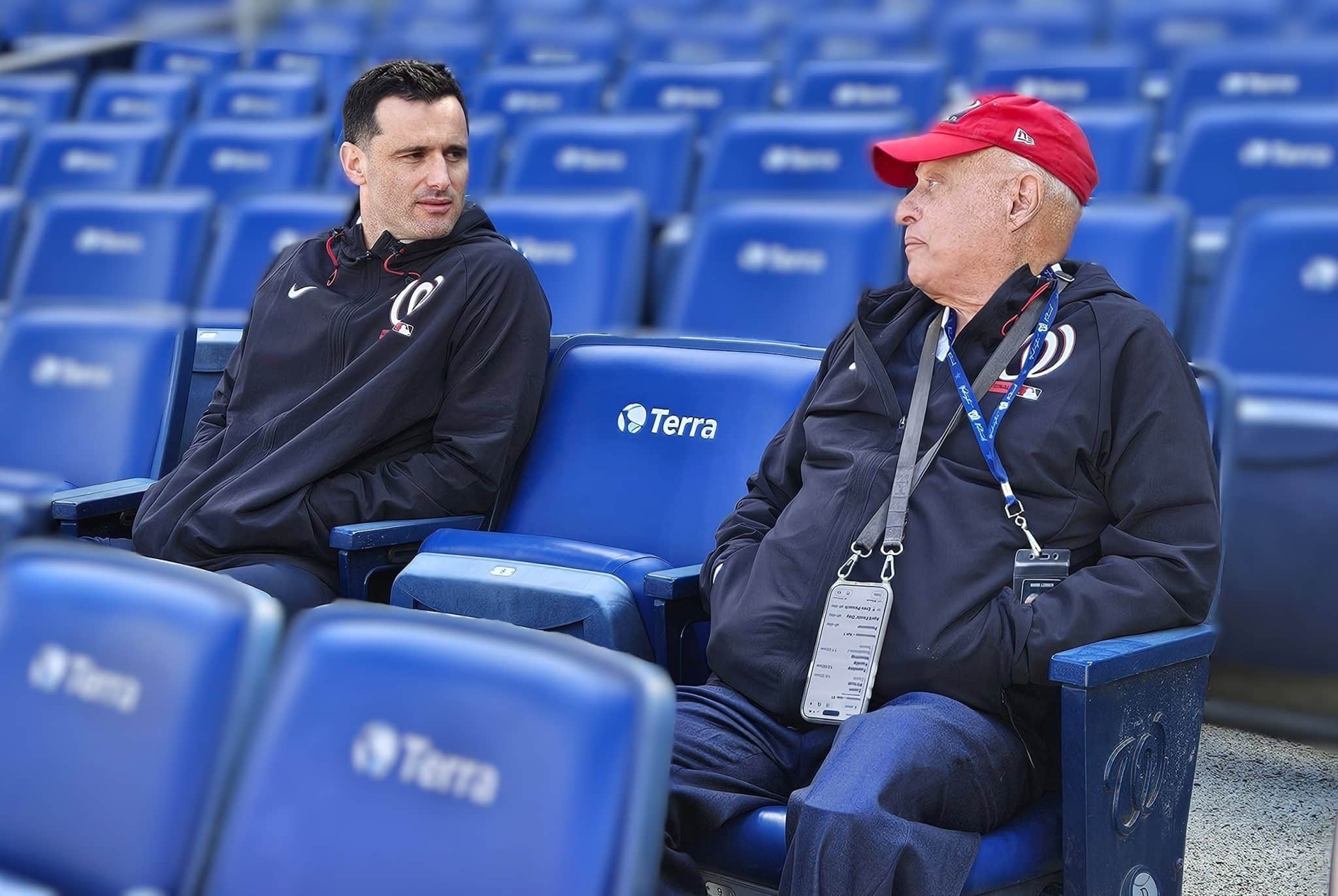
While ownership made some very tough decisions in the past 15 months with changing over their front office, coaching staff, player development staff, and business operations, they created two separate President positions for Toboni on the baseball operations side, and for Jason Sinnarajah on the business side.
Everyone must row in the same direction and with the same purpose. While Toboni might think his only job is to improve the product on the field, but he could also help by casting a better image on the team. That becomes the gray area of “not my job.” True. But this has been a problem with the Nationals since they relocated from Montreal that the narratives about this team have been negative. That negativity directly affects attendance. And attendance is still the top revenue driver for this team.
Remember, attendance drives merch sales, F&B sales, parking, and in-stadium sponsorships. Sportico estimates that MLB on average gets 31 percent from attendance with another 10 percent for concessions and parking making it 41 percent of the total. That is the number one driver of revenue.
In recent financial assessments for the 2025 season, the Washington Nationals generated roughly $300 million to $314 million in total annual revenue. Those specific figures come from CNBC and Forbes:
- Gate Receipts (Ticket Sales): Estimated at $83 million to $90 million, making up roughly 27 to 30 percent of their total revenue stream.
- Other Channels: The remaining 70%+ is split between the national broadcast distributions, local television media agreements (such as Nationals.TV), stadium sponsorships, jersey patches, and merchandise.
Unfortunately with a drop in RSN money and a further decline in attendance, the Nationals probably dipped below $300 million in revenue. That is hard to believe since the Dodgers are reportedly making nearly $1 billion.
We also did a study on the Nats increasing debt-load. That also has to get chipped away and lowered as CNBC and Forbes both estimated the Nationals are losing money annually after paying interest expense.
The Circular Equation
Successful businesses have a high demand for their product. That is where the Nationals have to get to. While the effort by Sinnarajah is certainly working towards improving the team’s image, the attendance drives everything. The Brewers this year hit attendance numbers the Nats have never achieved in their winning years. As the chart above showed, even in the winning years, the Nationals never reached the Top-10 in MLB in attendance.
The past attendance numbers has always shown poorly for Washington as a baseball town. You cannot survive spending over your revenues. That is a catastrophic business model. A new CBA might save Washington. Right now Washington is bottom-5 in revenue per both CNBC and Forbes modeling.

You create a better image of your product (Part #2) with proof of a good product (Part #1), and attendance will increase through customer loyalty (Part #3). That seems to be obvious if there is positivity about the team, and they create new fans.
This is always in a circular equation. Make more money to spend more money on the fan experience and the on-field product. That is the “build it and they will come” model.












Leave a Reply