
Today is another decision day for baseball teams. The item du jour is whether or not to tender players who are arbitration-eligible. To begin the offseason, the Washington Nationals had eight eligible players for arbitration, and as of now, there are only three decisions remaining. Four of the eight players are no longer employed by the Nats, one got a long-term extension (Jacob Young), and the remaining three players to tender -or- non-tender are CJ Abrams, Jake Irvin, and Jake Bird.
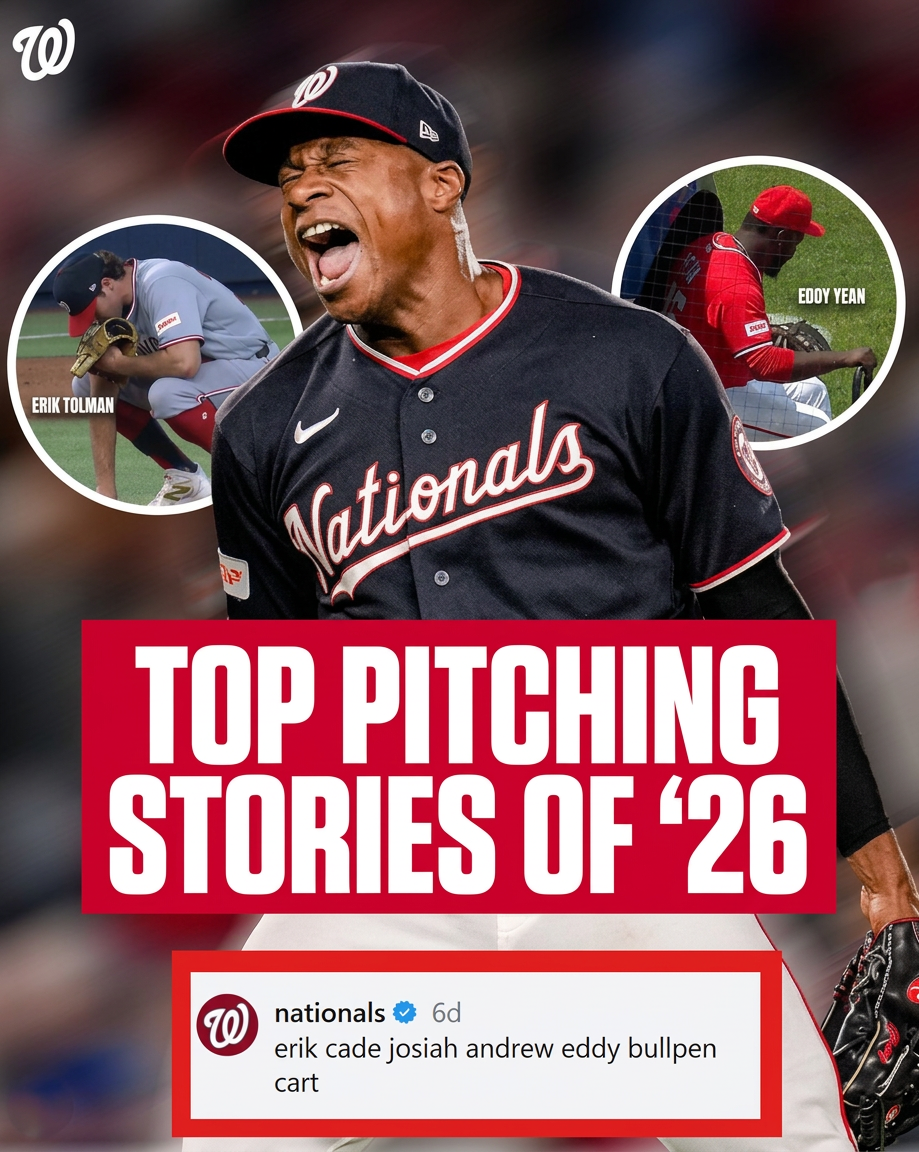
The real shocker was the decision on Monday to designate Josiah Gray for assignment. Two days before that, the Nationals were showing Gray in social media posts about his first career save. He seemed like a no-brainer for a contract tender given that his arb estimate was only $1.6 million. The MLBPA is asking for a minimum MLB salary at $1.5 million. Gray’s number is $100,000 over that minimum. But President of Baseball Operations, Paul Toboni, needed Gray’s roster spot to give to another pitcher. So goes the cruelty of roster squeezes.
By the way, the MLB Trade Rumors projections of arbitration-eligible players on the hot seat have the names of Irvin and Bird.
Below were the original MLBTR projections of 2027 salaries, but then again, at this point only Abrams, Irvin, and Bird matter.
Josiah Gray (5.075): $1.6MM
CJ Abrams (4.130): $10.2MM
Richard Lovelady (4.052): $1.7MM
Jake Bird (3.169): $1.3MM
Jake Irvin (3.152): $3.4MM
Ken Waldichuk (3.150): $1MM
Jacob Young (3.037): $2.3MM
Mitchell Parker (2.167): $1.1MM
Last week at the GM Meetings in Las Vegas, Toboni mentioned that Irvin was working hard at the team’s facility in West Palm Beach. You would assume that would be a strong indication that Irvin will be tendered a contract. However, the team most likely does not want to pay Irvin $3.4 million given his 5.48 ERA in the 2026 season. Last year, Irvin’s salary was $2.8 million.
With the original MLB Trade Rumors arbitration projections serving as the baseline, here is where the final three decisions stand:
- CJ Abrams (4.130 service time) – Projected: $10.2 million
Abrams is the lone certainty of the group. Fresh off a 30-30 campaign with over 100 RBIs, he is an automatic tender and projects to be the Nationals’ second-highest-paid player in 2027 behind Cade Cavalli ($11.75 million). The larger question isn’t whether Washington tenders Abrams, but whether the front office can finally find common ground on a multi-year extension—especially with questions still lingering about his long-term defensive home. - Jake Irvin (3.152 service time) – Projected: $3.4 million
Last week at the GM Meetings in Las Vegas, Toboni noted that Irvin was already putting in heavy work at the team’s West Palm Beach facility—typically a strong signal that a player is in the club’s plans. However, paying $3.4 million (up from $2.8 million in 2026) is a tough pill to swallow after Irvin posted a 5.48 ERA and 1.39 WHIP across 106.2 innings in an injury-interrupted 2026 season. With two straight years of an ERA north of 5.40, Toboni must decide if Irvin’s durability history and offseason work warrant the raise, or if the $3.4 million is better allocated elsewhere. - Jake Bird (3.169 service time) – Projected: $1.3 million
For Bird, the hurdle isn’t the projected $1.3 million price tag—it’s the roster mechanics. Because Bird is out of minor league options, tendering him virtually locks him onto the 2027 Opening Day bullpen unless the team risks losing him on waivers. While Bird flashed a 3.24 ERA in a tiny eight-game sample with Washington after struggling to a 5.93 mark with the Yankees, committing an optionless bullpen spot to a reliever with a 5.35 overall ERA in 2026 is a steep gamble for a relief corps desperate for reliability.
These non-tender decisions are also playing out against a shifting financial backdrop across Major League Baseball. With ongoing labor negotiations due the expiring CBA, proposals to dramatically raise the league minimum salary are on the table. Front offices are scrutinizing mid-tier arbitration players more aggressively than ever before. A few years ago, paying $3.4 million for a back-end starter with innings-eating potential or $1.3 million for a depth reliever was standard operating procedure. Today, teams view those marginal dollars—and the 40-man roster spots attached to them—as prime currency that can be redirected toward higher-upside external additions or used to protect emerging prospects from the Rule-5 Draft.
For Toboni and manager Blake Butera, the calculus goes beyond simple payroll accounting; it is about raising the floor of a pitching staff that too often put the offense in early holes or turned late-inning leads into high-stress adventures in 2026. Tendering pitchers purely because they are familiar or inexpensive only clogs the pipeline when a club is trying to transition from rebuilding into genuine postseason contention. By cutting ties early with players who lack clear roles or minor league flexibility, Washington avoids carrying dead weight into spring training and maintains the agility to strike quickly once the free-agent and trade markets accelerate at next month’s Winter Meetings.
Should Toboni decide to move on from either Irvin or Bird—or both—the Nationals will enter December with enviable roster elasticity and meaningful financial breathing room to add some upgrades via free agency or trades. Of course with the expected work stoppage, December business days might today just one day. As of today, the clock is counting down to just 11 days remaining until Dec. 2.
Any newly vacated 40-man spots can immediately be deployed to target established mid-rotation starters, and leverage relievers with swing-and-miss stuff. Toboni is also looking for buy-low bounce-back candidates on non-guaranteed deals.
Every tendered player remains locked onto the 40-man roster, while every non-tender opens another avenue for Toboni to reshape the roster in his image. After Monday’s Gray stunner, predicting Toboni’s next move is a fool’s errand. All Washington can do now is wait for the clock to strike.













Leave a Reply