
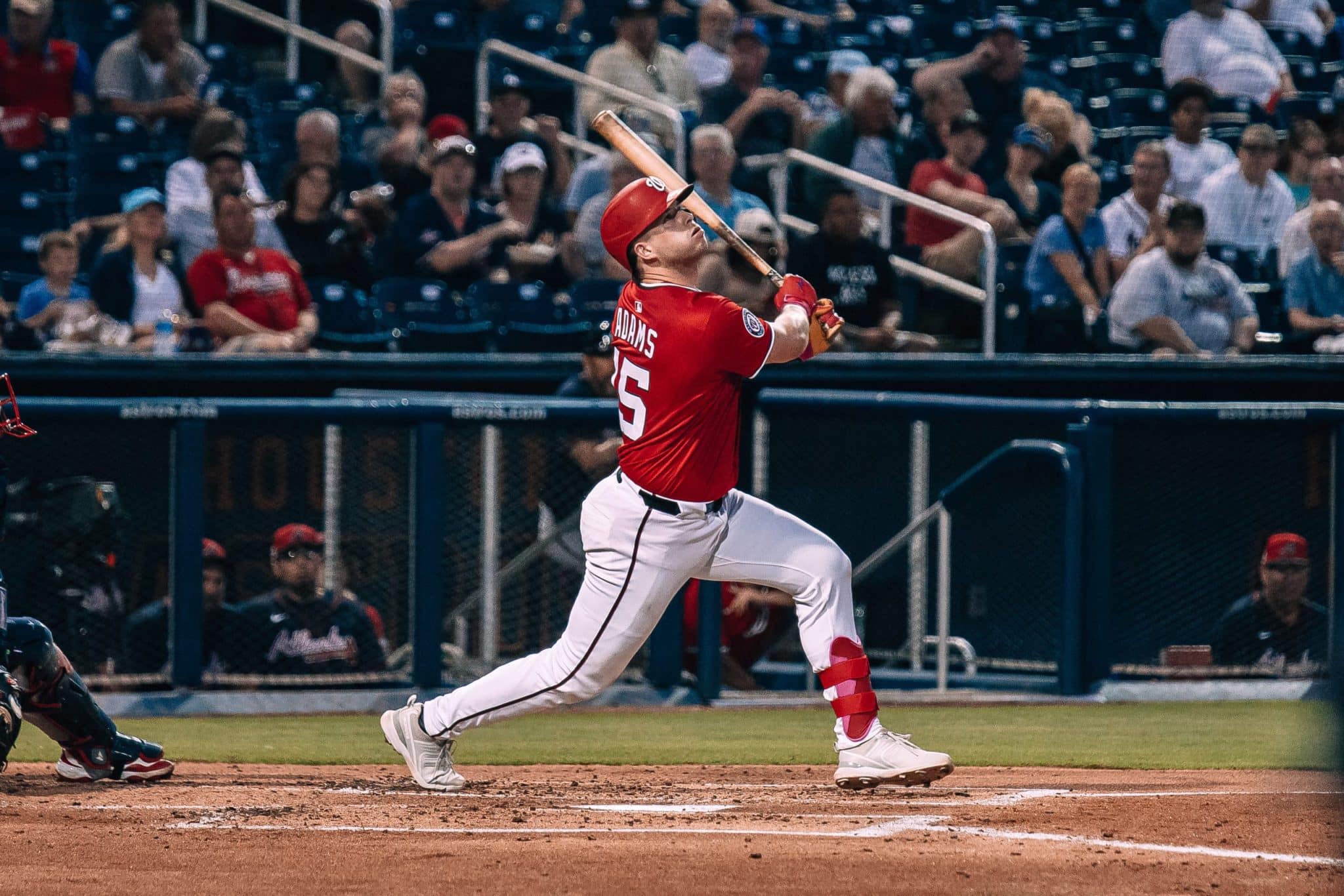

The final two days of the 2021 trade window saw the Nationals shake up their catching department in a way few teams have before, either trading for or trading away four different catchers in that 48-hour span. Former Toronto Blue Jays catching prospect Riley Adams became the first when Washington acquired him for closer Brad Hand on July 29th, 2021. In addition to receiving Adams, Washington would also make the following moves:
- Sent veteran starter Yan Gomes to the then-Oakland Athletics,
- Acquired then-Oakland Athletics High-A prospect Drew Millas, and
- Acquired Los Angeles Dodgers top prospect Keibert Ruiz.
In the aftermath of the deadline, Washington’s catching situation essentially became a tryout for the starting role for the 2022 season, if not for the team’s long-term catcher of the future. Much of the spotlight fell on the team’s three primary prospects at the time – Adams, Ruiz, and 19th-ranked prospect Tres Barrera. And then Barrera would struggle down the stretch, hitting just .216/.370/.297 over 12 games in August. He would finish the season with Triple-A Rochester after being optioned at the end of that month. Adams would make the most appearances of the three, posting an impressive .268/.422/.465 line over 35 games, but Ruiz would be named the team’s starter for 2022 after hitting to a similarly impressive .284/.348/.409 line in 23 appearances.
The rest is history, and when Ruiz was healthy, he has been the Nationals’ starting catcher ever since. The team’s faith in him is not least reflected in the eight-year, $50,000,000 extension he signed with Washington going into the 2023 season, a time when he had only a little over one full year of MLB service time to his name.
While playing time comes with a starting role, to say Ruiz has played often would an understatement. Over the last three seasons, Ruiz’s playing time has been as follows:
- 2022: 112 games, 16th-most of the 116 catchers with at least one MLB appearance
- 2023: 136 games, 7th-most of the 99 catchers with at least one MLB appearance
- 2024: 127 games, 11th-most of the 95 catchers with at least one MLB appearance
Adams has undisputably been the next in line since 2022, but there just has not been much playing time to go around. He did not make even the median number of appearances among MLB catchers in any of those three seasons, as shown by his playing time below:
- 2022: 48 games, 62nd-most of the 116 catchers with at least one MLB appearance
- 2023: 44 games, 65th-most of the 99 catchers with at least one MLB appearance
- 2024: 41 games, 60th-most of the 95 catchers with at least one MLB appearance
Through June 23rd, 2025, Ruiz had played in 66 of a possible 79 games, a rate of 83.54%. That mark put him on pace for 135 appearances through the end of the season, a total which would have fallen short of his career record by just one appearance. Alas, the season had different plans for Ruiz, as that day, he was forced to the 10-day IL with a concussion after a rogue foul ball caromed off the back wall of the Nationals’ dugout and struck him in the head. As a result, Adams, being the next man up, was called into action for an extended period of time for the first time since April 2024, when Ruiz was placed on the IL with an extreme case of influenza.
In his six appearances before Ruiz was activated from the IL on July 4th, Adams put up a solid .273/.304/.364 line, albeit with a 43.5% strikeout rate. Upon returning, Ruiz initially showed positive signs, going 1-for-4 in each of his first two games back, but his concussion symptoms would resurface following his appearance on July 5th. Ruiz would be placed back on the IL on July 8th, this time with him and the team anticipating a much longer absence than before. Again, Adams suddenly found himself the starting catcher, but this time not only for the foreseeable future, but for the longest consistent stretch of his MLB career.
At the time of Ruiz’s initial injury, Adams had 64 plate appearances to his name in 2025. He had struck out in 28 of them, walked once, and sported a batting average of just .097, third-worst in the MLB among hitters with at least 50 plate appearances. To his credit, he did have three home runs, but those three home runs also accounted for 50% of his hits. Adams had struggled immensely, especially in catching up to fastballs, which accounted for 16 of his 28 strikeouts to that point. He was frequently swinging late enough on fastballs that he hardly, if at all, gave himself a chance to put the ball in play, a trait uncharacteristic of a hitter that pulls the ball as often as he does.
If anything, it looked like the rest of the season was simply going to be a salvage operation for Adams. His previous career-lowest batting average was in 2022, when he posted an anemic .176/.245/.310 line, but even matching that mark would require Adams to nearly double his batting average over the remainder of the season. That would be difficult enough in a vacuum, but it would be unimaginable for a hitter that had the trouble Adams did simply timing up a fastball.
With his newly-found playing time, though, Adams was able to start making progress in that regard. He was able to raise his batting average to .143 by racking up five hits (two for extra bases) in his first four games. By the All-Star Break, it was up to .152 and Adams’ OPS, which had fallen to just .383 on June 23rd, was up 120 points to .503. At the end of July, five and a half weeks after taking over the starting spot, Adams’ batting average was up to .164 – just 12 points off his career low and 30 points from the .194 mark he’d need to do the unimaginable and double his initial .097 average. Even .200 was beginning to look like it was in reach.
The .193/.270/.386 line Adams put up in July was a welcome, much-needed turnaround. Adams may have still looked like a backup, but he was at least starting to look like a ballplayer again. He was still striking out often, but his 38.1% strikeout rate in July was a full six percent lower than where it was when Ruiz was placed on the IL. With that lower strikeout rate came more balls in play – Adams added 11 hits, including three more home runs, doubling his season total in both respects from the beginning of the month. Even more impressively, he did that while playing in only 17 games, 68% of the 25 he had played through the end of June. To an extent, Adams even looked like his old self – his July OPS of .656 was higher than the .629 mark he posted over the entire 2024 season.
Here is a FanGraphs WAR from the day that Miguel Cairo was named the interim-manager which also tracks to Adams taking over as the primary catcher with Drew Millas as the backup:

In that same timeframe since Adams and Millas paired up as the team’s two catchers, the Nationals tied for 7th in catcher’s WAR at +1.3 with the Seattle Mariners. That’s a lot better than 30th (last) in baseball as the worst catcher’s WAR at -1.7. What a turnaround.
Adams has only been more impressive in August. Through August 23rd, he has posted a .320/.404/.480 line across 16 games, which falls in the top three results across the team in all three metrics. Only fellow catcher Millas (.348/.375/.609 over seven games) and outfielder Daylen Lile (.328/.377.469 over 18 games) have posted better results in any of those three metrics in August so far. Adams’ strikeout rate for the month currently stands at “just” 29.8%, representing another 8.3% drop in that metric since July. Notably, August would also be his first month with a strikeout rate below 30% in 2025 should he maintain it for another week.
With this red-hot August, Adams officially doubled his initial .097 average on August 12th, his 51st game of the year and 30th since taking over the starting spot. He has not stopped there, though. Adams also took his average above .200 – the infamous Mendoza Line – not just once, but twice. He first passed the mark on August 16th but saw his average fall back to .198 three days later. Adams then broke .200 again on the 21st and has been able to keep his average above that mark since. His line from his 37 appearances from June 24th to August 23rd now sits at .262/.333/.434 and counting, adding up to a Weighted Runs Created Plus (wRC+) of 115, indicating offensive production 15% better than the average MLB hitter over that same span.
These improvements also coincide with a couple notable changes in Adams’ batted-ball profile, as shown by the breakdown below:
- Before June 24th: 11.8% line drive rate, 52.9% ground ball rate, 35.3% fly ball rate
- June 24th and after: 23% line drive rate, 45.9% ground ball rate, 31.1% fly ball rate
- Before June 24th: 47.1% balls in play pulled, 29.4% middle, 23.5% to opposite field
- June 24th and after: 48.6% balls in play pulled, 25.7% middle, 25.7% to opposite field
- Before June 24th: 8.8% soft contact rate, 50% medium contact, 41.2% hard contact
- June 24th and after: 14.9% soft contact rate, 41.9% medium contact, 43.2% hard contact
As he has seen more pitches, Adams is turning some of the ground balls he used to hit into line drives, which have a much higher likelihood of being a base hit. His pure fly ball rate has also fallen, which likely came with better timing as he has not made any mechanical changes to his swing. Keeping the ball in the air also allows Adams to take advantage of his elite average bat speed of 78.1 miles per hour, which is fourth-fastest in the MLB among hitters with at least 50 swings in 2025. He has also been able to translate that bat speed into an average exit velocity of 91.4 miles per hour, a hard-hit rate of 49.1%, and a barrel rate of 13.9%, all of which would be in the 80th percentile or better league-wide if Adams had enough plate appearances to qualify.
With all this good news on the hitting side, it should not be lost that Adams’ fielding has seen improvement as well this year in one important metric – runners caught stealing. Adams has thrown out 17 of 48 baserunners this year, a rate of 35.42% that is not just the best of his career by far, but the first season that he has caught even ten baserunners stealing. Adams still has a lot of work to do, however, in his work on framing and limiting wild pitches and passed balls. His framing run value of -6 as well as the 22 pitches that have gotten by him this year are both the worst marks of his career. Still, progress is progress, and it is important to not just take wins where you can get them, but also give credit where credit is due.
Despite the improvement he has shown over the last two months, Adams has a long way to go in proving himself worthy of being the first-team catcher in 2026. His defense is still, for the most part, quite poor. He has to not just maintain his improved performance through the end of this season, but also into Spring Training next February. The starting catcher spot in 2026 still is not his to lose, but his to win, and his play must continue to speak for itself if he wants to have a chance at starting next year.
Adams’ improvement, however, reflects the importance of playing time in maintaining quality performance. Players cannot improve by sitting on the bench for 75% of the season, and even professionals find it difficult to stay at their sharpest when playing time is at such a premium.
Likewise, it is fair to wonder whether playing as often as Ruiz had at such a high-impact position is best for any player. Similarly, it is fair to wonder whether players, and especially catchers, can be more mentally sharp and more productive with more frequent rotation. After all, Ruiz, after hitting two home runs in his first two appearances of the year, had yet to hit another in the two and a half months before he was injured. Through June 23rd, he posted a .247/.277/.318 line, which would mark the lowest slugging percentage, lowest isolated power, second-lowest batting average, and second-lowest on-base percentage of his career. Ruiz also walked in just 3% of his plate appearances in 2025, which would also be a career low, although he only struck out in 9.7% of his plate appearances, his fewest since 2021. All in all, when Ruiz went back on the IL, he had a wRC+ of just 65 for the season, indicating offensive production 35% lower than the average MLB hitter.
To this point, Adams has made 37 appearances since June 24th and current backup catcher Millas has made 15, splitting time in a ratio of almost 2.5-to-1. This is much more balanced than the nearly 3.15-to-1 ratio to which Ruiz and Adams were sharing time at the time of Ruiz’s injury. Adams’ line since June 24th can be found above, but Millas has posted an even more impressive .333/.375/.489 line this year with a wRC+ of 140, albeit across a much smaller sample. With that considered, it is fair to say, at least on paper, that it appears both Adams and Millas have benefitted from a more balanced playing schedule.
If anything, Adams’ and Millas’ performances as of late are a decent argument in favor of more balanced rotation among Washington’s players going into future years. If the playing time across the staff gets more balanced and the players can stay sharper as a result, it could very well lead to a better and more sustainable all-around product on the field for years to come.












Leave a Reply