
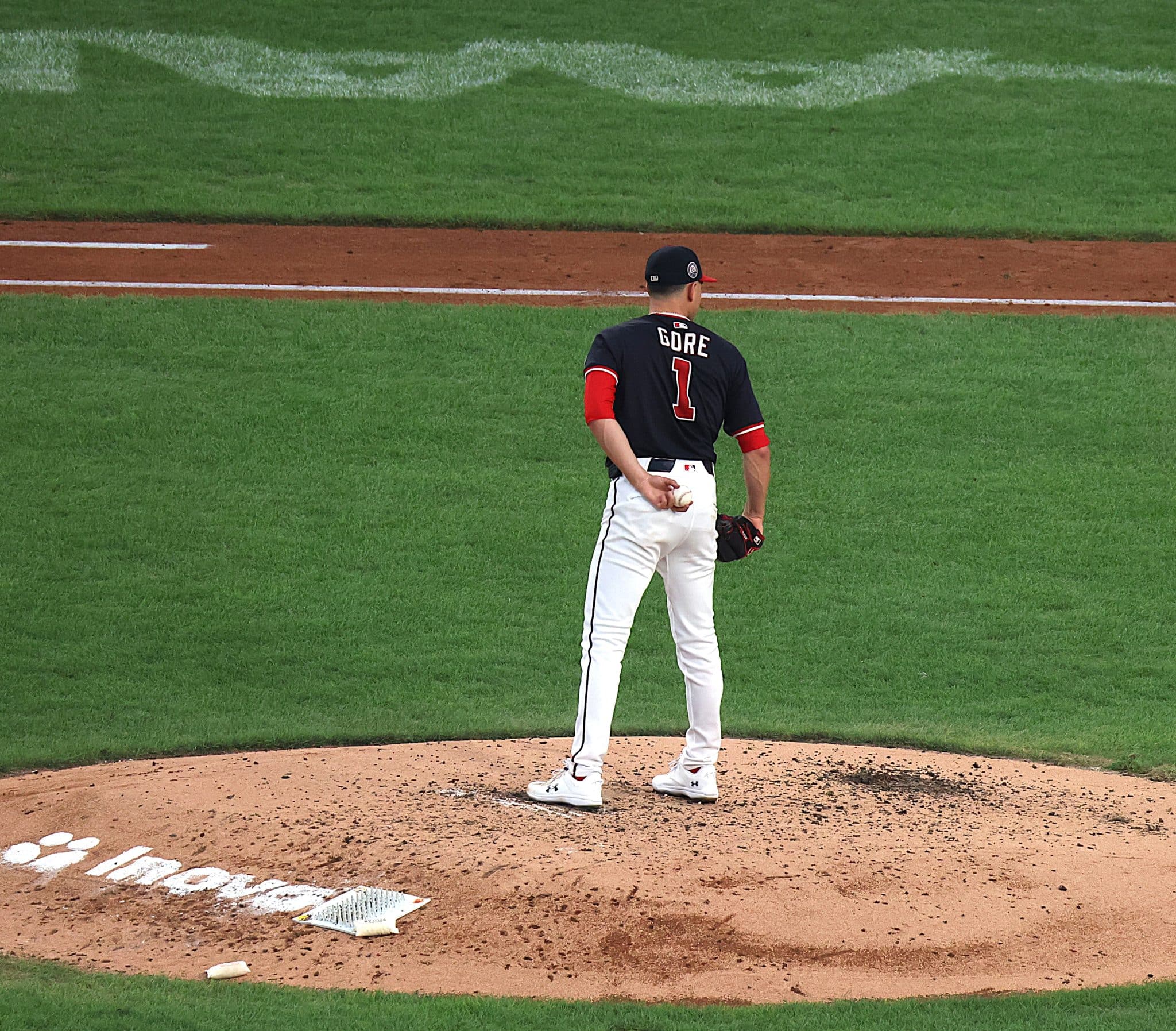

Before the Winter Meetings even started last week, the social media buzz had MacKenzie Gore … gone. In actuality, as of this morning, Gore is still the Washington Nationals No. 1 starting pitcher … as of this moment.
Days before the Winter Meetings opened, The Athletic’s Ken Rosenthal said there were at least 15 teams “in” on Gore. If you trusted Buster Olney’s words, GORE will be GONE by the time the Winter Meetings wrap up on Thursday as Olney wrote, “There is a perception in a couple of front offices that the Nats’ MacKenzie Gore will definitely be among those moved in the days ahead.”
We asked a source why Gore hasn’t been traded yet. And to paraphrase, “The answer is obvious that [the Nationals] couldn’t find the deal at this time that satisfied what [the Nationals] wanted.” So what went wrong? “Nothing went wrong. This can be a lengthy process. Or it might never happen.” What would speed up the process? “There are still excellent pitchers available in free agency. Teams have to be satisfied with their own internal process.” So pitchers like Framber Valdez, Ranger Suarez and Michael King, are slowing down the process, or are you talking about trade pieces like Freddy Peralta? “You said it.”
Maybe ESPN’s Jeff Passan was right. He put the odds of Gore being traded at 30 percent. He wrote that several days prior to the Winter Meetings. Passan also ranked each trade with some background.
Not much has changed in the pitching market. No blockbuster trades have been made unless you consider Paul Toboni’s trade for Harry Ford to be a blockbuster. In is Ford, and out went Jose A. Ferrer. Possibly a larger need was filled while weakening the bullpen.
If the Ford trade was an indication of how Toboni is approaching his process, this could mean that he is looking to fill larger and specific needs for Gore. What that means is Toboni had named pitching, first base, and the catcher positions as spots that he wanted to fill. Check catcher off the list. Next is pitching and first base. Could Toboni be waiting for a Gore trade before he fills in other spots? We asked our source that, and he would not answer that question.
The reason that Gore should be even more attractive to high payroll teams is because he is cost-controlled for the next two seasons. Matt Swartz was a Washington Nationals arbitration consultant for years, and he also contributes to MLB Trade Rumors.
Swartz projected Gore at a $4.7 million salary in his second arbitration year. MLBTR wrote, that Gore would probably get to “$8-10 million in 2027. An acquiring team would be getting two years of a mid-rotation arm for a total around $12-15MM. That’s a bargain even if Gore never reaches another level, but there are surely clubs that believe they can coax a better full season than he has shown so far.” And it goes further than that. If a team is paying a 50 percent luxury tax and isn’t spending $50 million over the next two seasons for Valdez, the salary savings is $35 million plus a $17.5 million luxury tax savings making it $52.5 million.
Gore ranked as MLBTR’s top trade candidate entering the offseason. Again, rankings are great. None of that matters in projections. It does feel like Gore is holding up the Nats offseason. The risk that Toboni is taking is what we saw this morning when news broke that Josh Bell signed with the Minnesota Twins. That is one more potential first baseman off the board. Everything is supply and demand.
Should Toboni move forward as if he is retaining Gore and make the rest of his acquisition -or- should he wait to potentially move Gore and then go from there?
Leave a Reply