
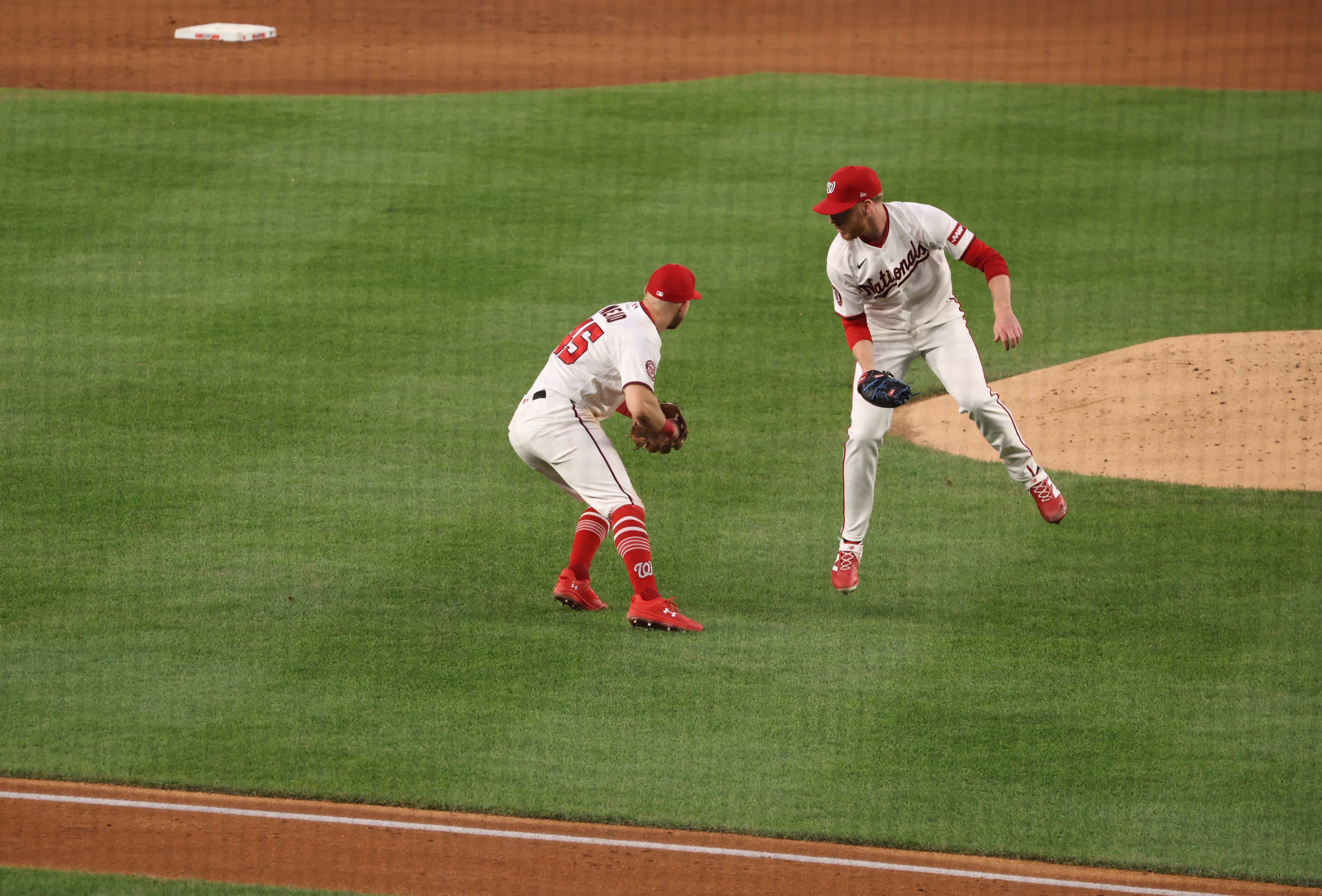
Last night felt like June 1 was April 1 all over again. Some déjà vu to unhappier times. A paradoxical time warp back to another solid Cade Cavalli start where the bullpen would blow another multi-run lead while also giving up five runs. And Cole Henry would be the last reliever on the mound … again … as the other dugout was celebrating.
Tell the truth, before last night, did you know who Heriberto Hernández was? He entered the game in Nationals Park during the 6th inning as soon as Richard Lovelady was summoned to the mound in relief of Cavalli. The lefty reliever would inherit a runner at first base and no outs. And Hernández’s stats flashed up on the scoreboard with a .200 batting average and a .571 OPS.
For some reason, Lovelady kept trying to pepper the the upper outside corner and missed three times as if he was facing some superstar and that was his kryptonite zone. It made little sense, and Lovelady quickly got himself in trouble as he fell into a 3-1 count. On the next pitch, Lovelady threw a hanging slider that came over the middle of the plate that even the weak-hitting Hernández jumped on. The ball was crushed with a 110.6 mph exit velo that sent the ball into orbit and 406 feet for a game-tying home run.
In five innings, the Nats put together a good start by Cavalli with offensive helpers via a 2-run homer from Jacob Young, and an RBI single from Curtis Mead. In a matter of a minutes, that 2-run lead was gone, and Lovelady was collared with a blown-save just 5-pitches into his outing. For good measure, Lovelady would give up another run to put the Nats in a 4-3 deficit, and that was all the Marlins would need on this night.
Baseball success is about consistently performing above the league average. One bad game happens. Lovelady, if you remember, was DFA’d in early April by the New York Mets, and sold to the Nationals on April 16. With four saves in the books and a 2.25 ERA entering last night’s game, the lefty had been one of the better relievers on manager Blake Butera‘s team. Sure, the 18 games he’s pitched in for the Washington Nationals have mostly been good — but last night was by far his worst. That’s two bad appearances in a row, and fans have to be nervous as to whether the 30-year-old has turned back into a pumpkin. Hopefully, Lovelady finds his love again.
With a solid and perfect 2⅓ innings by Paxton Schultz, the Nats were in this game until the 9th inning at that same 4-3 deficit. Then Henry came in for the final frame and totally unraveled. He gave up three runs that pushed his ERA to 7.20. It’s Henry who is really on the hot seat. Since his first appearance of the season, he hasn’t had a clean appearance from that point forward. He has two blown saves to go with two losses on the season. At this point, you have to ask, why Henry is here?
Actually, there are a few players that we constantly ask “Why are they here?” Some subscribe to the theory of “If it ain’t broke don’t fix it” since the team has a winning record. Maybe the guy who makes the decisions, Paul Toboni, thinks they can be fixed. Isn’t that what the minor leagues are for?
Of the 30 losses to date, the bullpen has 14 L’s on their record. The bullpen has 19 saves and 16 blown saves after last night. How does that stack up versus the league average? Not good to be honest. League average is converting 64 percent of save opportunities and the Nationals are at just 54 percent. So when you wonder why Toboni, just two weeks ago, said the team has squandered several wins, isn’t that an indictment on the bullpen he built?
Toboni gave that interview when the Nats were 21-22 on the season. Those “5-or-6 games where we let it get away from us” could be 9-or-10 games now. Again, no bullpen is perfect. But it has to be better. A 54 percent save conversion rate is not good enough.
Even though the Nats lead MLB in runs scored, the clutch hitting has to be better. The team has some real issues. This is where Ryan Zimmerman aka “Mr. Walk-off” needs to put on his coaches hat and talk with some of the players. Daylen Lile only has a .143 RISP batting average in those situations. Why can’t Lile replicate what he did in that one series near his hometown in Cincinnati? Then you have Jorbit Vivas who is batting .000 in a 24 at-bat sample size. That’s hard to be that bad. Two of the worst RISP hitters, Brady House (.196) and Joey Wiemer (.211) were both sent packing and are at Triple-A. And Jose Tena is at .222 and mostly getting platoon advantage at-bats.
This begs the question, why does a player do markedly better when a runner isn’t standing on second or third base? Lile bats .287 in non-RISP spots and exactly 50 percent lower in RISP spots. That has to be a mindset, some really bad luck, or a crazy coincidence. The opposite is true for CJ Abrams. He is near the top of MLB in RBIs with 47. He’s batting .390 in RISP spots and .258 in non-RISP situations.
In baseball history, Zimmerman is tied for the 8th most walk-off home runs with 11. He was asked about his approach with the game on the line in an at-bat:
“The pressure is on [the pitcher], man. It’s not on me. I’m supposed to get out. … The way I’ve always been taught is, the pressure is on the pitcher. Obviously, I want to get a hit as much as anyone else. But if you kind of put it into that mindset, it puts the pressure on [the pitcher], keeps you calm [as a hitter].”
— Zimmerman said in interviews
Pitchers have to remember that they have the upper hand. Even in the HR Derby, the batter doesn’t crush every meatball. Batters have to remember that the pressure is on the pitcher so don’t help him. Some say you learn it with age. Sure, experience matters. But Zimmerman hit his first walk-off home run at 21 years old. He had four walk-off homers by the age of 23.
There are teachable moments. Coachable moments. But there are some players who need to be learning it on a different stage.











Leave a Reply