
The current MLB soft cap system at the top, known as the Competitive Balance Tax (CBT), worked for years. Then teams like the Mets, Dodgers, and Phillies stopped caring about CBT penalties and spent like the money was burning holes in their pockets. The amount of 9-digit deals skyrocketed.
The New York Yankees finally jumped in, and the disparity in baseball was of the ‘haves and the have nots’ and that caused a seismic shift to scrap the CBT and go to a hard cap and a hard floor. The MLB owners want it, and the MLBPA players union does not.
The current Collective Bargain Agreement (CBA) for MLB expires on 11:59 p.m. EST on Dec. 1, 2026, runs 426 pages, up from 359 in the deal that ended on Dec. 1, 2021.
MLB and the MLBPA have been here before trying to agree to a cap which did not happen and of course there have been lengthy work stoppages before. If you trust both CNBC and Forbes for independent business reporting you know that MLB has fallen well behind of the NFL and NBA in team valuations and there are some NHL teams that are now worth more than MLB teams.
Let’s look at Forbes valuations of the four main Washington teams:
- Washington Commanders $7.6 billion
- Washington Wizards $4.7 billion
- Washington Capitals $2.55 billion
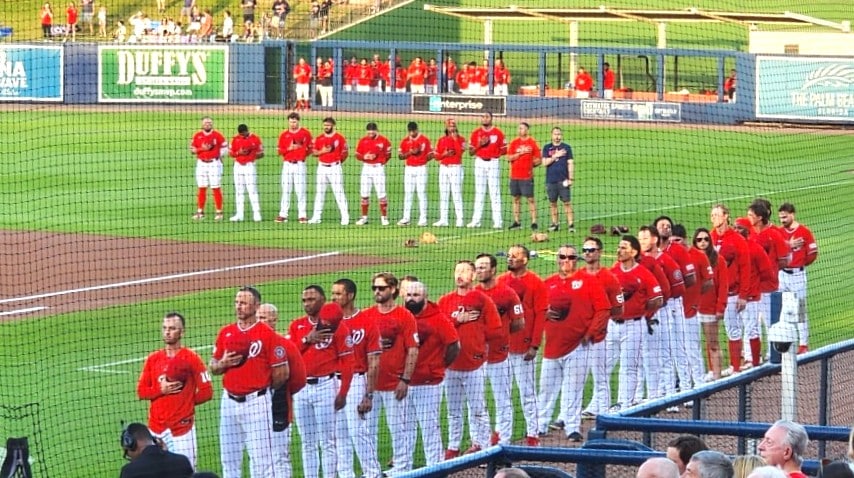
- Washington Nationals $2.1 billion
Just five years ago, the Nationals were the second most valuable sports franchise in the D.C. area. Today they are last in valuations. This isn’t a shift in just one city, this is happening in almost every city outside of New York and Los Angeles. MLB teams are slowly sinking to the bottom in valuations.
As far as average profit goes, MLB is dead last of all the major sports leagues. While some teams are making money, MLB owners have not opened up their books — except the Atlanta. The Braves are a publicly traded corporation, hence their books are open. They lost a lot of money in 2024 at over <$31> million, and narrowed that loss to <$23> million in 2025. But they also hosted the All-Star game in 2025 which was a 1-year windfall. In 2026, that might give us a better idea of their situation. Of course making the postseason could also shift the revenues. The Braves missed the playoffs in 2025 and had to refund to ticket-holders any funds they prepaid for playoff tickets.
MLB says that with a cap and a floor that salaries will increase overall while the MLBPA says that is not the case.
MLB’s Stance: The league argues that a system linking a hard cap and a hard floor to a 50/50 revenue split will boost overall salaries. Under this framework, MLB asserts that low-spending teams would be forced to increase payrolls to meet the minimum, while the cap would force high spenders to distribute talent and dollars more evenly across the league, improving competitive balance.
MLBPA’s Stance: The union strongly opposes this, arguing that hard caps generally suppress top-end salaries, acts as a ceiling, and restricts free agent bidding. According to the MLBPA, the proposed escrow system (designed to guarantee the 50/50 split) and limitations on maximum individual contracts would actually result in a massive pay cut for players in aggregate, effectively reducing the players’ overall share of industry revenue.
Major League Baseball proposed a hard salary cap of $245.3 million paired with a $171.2 million salary floor to the Major League Baseball Players Association (MLBPA) for a 2027 start. The players’ union has consistently rejected salary cap systems and opposes the plan. What was shocking to many was how strong MLB came into the negotiations with big numbers. Experts feel that salaries will rise accordingly if teams over the cap have a phase-in to get to that hard cap ceiling.
But the MLBPA knows that with a hard cap ceiling that some teams will not be able to bid up salaries like what happened in the Juan Soto sweepstakes where the Yankees and Mets battled it out. When the next big free agent comes up, there might be five to 10 teams who won’t have room for a Soto type of deal. We’ve seen that in the NFL but over time, that allows a small-market team like the Kansas City Chiefs a hometown advantage to retain a player like Patrick Mahomes. He still got paid but wasn’t going to risk free agency because few teams could pay him $64 million under the cap. Few complain in the NFL. Everyone seems to get paid at the top — the problem is more at the bottom just like MLB.
The salary disparity from the top to bottom where a pre-arb bench player makes below $800,000 a year, and Soto is earning more than that every 3-games is something that the veteran players seem to be fine with.
Approximately 25% to 30% of Major League Baseball players make over $5 million a year. While the average salary in MLB is a record-setting $5.34 million, the figure is skewed by massive top-tier contracts like Soto’s deal. The median salary is roughly $1.35 million to $1.5 million. But with the new CBA, you could expect salaries to rise at the low-end for a greater sharing of the wealth.
Doesn’t the MLBPA want a system where the median salary rises? As long as they have more salaries in total, isn’t that the goal? It sure doesn’t seem like it. They seem to want to protect the system with little change. The last time a small market team won a World Series was the Kansas City Royals in 2015. The Dodgers are dominating baseball due to their ability to sign almost any player they covet. They are also a well-run team. The Mets showed that spending isn’t everything.
For the Washington Nationals, a hard cap could be exactly what they need to keep some of their young star players who might not want to test free agency just like Mahomes. Fans want to retain their homegrown stars who often leave to go to the highest bidder. Again, in the short-term, salaries at the high-end probably will be impacted because there will be fewer teams that can bid on the top free agents. But over time as the NFL showed, that will change as team free up cap space.
Don’t worry, a player won’t starve if he doesn’t get picked up by the Dodgers. But why shouldn’t a small market team like Tampa have a shot at a superstar player because they have the cap space.
Some would argue that even with NFL parity that there are some bad franchises. That is true. But then it really comes down to drafting and developing players.
My belief is the Washington Nationals will hold-off on trying to sign any of their top young players until the CBA is resolved. This could be a great thing for Washington. A salary floor would force the team to spend more, and sharing TV money equally would give the Nats the needed revenue to increase their payroll.
December 1 is less than five months away. This could be headed to a showdown. But you hope the two sides can make compromises for the good of the game. The fans are the customers — sometimes they forget that. Play Ball.












Leave a Reply