

The NL East has three teams that could be aging out, and they all have poor farm systems. The Washington Nationals are aging in as the youngest team in baseball, and they have an excellent farm system.
Today, Bryce Harper turns 34. Father time is undefeated. Baseball years are kind of like dog years. On this day in 2027, he will be 35. Harper’s OPS is down nearly 18 percent from 2021 and while his numbers are still good, at some point age regression could hit hard. His own team president, Dave Dombrowski, called him ❝NOT ELITE❞ in a troubling statement on the day of Harper’s 33ʳᵈ birthday, a year ago.
Maybe Dombrowski learned on how to talk to his players as he said he talked to Trea Turner recently and said, “He did not have a good year. He needs to fix things with his swing. He knows he has to be better at shortstop. I told him that is mandatory.” But why the need to publicly discuss private conversations?
While Harper is a future Hall of Famer, he has played on some stacked teams that have severely under-achieved in his career with both the Washington Nationals and the Phillies. He will be known for signing with the Phillies in March 2019, and watching the Nats immediately win a World Series less than seven months later — without him. It just goes to show you that talent alone doesn’t win championships nor does the size of your payroll per Nathaniel Lowe.
The Atlanta Braves starting rotation will rely on Chris Sale who turns 38 in March. They are old and just not what they used to be. Like the Phillies, making the playoffs then making early exits don’t matter much. The Braves hold a $7 million team option on Ozzie Albies for the 2027 season — a bargain and then he becomes a free agent after next season. Ronald Acuna Jr. will be on team options for 2027 and 2028 (if they retain him) before he will head to free agency. Their window is just about closed.
Then you have the Mets. What an embarrassment on and off the field. They spend like drunk sailors with pockets lined with millions. They assembled a team with middling starting pitching and a billion dollar trio of position players in Juan Soto, Bo Bichette, and Francisco Lindor who watched their team sink to last place in the NL East. Bichette has an opt-out clause in his contract, but who will pay him what the Mets did?
All four of the Phillies, Braves, Marlins and Mets have farm system rankings in the bottom-half of baseball respectively at 29, 19, 18, and 16 per Baseball America. The Washington Nationals are ranked as the 7ᵗʰ best farm system with four Top-100 players.
❝The current [Phillies] group has grown stagnant. Change is necessary, before things get worse.
— Ken Rosenthal wrote in The Athletic two weeks ago
Their fans are tired of watching the season play out the same way year after year … [attendance] is down 4.3 percent from a year ago.
A number of the Phillies’ most prominent players — from Harper to Kyle Schwarber to Trea Turner; Zack Wheeler to Aaron Nola to J.T. Realmuto — are 33 or older.
The team is inconsistent offensively, shoddy defensively and haunted by Dave Dombrowski’s historic inability to build a quality bullpen.
Baseball America recently ranked the Phillies’ system the second-worst in the majors.❞
Baseball is as cyclical as it is cynical. In time, you get both. Players don’t dominate forever even though Max Scherzer is trying to prove otherwise. We don’t know what the future holds, due to the unpredictability of sports.
There is also the looming collective bargaining agreement (CBA) that could shake baseball and especially the Mets and Phillies, since they are well over what MLB is proposing for a hard cap of $245.3 million to go with a salary floor of $171.2 million starting in 2027 as part of a new seven-year CBA.
Some would say the Phillies and Mets have been in survival mode based on their spending to stay in the hunt. But it didn’t work for the Mets as they took last place this year, even though they spent $357 million. The Nats Opening Day payroll this year was $123 million of which $35 million was dead payroll for the retired Stephen Strasburg which means the Nats only spent $88 million comparatively. The Mets spent over four times what the Nats did, and Washington bested New York in the standings.
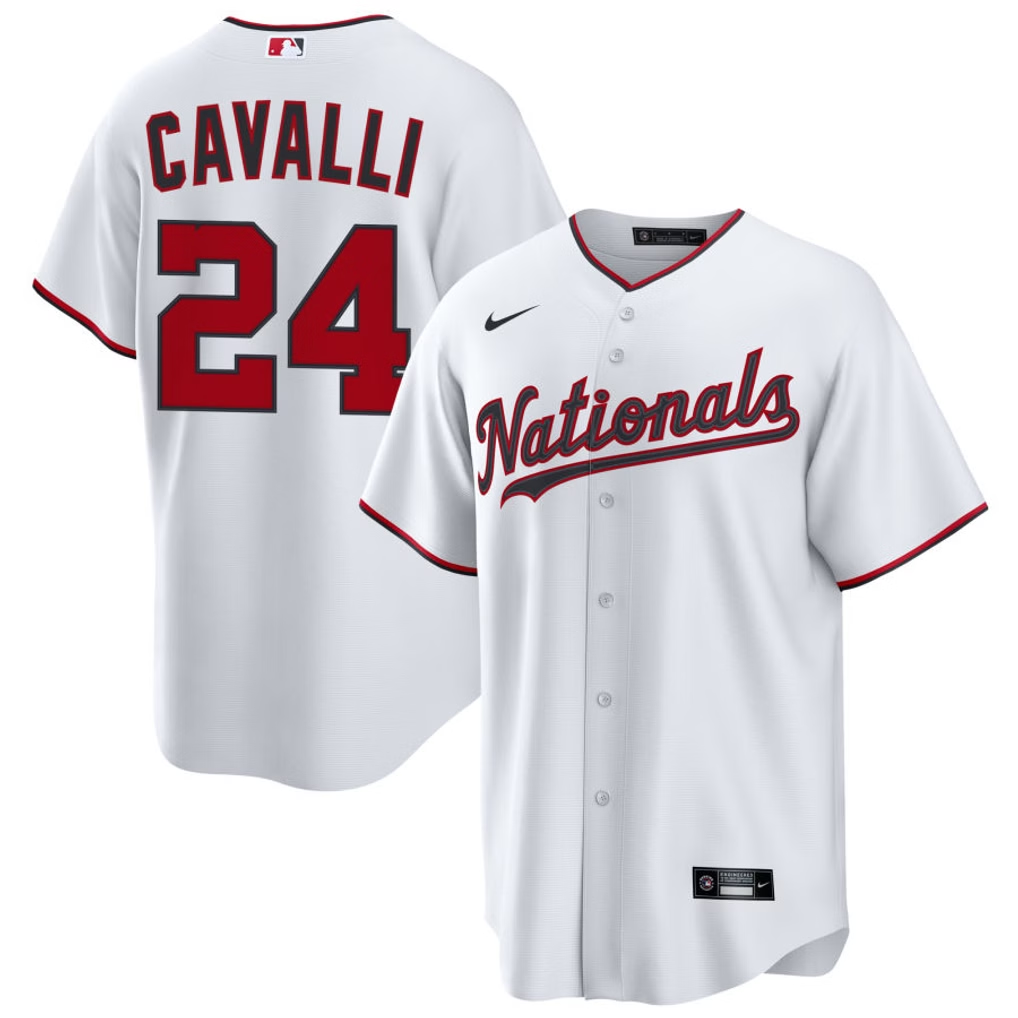
If you listen to Cade Cavalli, he believes that the playoffs are going to happen with the Nats contending in 2027. Cavalli says the rebuild is over. ❝Process is of a winning culture. … Fully plan on playing in October [2027].❞ When Cavalli says October, that is synonymous with playoffs. Playoffs? Playoffs? Yes, playoffs. ❝We’re walking around here feeling the weather, it feels like playoff baseball weather,❞ Cavalli said in September. ❝We’re planning on playing in it next year, and I know that every guy feels it — and thinks that.❞
If that payroll cap floor of $171.2 million becomes the law of the land as MLB proposed for the CBA, the Nats will be forced to spend — and if they spend wisely — that could accelerate the Nats towards serious contention in 2027. Our projected payroll to begin the offseason for the Nats is at $86 million assuming all arb-eligible players are retained, and minimum salary players get a pay raise to $1 million. If the minimum salary goes to $1.5 million, the number jumps to $96 million. Either way, that will give the team plenty of money to spend.
The Nationals are in a position for growth from their 77 wins from 2026. As president of baseball operations, Paul Toboni, said at the end of September, if they just won have of those blown save games that turned into losses and totaled 24, that would have been 12 more wins for a total of 89 wins — and guess what, that would have tied the Nats for the second Wild Card.
At his introductory presser, Toboni also talked about the “visible scoreboard” is how you should be judged. In the final count, they had 77 on that visible scoreboard along with some stats that show where they need to improve. And it’s clear how you better those numbers — but not easy to get there. As they say, improvement is easier for a losing team than a winning team.
Again, you cannot change the past — you can learn from the past to impact the future. Toboni talked about building a strong foundation then putting in the doors and windows once the foundation was ready. What’s interesting is Chicago White Sox owner Jerry Reinsdorf just said the same about that after his team’s wild card win to end September, “When you build a building, the foundation comes first. [Our GM] went about putting in-place a terrific foundation, [through] scouting and minor-league development.”
Yes, Reinsdorf hit on “scouting and minor-league development” which is exactly what Toboni took on to improve the 2-headed “monster” he referred to when he inherited a Bottom-10 farm system in what Toboni called the “lifeline” of a team that needed an overhaul and improvement. He hired Devin Pearson to oversee the player development in the minor league system. Within 10 months, the farm system transformed into a Top-7 system per both Baseball America and MLB Pipeline rankings.
Toboni has shown that great coaching and player development matters. How they got there — and how quickly they got there is amazing. But it took blood, sweat, and tears, plus massive change to get there. And while few give credit, it took financial resources too.
Over 50 people were let go in what was described as a bloodbath of firings a year ago, and then Toboni brought in much more than 50 people to replace them. At the end of September, Toboni referred to where he spent money was in places fans couldn’t see:
❝I wouldn’t have [taken] this job if I didn’t think there was a real chance to win here for a good amount of time. The jump to 77 wins this year and what led to that — and a lot of what drove that was ownership pouring money into things that fans didn’t really see. … The [technology, analytics, and machines] and we hired a ton of people who are top of the industry and that requires a lot of money. ❞ — Toboni said on 106.7 radio
The new hires in the front office, coaching, analytics, and player development didn’t go to traditional lifers in baseball, and instead went for mostly younger minds, many without any pro baseball experience at all.
Names that were not top-of-mind that began with the hiring of manager Blake Butera, a 33 year old at the time, who only had lower-level minor league managerial experience. This was just one of Toboni’s moves that was criticized for months.
At 33, Butera became the youngest MLB manager since the Minnesota Twins hired Frank Quilici in 1972. Quilici inherited a team that only lost 86 games the year before. Butera inherited a 96 loss team. In his first full year, Quilici’s team went 81-81, a 5-loss improvement. Butera’s improvement was by 11. That should get him some Manager of the Year votes.
For the first few months after Toboni’s hirings, there was lots of talk about their ages and lack of experience. Some called the hirings a typical Lerner ownership move to save money because some just always think the worse. Many were in waiting for this to fail. Well it didn’t fail. If anything, this might become the blueprint for teams in the future. In order to do that, the next step is a return to winning as proof of concept.
Having postseason aspirations is why you play the game. You play it to win. There are no participation trophies. Winning 77 games with declining attendance felt like a step backwards as a business entity for the Washington Nationals. But 77 wins with the hopes for some shrewd offseason acquisitions coupled with continual improvement is the recipe for success at the turnstiles and a push to making the 2027 postseason.
“ … Make sure there are [coaches hired] here that will help players reach their ultimate potential.”
“I think more than anything, we have some young, exciting players. … I’ve told many of them, and I really believe it, I think there’s another gear to tap into with many of them.”
“So many of these [young Nats players] have such great skill sets. Now, it’s up to me to hopefully place the support around them where we can tap into another gear for them. But at the same time, it’s up to them to hold themselves accountable — and hold each other accountable — to reach each of their own potentials.” — Toboni said after he was hired
With all the changes in the front office and coaching staff, there was little change to the roster, other than the bullpen and the back of the rotation. Curtis Mead, Jorbit Vivas, and Joey Wiemer were the only changes to the position roster at the beginning of the season.
They essentially kept the majority of players from the previous team and did exactly what they promised that they would get an “extra gear” out of each player.
“The organization is built around people, trust, and doing things the right way… The goal is to create an environment where every player feels challenged yet supported … maximizing each player’s potential … start with the foundation … I think they are really good right now — but there is another gear they can get to, and as we build out our staff, make sure we surround them with people who can get them to that second gear .” — Butera said when he was hired
Again, the “extra gear” statement sounded gimmicky and BS. But it absolutely worked. Coaching mattered. The analytics mattered. The technology mattered. This is the blueprint. The key going forward is evolving and improving and winning.
Now we have the final numbers to see the extra gear, and it’s impressive when you look at the returning full-time players of which there was seven of them in the lineup. OPS increases for the seven: Dylan Crews (+5.1%), James Wood (+8.0%), CJ Abrams (+11.5%), Jacob Young (+21.3%), Brady House (+23.7%) Luis Garcia Jr. (+24.5%), and Keibert Ruiz (+27.6). Take those numbers, and that is an increase of 17.4 percent in an unweighted average.
In 2025, the Nats were the 20th scoring offense in baseball with 687 runs scored — today, the Nats finished No. 3 in runs scored (821) with virtually the same lineup as last year. The Nats finished ahead of the mighty Los Angeles Dollars Dodgers. Before we take a victory lap, there is work to be done here. The Nats finished in the bottom-half for RISP hitting (.250) and tied at No. 16. The Top-10 teams in RISP all made the playoffs but two teams. Situational hitting is where the Nats must improve going forward.
On RISP, if the Nats could increase by 4 percent to get to at least .260 next year that would get the Nats to where the 10ᵗʰ best team in RISP was in 2026. That might not sound like a lot, but that 4 percent on 1,399 at-bats would have resulted in 56 more hits and kept more innings alive. Assume just 56 more runs, and the Nats would have finished No. 1 in runs scored. Those extra 56 runs would equal 2-wins additionally per the Pythagorean formula. Hard to believe just 2-wins — but that is Bill James formula. Pitching runs saved means more than offensive runs scored in the Pythagorean calculation.
Staying on the RISP theme, the other bad news is that two of the Nats best RISP hitters are gone: Luis Garcia Jr. hit .330, and Curtis Mead was at .311. The other Nats above .250 were Yohandy Morales in a small sample size was at .400, Andres Chaparro at .341, CJ Abrams at .311 and Jacob Young at .276. That’s it. You now know that six other starters were below the .250 and there is work to do. By taking out Garcia and Mead, that makes the numbers worse.
If there are two challenges for the hitting staff led by Matt Borgschulte, it is to improve on situational hitting and especially RISP, and fewer chases out of the strike zone and what FanGraphs calls O-Swing. By the way and speaking of Borgschulte, a source told us that his contract expires at the end of 2027. He needs to be extended at least for another year.
Now let’s get further into the math. The Nats’ pythagorean per Baseball Reference.com in a W-L was: 82-80 based on the Nats finishing at a +6 run differential. That might say the Nats under-achieved by five wins. Yes, there is the unlucky factor, and an historically bad bullpen based on those blown-save losses were the difference.
“I think if we had an average bullpen, I think we’re probably talking about who we’re playing [in the postseason].”
“Whether it’s personnel, whether it’s roles, whatever it might be, we’re going to spend a lot of time on the bullpen this offseason.”— manager Blake Butera said in September
Fix the bullpen to a league average in runs given up at the very least. The Nats bullpen finished at a 4.99 ERA (editor’s note that bullpen ERA isn’t close to the worst in Nats history). The MLB middle is 4.065. That is 92.5 runs of improvement for a bullpen that pitched 730⅔ innings in 2026.
Do you know how many runs a 4.06 ERA would save? We did the math. That would improve the Nats from 405 earned runs in the bullpen to 330. An improvement of 75 runs. It’s like magic. With no changes to the starting rotation and just improving RISP hitting and the bullpen to average, the new Pythagorean gets the Nats to 88.85 wins. Round that up to 89. Now if the Nats scored the same exact 821 runs, the Pythagorean changes to 86 wins. Then you would have to improve the starting rotation some.
Well, here’s the great news. After the trade deadline, the Nats had the 10ᵗʰ best starting rotation ERA in baseball at 3.91. Another incredible factoid. We gave you this number before and people were surprised by that number. Maintain that 3.91 ERA for a full season (706⅓ innings) and that is 307 starter’s runs allowed — a vast improvement, and get the bullpen to league average at 330 bullpen runs, and score the same 821 runs, and voila, this team is a playoff team at 91 wins per Pythagorean. Math is fun.
Where would 637 earned runs by the pitchers be in baseball this year? That would be 10ᵗʰ in MLB. While nobody is going to brag about being the 10ᵗʰ best, that is a much better starting point than 5ᵗʰ to last like the Nationals were this year in pitchers’ ERA, right? And everything is about the right amount of balance. Balance is what is needed to build properly on top of that foundation.
Everything had to work seamlessly, and Toboni was hiring personnel at the same time as they began redoing facilities at the West Palm Beach baseball complex and bringing in technology. He was spending millions of his budget on key people, infrastructure, and technology. They were hard-wiring every backstop on each field in West Palm Beach for his new tech. He didn’t get one Trajekt Arc machine — he got three of them. And Toboni hired people who understood the technology and how to communicate with the players. The undertaking was enormous. There were reasons to be skeptical at the time, and he pulled it off.
Toboni said he would be working on his autopsy of the season and has probably finished that now. This one should be easier than last year. He already parted ways with some personnel as you read. He also said he expects other teams will be trying to poach some of his people. At the same time, Toboni said he is trying to hire additional staff and especially in his analytics department.
Small steps became big steps during the year. Not everything was perfect, and to the public, they rarely get a glimpse of what is going on behind closed doors. A source told us that it was “controlled chaos” at first then it was smooth sailing as everyone was rowing together. We quoted that before.
It shows first and foremost that the Juan Soto trade probably saved the Nats, and Toboni made special mention of that in his final radio show of September on 106.7 The Fan. That trade yielded James Wood and CJ Abrams, and also MacKenzie Gore who was traded for top prospects. And still in the wings from that trade is Jarlin Susana who I still believe should be a back of the bullpen stud.
Getting that “extra gear” was the key in all of this. Getting more out of the same players was transformative. This was not the same Wood and Abrams of yesteryear. The old regime did trade for them, and the new regime took them to new heights, from very good players to great players. As Toboni and Butera talked the talk — they walked the walk, and that is so refreshing in a world of over-promise and under-perform.
If you aren’t a player who improved year-over-year, a good chance that you were already released or demoted. There will be some minor leaguers who won’t be back next year. One is Riley Adams who never made it back to the Nats this year and as a minor leaguer who had been outrighted more than once with at least three years of MLB service time, and currently off the Nats’ 40-man roster during the 2026 season without being added back, he qualified to declare after the minor league season ended to become a free agent.
The new Nats system was built for improvement. This improvement is why the system is now ranked so high in baseball. Toboni’s other goal that he laid out at his hiring was to create a “scouting and player development monster.” Being Top-7 is close. You could say the team is moving in the right direction.
“Beyond that, we’re going to be pretty open-minded,” Toboni said on Friday. “What is involved there, too, is not just like ‘Are we going to go outside and sign players?’ but we have a number of pitchers on our staff that are at inflection points in their career. … We want the process of really developing this offseason to be really dialed in, and I think our guys are bought into that.”
Today, the team is better, the system is thriving, and the pitching is the next order of business. Fix the pitching, and this should be a playoff team as we showed you. Hopefully the Nats’ ownership understands that. If extending Cavalli was a sign, that was a welcomed sign. Toboni appeared in the final weekend of the season on the Nats’ broadcast and said that everything that he has brought to ownership they agreed to. Everything? Yes, “everything” per Toboni’s words. Their job is to support Toboni with the financial resources to make the next step forward.
The NL East should be there for the Nats to jump into contention. In theory, that all sounds great. Now ownership must back-up the front office with more financial resources to get to this important next step: Playoffs.










Leave a Reply