
There are obvious holes to even the untrained eye when it comes to Washington Nationals. When you set an ignominious record for 42 blown saves, you have a gaping black hole. When the back of your rotation has a full-time starter with a 5.48 ERA, and you DFA’d the pitcher with the 4.97, things are crystal clear that President of Baseball Operations, Paul Toboni, has gaping holes to fill in pitching.
On top of that, Toboni traded away two of his best hitters at the trade deadline and probably needs to add at least one more impact bat this offseason.
In a letter to the fans, Toboni wrote, “I am not an anxious person, but if there is one thing that keeps me up at night, it is the possibility that we fail to maintain our forward momentum.”
Expect more from Toboni as the General Manager’s meetings started today and run through Nov. 12 in Las Vegas, Nevada.
All of this came earlier from Toboni:
“Generally speaking, future payroll flexibility is a really good thing. I’m happy that we’re in this spot that we’re in. What I would say is that there are creative ways to actually use that payroll, whether it’s actually going out and signing free agents or extensions or whatever it might be. What we want to do is — regardless of how we’re going to use the payroll — do it in a way that sets us up, hopefully, to be a much better team next year, but then be a really good team into the future.”
“I don’t think we can go into next year just thinking it’s a given (the offense stays as good as 2026). … Wherever the roster could benefit most from either internal development or promotions or trying to go out and sign players that play those positions obviously, we’re going to be super open-minded on it.”
At the end of the regular season, the free agents available were in a much more condensed list. With several opt-outs and option declinations, the free agents available are in a much larger list.
The Nationals will have a good supply of starting pitchers and relievers to consider via free agency. But the stock of position players is not a deep list, and especially for left-handed bats.
Do not be surprised if Toboni goes the trade route for a position player a source told me.
Toboni also said he doesn’t want to look at just closers for acquisitions to help his bullpen next season. There are key set-up men and high leverage relievers who haven’t been primary closers that Toboni will look at for acquisitions.
“I wouldn’t want to pigeonhole us into just going after guys that have ninth-inning experience. Not to say it’s not important; it’s just that there are countless relievers across the league that aren’t throwing in the ninth inning that are really good arms that we’d love to have,” — Toboni said
Roster Moves
The Nats made two trades already this offseason. Both trades were not for players with spectacular MLB résumés. The team acquired two players in separate deals with the San Francisco Giants for infielder Nate Furman and LHP Reiver Sanmartin. The Nats sent left-handed pitcher Tony Neubeck and right-handed reliever Robert Cranz back to San Francisco. To clear 40-man roster spots, the Nats DFA’d LHP Richard Lovelady and RHP Kyle Nicolas.
To clear a 40-man spot earlier last week, the Nats DFA’d Jose Tena. Next week, the Nats have Rule-5 decisions to make as they will need at least two spots for Jarlin Susana and Travis Sykora. There would be no surprise if Toboni wanted to protect Alejandro Rosario and even Max Romero Jr.
Plate Discipline
If you take clues from Toboni moves, Furman was cited by Baseball America as having the “Best Strike-Zone Discipline” in San Francisco’s system. This is where Toboni and the player development system have been stockpiling players in the draft as they look for that strike-zone discipline.
Players like Chris Hacopian as the first pick in this year’s draft, and Eli Willits in last year’s draft as well as Toboni’s trade acquisition for Devin Fitz-Gerald have been the focus on strike zone recognition as well as O-swing discipline. If you want a good read on that focus, read this article on FanGraphs.
Also, this is a Moneyball play. Players with strike zone recognition as well as O-swing discipline are generally considered less expensive than free-swinger power hitters, unless you’re talking about Juan Soto who has the plate discipline and the power.
The top team in O-Swing discipline was the Milwaukee Brewers. They were also the top team in RISP hitting. In fact, look at this chart that Esteban Elizondo created for us. The two best RISP teams were the World Series teams, and Milwaukee scored the second most runs in the 2026 season.

To sustain the success of the offense, the measuring stick is on runs scored on the results side. On the process side, how did you get there? The Nats were first in baseball before the trade deadline and were near the top on power and speed. They gave themselves more RISP chances with all of the runners they put in scoring position, even though they were middle of the pack at a .251 batting average in RISP opportunities.
Building a roster of position players on power, speed, and athleticism was the 2026 Nats. Getting back there is what keeps Toboni up at night. That is understandable. Who and how he adds to the roster will be interesting. The lineup feels like it needs a bat to replace Luis Garcia Jr. from the left side. Who that will be and where they would fit on that graph is important.
The New Moneyball
Truth be told, and I forgot all about an article I wrote last year in early October about the Milwaukee Brewers about the new Moneyball. What was of interest is that last year the Brewers and Nationals of 2025 had the same payroll yet they were oceans apart on most everything else that counts.
In clearer focus with recency bias, we got to see what worked for the two World Series teams of Milwaukee and Tampa, and it wasn’t about home run power or sustained starting pitchers, rather it was about unselfish at-bats and working pitchers with RISP success, and relievers who stepped up and got the job done.
Before this year’s playoffs, how many baseball fans outside of Tampa and Milwaukee knew Bryan Baker, Aaron Ashby and Trevor Megill?
In Moneyball, you maximize great results at a smaller payroll cost. The movie focused on-base percentage not bullpens. There is much more to it than just that.
For the 2026 Major League Baseball season, all three relievers provided an incredible return on investment, as they were paid a combined total of $11.475 million in base salary:
? 2026 Salary Breakdown
Aaron Ashby (Milwaukee Brewers): $5,500,000 base salary
- Contract Status: Ashby is playing under a 5-year, $20.5 million contract extension signed back in 2022. Because the deal escalates annually, his base pay was $5.5 million for 2026 (carrying a total payroll cap hit of $5.7 million).
Trevor Megill (Milwaukee Brewers): $4,700,000 salary
- Contract Status: Megill avoided arbitration prior to the season by settling on a 1-year, $4.7 million deal. He has one final year of arbitration eligibility left for 2027 before he hits unrestricted free agency.
Bryan Baker (Tampa Bay Rays): $1,275,000 salary
- Contract Status: Baker hit arbitration for the first time before the 2026 campaign, avoiding a hearing by locking in a 1-year, $1.275 million deal. He remains under team club control through 2028.
Following this approach, Toboni needs to find his Baker, Megill, and Ashby. That would be a good start to fix the broken bullpen from the 2026 season.
Again, this is not about targeting expensive players, rather finding the right players who fit the model that Toboni wants to build of dependable starting pitchers, disciplined hitters who drive in runs and score runs, and a lockdown bullpen.
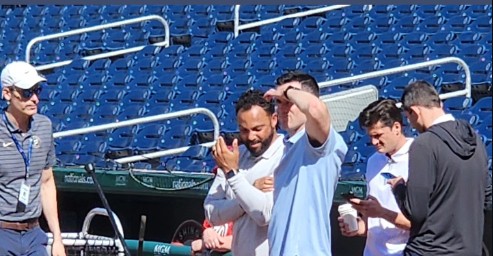
Photo by Andrew Lang for Talk DC Sports










Leave a Reply