
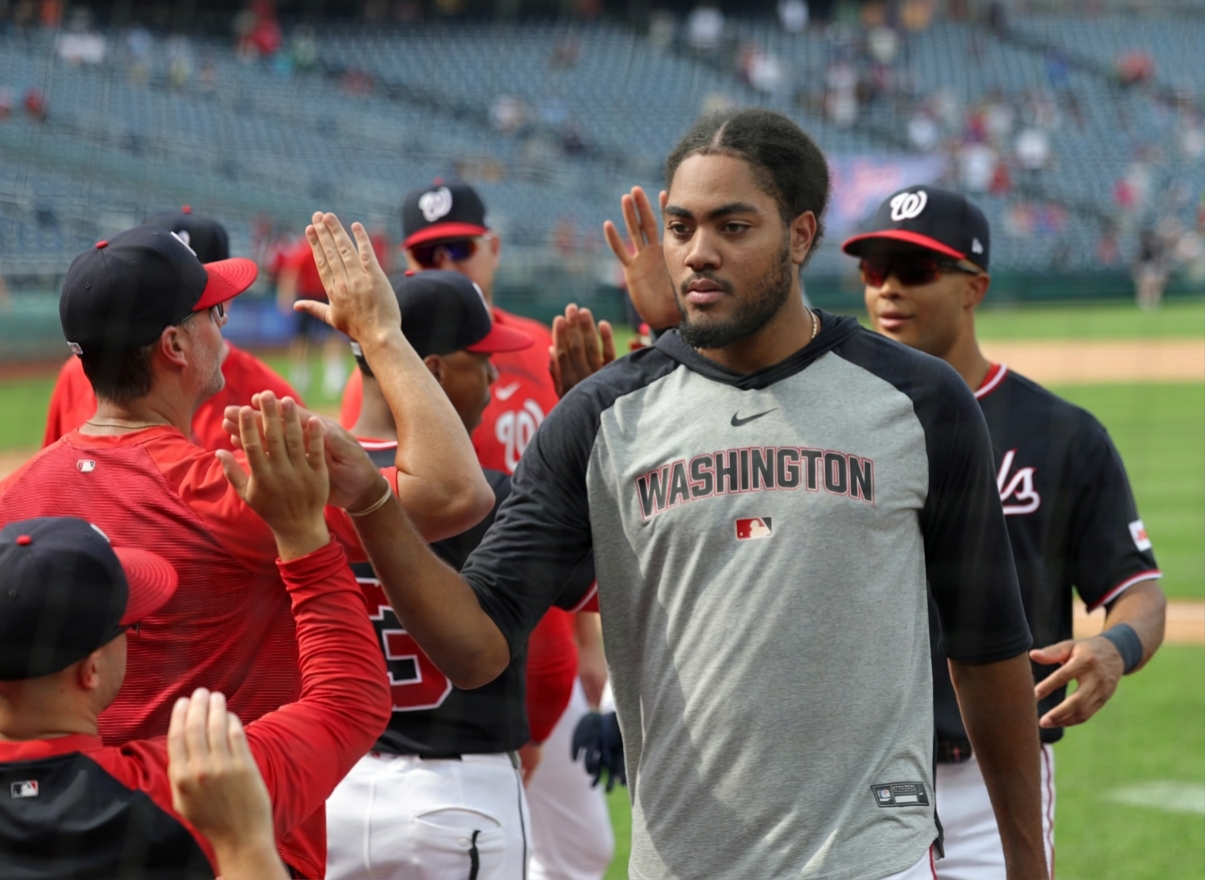
Washington Should Lock Up Their Young Superstar Before the Price Gets Even Higher
The Washington Nationals have an opportunity to change the future of their franchise, and one of the most important decisions facing the organization is whether they can convince James Wood to sign a long-term contract extension. Yes, this one is complicated. His agent is none other than Scott Boras.
Rather than waiting until his contract situation becomes more complicated, Washington should prioritize keeping Wood in the nation’s capital for the foreseeable future.
According to reporting from former Nats’ general manager Jim Bowden, the Nationals are still attempting to work out a long-term agreement with Wood. That is encouraging news for Washington fans, particularly because the organization appears interested in building around its young core. However, there is an important distinction between Washington wanting to sign Wood rather than any credible news that anything is close. As we reported, the Nationals’ interest in a long-term deal when we asked the Boras side about the possibility of an extension was described as “non-substantive” at this point. In other words, Washington may be interested in getting something accomplished, but there is no indication that negotiations have reached an advanced stage. That does not mean an agreement is impossible. It simply means the Nationals have work to do.
Securing Wood should be a major organizational priority. Is it? That’s the main question. Will the team wait for a new collective bargaining agreement (CBA)? That would seem prudent. The Nationals have another potential franchise cornerstone developing right in front of them. Wood is team controlled through 2030 — giving this some time. So when is the right time to get serious?
James Wood Is Exactly the Type of Player Washington Should Build Around
There are plenty of reasons why the Nationals should make Wood a priority. At just 24 years old, Wood has already established himself as one of the most exciting young power hitters in baseball. The 2-time All-Star was 16th in NL MVP voting.
Wood’s combination of size, athleticism, plate discipline, and power gives him the potential to become one of the most productive offensive players in the National League. His 2025-2026 seasons demonstrated just how much potential he possesses. He finished with 30 home runs, 77 RBIs, 21 stolen bases, and a .891 OPS in 2026 while recording back-to-back 30+ home run seasons and got to over 20 stolen bases. The power/speed combo was huge. His .388 on-base percentage and .503 slugging percentage demonstrated that he continued developing into a more complete offensive threat. Those numbers are particularly encouraging because Wood is still young enough to improve. He is not simply a home-run hitter who depends on one offensive skill.
The ability to get on-base, hit for power, and steal bases gives the Nationals a player in Wood who can influence games in multiple ways. Wood represents the type of player who can become the centerpiece of this youth process with the team.
A long-term extension of Wood could give the organization a legitimate foundation around which it could build its next competitive roster.
The Nationals Do Not Want to Repeat Their Previous Mistakes
Washington fans have every reason to be concerned about the organization’s history with retaining young superstars. This isn’t just a Nats issue — this is an MLB issue. All teams face this issue.
Fans point to former Nationals players such as Bryce Harper, Trea Turner, and Juan Soto who were all offered lucrative extensions and all declined them. This shows how timing and a myriad of factors make it difficult when free agency in MLB is a feeding frenzy. All three were important pieces of the franchise, but Washington ultimately didn’t keep them in the organization for the long-term. The circumstances surrounding each departure were different, but the broader lesson remains the same: developing elite talent is only part of building a successful franchise. Retaining that talent can also be important.
The Nationals cannot afford to continually develop outstanding players only to watch them somewhere else. Again, nothing is a guarantee as we saw with Anthony Rendon. And truth be told, the Nats have multiple stars thanks to trading Turner and Soto that includes a huge tree of prospects starting with Wood, CJ Abrams, Keibert Ruiz, Jarlin Susana as well as the prospect haul from the subsequent MacKenzie Gore trade.
Wood provides Washington with an opportunity to take a different approach. Instead of waiting until he approaches free agency, the organization should explore a contract that rewards him financially while also providing the franchise with several additional years of control. There is no guarantee that Wood will sign such an agreement. His representation, led by Scott Boras, has historically been comfortable allowing elite clients to approach the open market when doing so offers the greatest financial opportunity. That makes the Nationals’ challenge even more significant.
Washington must present Wood with a compelling reason to believe that remaining with the organization is just as attractive as eventually testing free agency. He was born and raised in the Washington, D.C. suburbs making this more significant.
Why the Timing of an Extension Matters
One advantage Washington currently has is time. Wood is not expected to reach free agency until after the 2030 season. That gives the Nationals several years of contractual control before he can become an unrestricted free agent. From the team’s perspective, that creates an interesting negotiating situation. The Nationals do not necessarily have to offer an enormous contract immediately. They could potentially structure an extension that buys out some of Wood’s remaining arbitration seasons while adding several additional guaranteed years. However, waiting also comes with significant risks. If Wood continues producing at an All-Star level, his value will increase. Every additional season of elite production could make an extension more expensive. His 2026 performance is a good example. After hitting 31 home runs in 2025, he followed that with another 30-homer season and improved his OPS from .825 to .891. If that development continues, Washington could eventually find itself negotiating with a player whose market value has increased dramatically – and then again, need we mention: Boras is his agent!
The Nationals should recognize that an extension is not simply about securing Wood’s services for a few additional seasons. It is also about potentially creating financial certainty before his price reaches its highest point.
What Would a Realistic James Wood Extension Look Like?
The Nationals would likely need to make a significant financial commitment to convince Wood and Boras to consider giving up future free-agent opportunities. An extension should recognize his age, offensive production, long-term potential, and importance to the franchise. A reasonable starting point for discussion could be an eight-year contract worth approximately $180 million to $200+ million, potentially structured to include a combination of guaranteed money, signing bonuses, and performance incentives.
That would be a substantial investment, but it would also reflect the importance of keeping a player with Wood’s potential in Washington.
The exact structure would depend on how many existing contract years are included, whether the agreement begins immediately or after his current contractual control, and how much additional free-agent time Washington would receive. The Nationals could also explore a longer agreement with a higher overall guarantee if Wood and his representatives are willing to negotiate.
If the Nationals genuinely want to keep Wood, they need to demonstrate that commitment financially. A contract in this range would be an aggressive proposal rather than a prediction of what Wood will accept. The club should be prepared to adjust its offer if negotiations develop.
Scott Boras Makes This a Challenging Negotiation
One of the biggest obstacles facing Washington is Wood’s representation. Scott Boras is one of baseball’s most prominent agents, and his approach to contract negotiations is well established. He represents players whose performance and market value can translate into enormous free-agent contracts.For Boras, allowing a young star to continue developing before committing to a long-term agreement can make considerable financial sense.
Wood has already demonstrated that he can produce at a high level in the major leagues. If he continues improving over the next several seasons, his earning potential could become enormous. That is why the report describing the Boras side’s response as “non-substantive” should not necessarily alarm Nationals fans. It does not establish that Wood has rejected an extension. It also does not establish that negotiations are progressing. It simply suggests that there is not yet a meaningful indication of where Wood and his representatives stand.
Washington must be patient, but patience should not become an excuse for failing to make a serious offer. The Nationals need to show that they are committed to Wood and willing to make the financial investment necessary to keep him.
An Extension Must Be Accompanied by a Commitment to Winning
There is another important factor that could influence Wood’s decision. Players do not always make contract decisions based exclusively on money. Winning, organizational direction, clubhouse culture, and the opportunity to compete for championships can also matter. Washington must demonstrate that it has a legitimate plan to become competitive again. That means improving the pitching staff, and adding established major league talent when opportunities arise.
A long-term extension with Wood would be an important first step, but it cannot be the organization’s only significant move. The Nationals need to convince their young star that he will not spend the majority of his prime years playing for a team that is constantly rebuilding.
If Washington can surround Wood with a competitive roster, the appeal of remaining with the organization could become considerably stronger. The team also needs to demonstrate that its front office has a clear vision and the willingness to invest in that vision.
Wood should be able to look at the organization and believe that the next several seasons will be about competing rather than simply developing prospects.
The Nationals Need to Make Their Move
Ultimately, extending James Wood should be one of the Washington Nationals’ biggest priorities. The organization has a young player who has already demonstrated tremendous offensive ability and appears capable of becoming one of baseball’s premier hitters. His consecutive 30-home-run seasons are encouraging, but his overall development is perhaps even more important.
Wood has shown that he can produce power, get on base, steal bases, and handle a significant everyday role. Players with that combination of abilities are difficult to replace. The encouraging part for Nationals fans is that the organization is reportedly still trying to work out a long-term agreement. That indicates Wood remains part of Washington’s plans.The challenging part is that there is no indication that the Boras side has entered substantive negotiations.
The Nationals must understand that they are negotiating from a position in which time is available, but the opportunity to secure Wood at a reasonable price may not last forever.
Washington has already experienced what happens when homegrown stars eventually move on. The organization should be determined not to repeat that history.
James Wood has the potential to become the face of the next great Nationals team. If the franchise wants to build a sustainable winner, it should make keeping him in Washington a central part of its long-term strategy. The Nationals have identified the player they want to build around. Now they need to make an offer that gives James Wood a compelling reason.
Photo by Marideth Sandler for Talk DC Sports













Leave a Reply