
By 6 p.m. ET on Tuesday, the Washington Nationals have to set their 40-man roster for the winter, and every prospect who is eligible for the Rule 5 Draft and left off that roster can be taken by another club when the draft is scheduled on December 9 in San Diego during the Winter Meetings.
The mechanics matter for everything that follows. A non-injured player selected in the Rule 5 Draft has to stay on his new club’s active roster for the entire season, or be offered back to his original team. That is why proximity to the majors drives almost every decision, and why injured players are their own special category, because a selecting club can stash an injured player on their injured list.
The Nationals’ math is tighter than most. Their 40-man roster is full at 40 players, so every protection comes with a cost: somebody currently on the roster loses his spot. By TalkNats’ count, there are 38 Rule 5 eligible players in the system. Here is how the decisions stack up.
The Nationals have history here
This process has shaped the roster before. The best Rule 5 pick in franchise history is still Jesús Flores, the catcher the Nationals took from the Mets in 2006. Flores had never played above High-A, stuck on the roster all season anyway, and became the club’s starting catcher. He is the proof of concept for the whole draft: a player another organization could not protect turned into an everyday regular.
The recent run has been active too. The Nationals took Thaddeus Ward from Boston with the first pick of the 2022 draft, and he spent 2023 in Washington’s bullpen before injuries and a stint at Rochester, and he was later claimed on waivers by Baltimore. A year later they took Nasim Nuñez from Miami, and Nuñez stuck, carved out a real role, and goes into this winter as the projected starting shortstop on the club’s own depth chart. The other side of the ledger is just as instructive. Evan Reifert, taken from Tampa Bay in 2024, was returned to the Rays the following March. Griff McGarry, taken third overall from the Phillies last December after winning Philadelphia’s minor league pitcher of the year award, was designated for assignment this past March to clear room for Jorbit Vivas and returned to the Phillies. Most Rule 5 picks do not stick. The ones who do tend to look a lot like Nuñez: close to the majors, with a skill a club can use right away.
The Nationals have also felt the sting from the other side. Sterling Sharp was one of the more talked about prospects in the system when the club left him unprotected in 2019, and Miami took him. He was eventually returned to Washington, but for one winter, the Nationals watched another club take a real prospect out of their system for nothing but the draft fee. That is the risk sitting underneath every name on this year’s list.
The locks
Jarlin Susana and Travis Sykora are not a debate. Susana is the No. 4 prospect in the system and No. 66 in baseball on MLB Pipeline’s rankings, and he just finished winning Arizona Fall League Pitcher of the Year, striking out a league-leading 26 batters in 18⅔ innings with a .162 average against and a fastball that averaged 100.7 mph. The command is still the watch item, with 13 walks in those innings, but assistant GM Devin Pearson told MLB.com the expectation is that Susana comes into camp ready to compete and take someone’s spot in 2027.
Sykora is the No. 2 prospect in the system and No. 48 in baseball, and he is rehabbing from Tommy John surgery. Teams protect top arms through rehab for a simple reason: if he were left exposed, a selecting club could draft him, stash him on the injured list while he finishes recovering, and keep his rights. The Nationals will not let that happen with a pitcher of his caliber.
The gamble: Alejandro Rosario
Rosario is the most interesting decision of the night. He came to Washington in the MacKenzie Gore trade, and his situation is unlike anyone else’s in this class. He tore his UCL in the spring of 2025, then waited almost a full year to have it fixed, and did not undergo Tommy John surgery until early 2026. He has not pitched in a game since 2024, he has 88 career innings on his arm, and before the injury he dominated two levels. Most outside lists have him as the strong third name the Nationals should protect.
The timeline is what makes this a real debate. Because the surgery came so late, Rosario is not expected back until around the middle of 2027. A Rule 5 pick only has to spend 90 days on his new club’s active roster, and the rest of the season can be spent on the injured list. So a rebuilding team could draft Rosario, keep him on the injured list for the first half of 2027 while he finishes his rehab, send him out on rehab assignments, and then carry him for just the 90 active days it takes to keep his rights. That is a much easier sell than rostering a healthy Rule 5 pick for a full season, and it is the strongest argument that the Nationals cannot risk leaving him exposed.
My prediction is still that the Nationals might gamble and leave him off, but I will admit it is a gamble with real downside. Those 90 active days are not nothing. They would have to be spent on a pitcher with 88 career innings, nothing above High-A, coming off two and a half years without pitching in a game, and if he does not reach the 90 days in 2027, the Rule 5 restrictions follow him into 2028. That is a long commitment for the most unknown arm in this class. I get why a team might do it anyway, and if one does, the gamble burns Washington. Either way, this is the decision I will be watching at 6 p.m.
The case for Trey Lipscomb
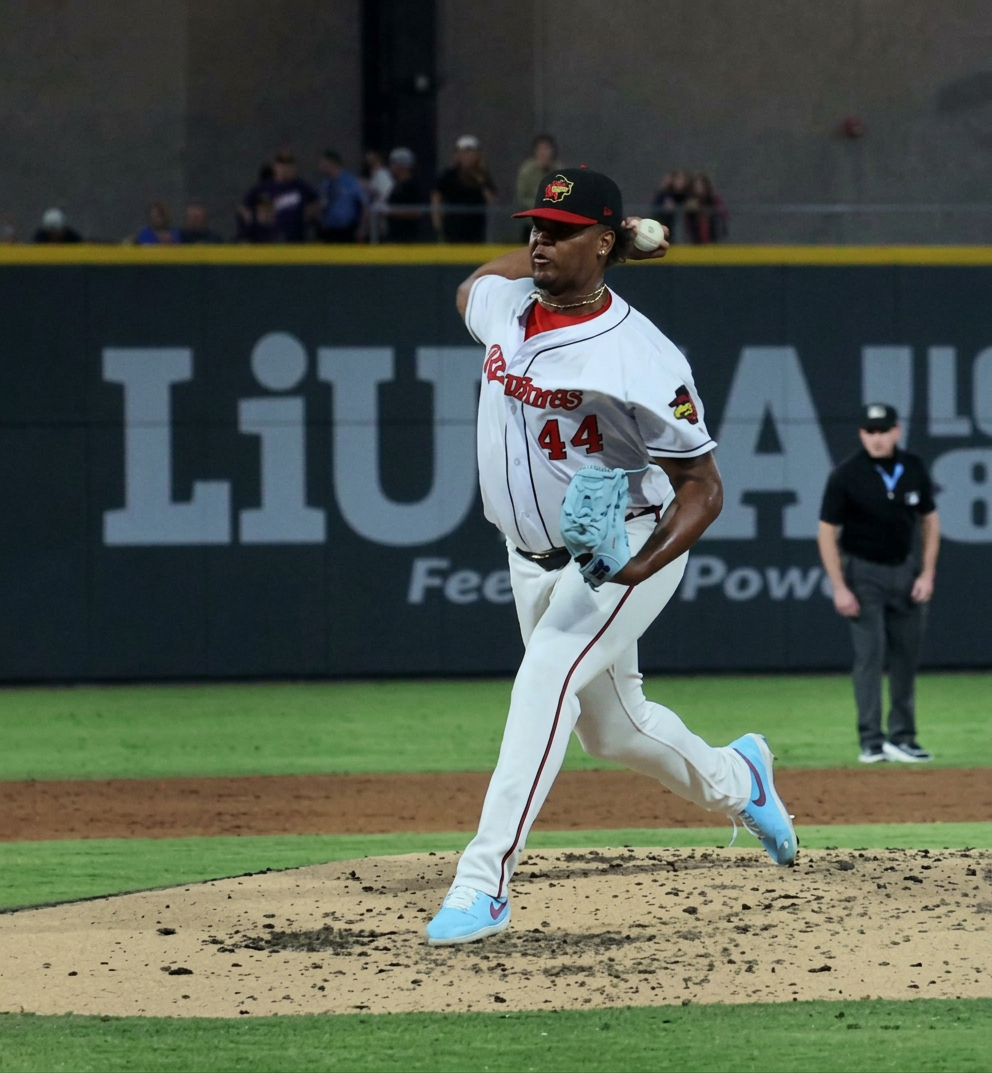
All Trey Lipscomb did at Triple-A Rochester this season was hit .287 with 32 home runs and 94 RBI and an .861 OPS. He led the International League in hits, RBI, extra-base hits and total bases, he was named an International League All-Star at utility, and he won the Red Wings’ team MVP award. He was the first Red Wing with 30 or more home runs and 30 or more doubles in a season since Steve Bilko in 1949.
He has already been on the 40-man once, was outrighted off it, and was not added back in September. My call is that the Nationals will protect him this time, and they should. Production like that, from a player who can move around the infield and has 64 games of major league experience, is exactly what Rule 5 teams look for. Leave him exposed and somebody takes him.
The rest of the debate
Maxwell Romero Jr. bashed his way to Triple-A this year, starting at catcher over bigger names to get there. The Nationals carry only three catchers on the 40-man roster, and catching depth is the classic Rule 5 profile, because every club needs it. One possibility to watch: the Nationals could protect Romero and create the room by designating Drew Millas for assignment, betting that Millas passes through waivers and stays in the organization.
Cayden Wallace hit 29 home runs across Double-A and Triple-A in a rebound year and plays all over the infield. He is the player I worry most about losing. If the roster crunch squeezes him out, he probably gets picked, and he is the kind of high baseball IQ player who ends up helping somebody.
Yeremy Cabrera, the No. 27 prospect in the system and another piece of the Gore trade, broke out of Low-A this season before cooling at High-A Wilmington. My call is that he is neither protected nor selected. He is simply too far from the majors for a club to carry all season.
Expected to be left exposed
Elijah Green and Cristhian Vaquero are two of the most hyped prospects this system has had, and both are expected to go unprotected. Green hit .214/.315/.371 at Double-A with 214 strikeouts in 426 at-bats. Vaquero, who signed for a $4.9 million bonus, repeated Low-A for a fourth straight season. Neither is close to the majors, and neither profiles as a player a club can carry on its roster all year. Also eligible and expected to be left out there: Eriq Swan, Kendeglys Virguez and Phillip Glasser.
And before you ask: Seaver King does not need to be protected until next offseason, because 2024 draftees are not eligible yet. Brady House and Yohandy Morales are already on the 40-man roster.
The decisions land Tuesday at 6 p.m. ET, and the corresponding moves might be the loudest part. Every name added means a name removed, and those removals will tell us plenty about how this front office values the bottom of its 40-man roster heading into the winter.
Who would you protect?
Photo by Marideth Sandler for Talk DC Sports












Leave a Reply