
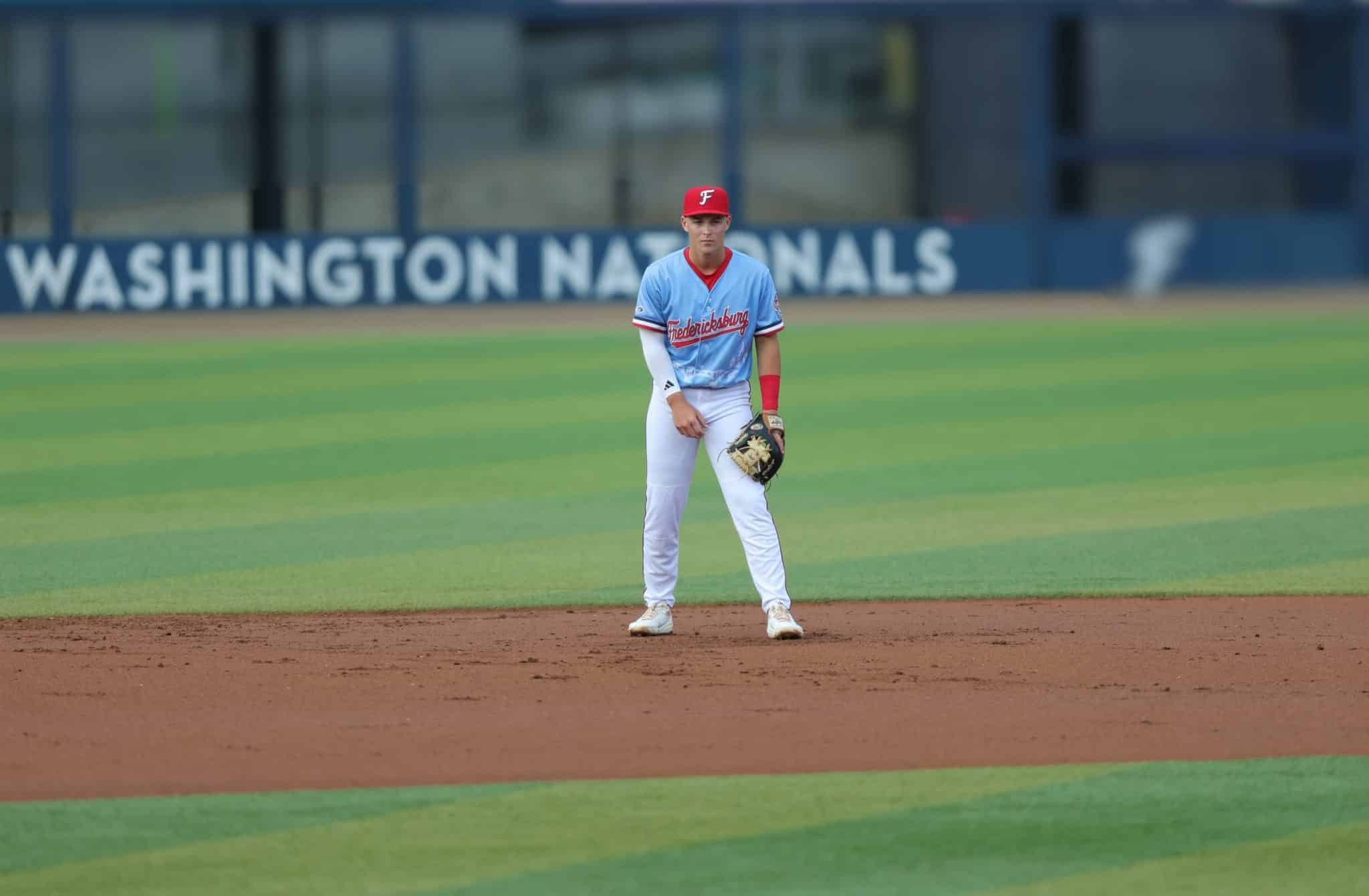

Photo by Sol Tucker for TalkNats
The top prospects list has completely upended from the beginning of the year until now. People like Brad Lord, Daylen Lile and others prove that while minor league success does not guarantee major league impact, prospect pedigree does not account for everything, either — the ability to establish a good record on the MLB roster and with good health has something to do with it.
At this point, the Washington Nationals have graduated quite a few prospects to rookie eligibility (so they aren’t listed here) and others are faltered from health issues. Still others may shine in time if we just have the patience and proper development — be it Cole Henry or Cade Cavalli or Drew Millas. Others have had their chance(s) and have not taken advantage (Andres Chaparro), and others show occasional flashes but will need to show more (Robert Hassell III and Brady House).
A word on biases: This is a list biased towards performance and upward trajectory. Age gets factored in for those who have performed at levels beyond their age/experience group. Sorry, but no one gets ranked who hasn’t even seen the field yet. Nor do rankings reflect bonuses or draft slots (why you don’t see Elijah Green and Victor Hurtado). Ranking for pitchers is tilted toward potential to make it as a starter, for position players to be a featured contributor – with Nationals or otherwise.
My Top-50 prospects:
Of note and based on the criteria aforementioned, here is my Top-50, taking all of those caveats into consideration. Who’s yours, and why?
1) Jarlin Susana – He just had surgery on his upper lattismus dorsi muscle, but he’s the easiest player to dream on in the Nationals minor leagues due to his 100+ mph heaters.
2) Eli Willits – To step in as he has as a 17 year old is enough to believe he can raise his own ceiling. He has the “it” factor.
3) Travis Sykora – Like Daylen Lile, a preternatural player who is so dedicated to refining his craft that one has to bet on him until he shows he is not the same player between the ears. He is out for next year due to his UCL surgery in August.
4) Andrew Alvarez – In the starts before his promotion, he was showing he had made significant improvements, and in the starts since, is outperforming people who were part of the team’s 2025 disappointments. There is a lot to be said about taking advantage of your chances.
5) Alex Clemmey – Showing the same ability to dominate in AA, and at only 20. He’s what they hoped he would be when they traded for him.
6) Andrew Pinckney – The power, the speed, the defense, the arm, the strikeouts, but the latter cut back in late 2025. This close to the majors, he’s forcing the issue with the Nats or the team that will try to trade for him. He suffered an injury on a defensive dive and we will see if he plays any more this season. Right now, he is not on the Arizona Fall League roster.
7) Riley Cornelio – In a results business, he delivers and adjusted to AA quickly and now hopefully, to AAA as well. One step away and really putting it all together.
8) Jake Bennett – He’s back to dominating, only now it’s AA. He’ll be close when 2026 arrives, as he builds back up. The team is sending him to the Arizona Fall League to stretch his season.
9) Marconi German – The system has not seen that kind of power/speed/plate discipline combination from a 17 year-old in my memory, even if it is DSL.
10) Yohandy “YoYo” Morales – Lots of power emerged in the recent months and clutch thump as well. At AAA, knocking on the door to get his chance.
11) Sam Petersen – One of the best measuring sticks on a fresh prospect is success at Wilmington, where Peterson took no prisoners, and even showed pop that was not so much a feature of his game in college. After an undisclosed injury, his season ended abruptly in August. The team is sending him to the Arizona Fall League to extend his season.
12) Jackson Kent – Overshadowed on the hype train by the younger and more dominant Clemmey, Kent was thrown into the Wilmington challenge in year one in the system, and showed more than enough to earn a late year promotion to AA. Consistency is the issue, not talent.
13) Caleb Lomavita – Faring well enough offensively but lacking power, he has survived Wilmington to land at the upper minors. If his defense can develop as well as his bat, he has a platform to inherit a Nationals starting job that no one has yet seized.
14) Dashyll Tejeda – There was no room for him this year at Fred’burg, but his extreme stolen base talent and overall game continued nicely in West Palm. He’ll be heard from in next year’s A ball team.
15) Nauris De La Cruz – When you are 18 and show some of the best pop on the team, and yet have a stat line that shows 30 walks to 17 strikeouts, and you aren’t dating the umpire’s daughter, you raise an eyebrow in my league.
16) Jorgelys Mota – Still only 20 and at the heart of the F’Burg batting order, the pop is starting to emerge from his big frame even as his defense still needs a lot of work.
17) Ethan Petry – The slugger the Nationals thought they’d be getting, but hasn’t yet been challenged at an age-appropriate level. Fortunately, he will be at the AFL, which means the Nats have seen enough to stay high on him.
18) Angel Feliz – Set the table at age 19 for a run at A ball next year. No easy feat for a kid going to a foreign country.
19) Liam Sullivan – Injury and timing has kept him from being adequately challenged, but since coming out of college, the big lefty has kept the walks down and the strikeouts up and is putting up big numbers again. A man on the move.
20) Pablo Aldonis – Sometimes the tincture of time heals and heals well. Aldonis delivered at every level, and next stop, AFL. Remember when Jose Ferrer came from nowhere to being on the verge? While Aldonis is his own pitcher, this has the same under-hyped international arm rising quickly once healthy.
21) Yoel Tejeda – Took a big step forward to become a bonafide starter with incredible height, then knocked down a peg at Wilmington. Still, a great first full year and lots to dream on as he keeps sponging in development.
22) Brayan Cortesia – Having succeeded at his 18 year old taste of DSL, Cortesia’s speed, bat, and plate eye served notice that nothing will be handed to Coy James or anyone else at FCL in ’26.
23) Robert Cranz – Looked like a monster closer in the making as he rose in the system, then became one of many arm casualties this year. Still, in a Koda Glover sort of way, you can’t wait for him to get back — if he can.
24) Phillip Glasser – All he does is really succeed and elevate to the next level with every challenge. Now he’s in AAA, and so soon after being a “table scraps” draft pickup. A smart player, and just as Alex Call became important with the tools he had, so can Glasser.
25) Christian Franklin – His impressive peripheral numbers translated into an uptick at the top of the Rochester lineup after the Soroka trade. He’s got a crowded field ahead of him and no tool that would carry him beyond the people in front of him, but as he keeps improving, he’s close enough to break through.
26) Tyler Stuart – Yes, he’s part of the MASH unit, but one cannot so quickly forget how he tore through AA in 2024 and has the measurables and moxie to be in the conversation – if he heals. The closer they are to DC, the more possible the payoff.
27) Luke Dickerson – Bonuses and hype do not equate to actual results, especially when a wrist injury interferes. He’s still new to the game and hitting the ball hard, but he’s got a ways to go to justify the exuberant bonus thrown at him.
28) Sir Jamison Jones – A legit catcher with power and plate selectivity at age 19? That will play. A real presence at an organizational position of need.
29) Cayden Wallace – The late season run made him a little relevant again, especially since he looked good some months ago in a few spring training trials.
30) Ronny Cruz – The almost forgotten headliner of the Soroka deal, he had a respectable pro start to validate others’ interest in him and the tools he is growing into.
31) Cristhian Vaquero – Forgettable but not forgotten, especially after his bat began to ignite and extra base power finally arrived at age 21. He plays a great outfield and has the arm and speed. A trip to forbidding Wilmington will tell us whether there is a future.
32) Sean Paul Linan – The apparent headliner in the Call trade, he fell off the radar darn fast. That he is appearing on the AFL roster speaks to the notion that the Nats took him behind a curtain to prepare for a fall rollout. Either he is the version of prospect that the Dodgers love for their good insight, or the version of prospect that the Dodgers turned into a chronically disabled casualty.
33) Seaver King – A forgettable year even though he made it out of Wilmington without too much delay – but then, players drafted far below him have churned through A+ as well. King has suffered from not demonstrating anything one can look forward to. But at only 22, there is still time for him to take the upward path to refine and shine.
34) Sauryn Lao – As PJ Poulin has shown (as did Kyle Finnegan), the right time is dictated where there is opportunity. None in Seattle, but the Nats are another story.
35) Jake Eder – May be washed up, but he was more than a velo prospect and the pitch movement is still there. Buy low and nurture along. The Nats have had some success with others and Eder will get his look in the upper minors.
36) Browm Martinez – At 17, he already showed great plate discipline in a pro game. At 18, he added pop and even better speed. The Yankees have a good eye for Latin American talent and his video game numbers are worth watching to see how they develop stateside.
37) Marquis Grissom Jr. – He was so promising in his steady rise as a late inning prospect, even in moments in AAA, and then life (injury) happened. Now on the DL, we don’t know the diagnosis or prognosis, but as a pitcher who relies heavily on change of speed, hopefully his rehab will not eat into that calling card.
38) Davian Garcia – A successful debut in A, but ran into reality at A+. Still had enough flashes to his year that he gives reason to look forward to 2026.
39) Nick Schnell – His late summer heater is behind him, and Schnell regressed some then has shown spurts. But he has shown he can make his strikeout tally manageable. If he stays in the organization after 2025, he’ll be important depth and an injury away from having the opportunity to surprise. Some become Clint Robinson, others become Joey Meneses, others become Alex Call, others become Blake Rutherford, other Derek Hill – he’s actually still playing.
40) Daison Acosta – He struggled at AAA the first time around, but really turned it around at AA and forced another look. Given the improbable course of relief pitchers in the Nats organization, if he has matured into a realistic option, he’ll have a path. Always remember, nobody predicted Konnor Pilkington would be a more successful relief option than Brzykcy. So there’s that.
41) Jose Feliz – He kept his success going stateside, though he is not now a particularly hard thrower. But the control is there, and he’s only 20.
42) R.J. Sales – OK, he was a 10th round pick in the draft and wasn’t dominant. But at age 21, he’s started well in A ball and kept things going despite the hiccup of a trade from the Tigers (which cannot be said about Randall, the apparent headliner).
43) Thomas Schultz – He’s shown steady climb and strikeout stuff, and now he’s going to get more looks in the AFL. With Rochester in sight, he’s a name we’ll see more of, just as he was one of those featured in spring minor league callups.
44) Sam Brown – One can’t overlook how he produced in Harrisburg after the trade with the Angels. Was it real? He’s early enough in his career to keep an open mind.
45) Juan Reyes – The best pitching numbers of the bunch at the DSL, and a lefty, too. That’s all that’s known, and perhaps all one needs to know.
46) Eriq Swan – A second year starter with big size, strikeout stuff and the need to curb his walks. I’ll wait until he produces before moving him up on this list – which is why Josh Randall wasn’t ranked here, but with his next 2026 stop potentially being AA, he can be one of the next group of starters that every year seems to leap forward into our consciousness.
47) Branden Boissiere – He stayed alive through a Wilmington sojourn because of his defense and refusing to quit. But at 1B, you have to do more. Here we are in 25, and Boissiere has added pop and hitting. He is in the land of “show me,” and he’ll need to do that in 2026 to be thought of as more than a one year wonder.
48) Zach Brzykcy – He may never see DC again, or we may just be witnessing the comeback pains of a pitcher who lost time for surgery. Arms with his kind of velo and successes in the minors will get a long look to see whether that potential can re-emerge in the next generation of his career, or whether he will be one of those arm casualties that never made it back.
49) Erik Tolman – A late bloomer lefty rebuilding his value after injury, he fared well until he met the challenges of AA. Still, he has shown success as a multi-inning reliever, and I can see him making a leap forward next year one more year removed from surgery.
50) Michael Cuevas – One of those failed starters who rebuilt value when switched to the bullpen, Cuevas is on the DL now but flashed at AA in high leverage situations. The Nationals have several pitchers at the upper minors who are going through arm surgery recovery. Most seem to fade away just as their star is rising. Hopefully Cuevas will be one that gets back to AAA and picks up where he left off.
Leave a Reply